

Why organizations should not rush towards AI
The innovative potential of AI is immense, but the sector is still navigating an unstable phase. These recommendations will help organizations to start leveraging AI right now.

The nuances that separate ‘innovation’ from mere ‘improvement’ are not always obvious. However, in a fast-paced business environment subject to constant technological developments, confusing the two can mean the difference between leading new markets or being left behind. "Innovation is about trying to conquer new positions, while improvement is a competitive obligation," summarizes Xavier Ferràs, Associate Dean of the Executive MBA at Esade.
AI is an innovation with enormous potential that has sparked anxiety among organizations fearing they may fall behind. But Ferràs recommends a cautious implementation. During the Innovation Roundtable hosted by Esade on 17 and 18 September, Ferràs presented his recent strategic innovation model and the lessons it offers for the current hype surrounding AI. His recommendation is not to rush into the opportunities opened by this technology. Instead, now is the time to understand its maturation period and prepare for an orderly deployment.
A framework for understanding innovation
The traditional innovation model revolves around the so-called ‘red’ and ‘blue’ oceans. The red ocean is a market saturated with competitors offering highly similar products. There are hardly any entry barriers, and price-cutting is the main approach to gain market share. This is a low-risk, but also low-return area. "The challenge here is to apply continuous improvement until reaching the frontier of perfection," Ferràs explains.
In the blue ocean, risk is high but the rewards are much greater. In these markets, the emphasis shifts from prices to the value provided. Instead of seeking to advance in already established sectors, blue innovation ‘creates’ new markets that scale rapidly, generating huge barriers to entry due to knowledge monopolies held by those who succeed in this space.
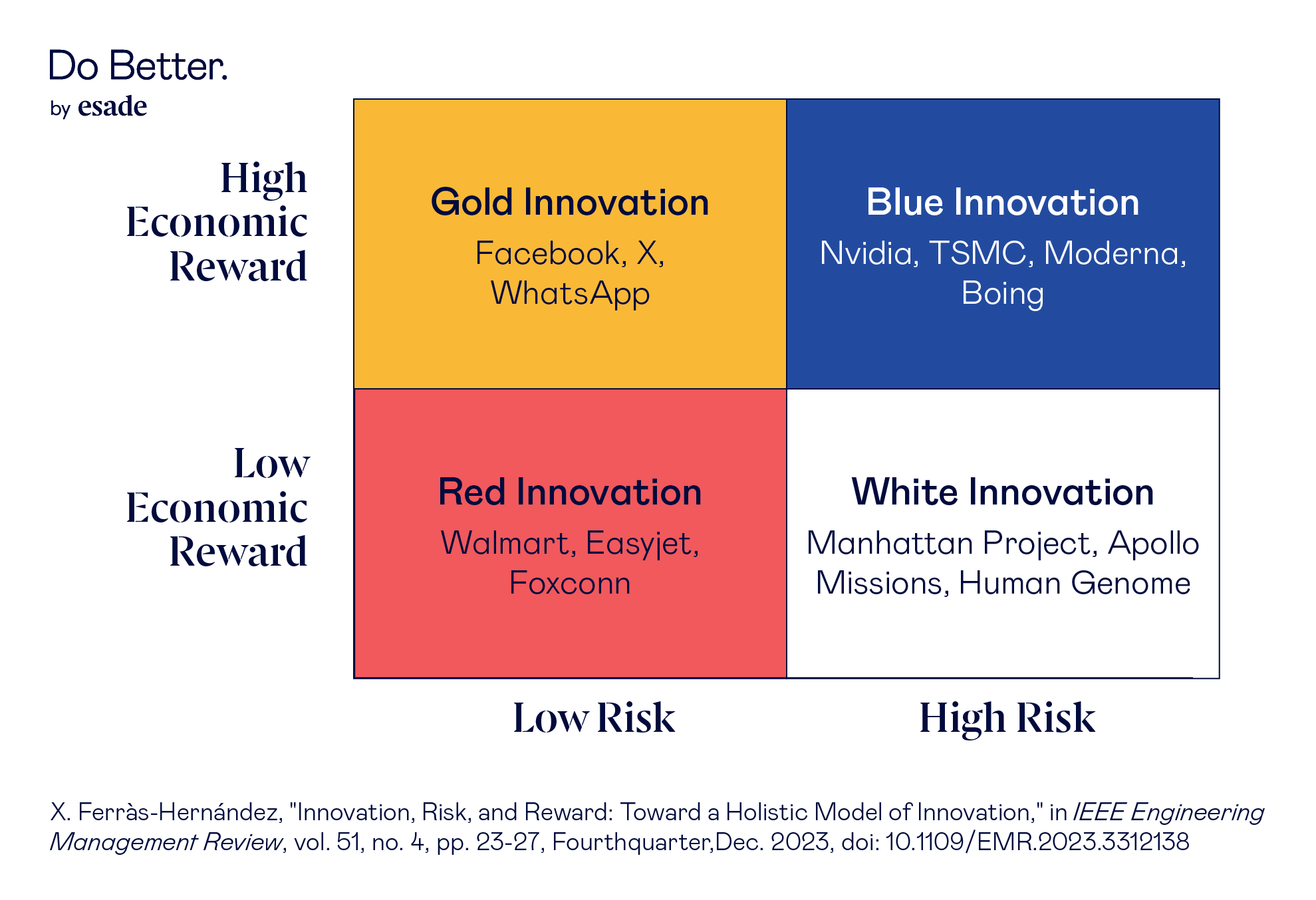
To these two classic oceans, the proposal presented by Ferràs —explained in detail in Do Better—adds two other areas. One is golden innovation, where simple and low-risk ideas with a highly disruptive component can scale quickly and generate a great competitive advantage for the first to arrive.
At the other end is white innovation. At first glance, it may seem counterintuitive to invest in a high-risk and low-return area, but it is a key space. Traditionally, this is not a space funded by the market but by taxpayers: it is the world of science, historically driven by states. "It is the type of innovation that pushes the boundaries of human knowledge," Ferràs notes. Moreover, in the long term, these innovations enable the creation of high-value products.
Selecting the right talent to drive innovation is more critical than the quantity of resources allocated
According to Ferràs, organizations committed to innovation must explore and develop each of these spaces. "It's not about allocating more resources, but about choosing the right talent," he warns. "It's about building teams who understand the opportunities presented to them and identify the advantages within their reach."
The history of Apple offers a splendid example of this multi-focal perspective. Apple was a pioneer in the field of personal computers, but with the entry of IBM and other competitors, the sector became a red ocean. Apple maintained its position through continuous improvement, but also ventured into a blue ocean with the launch of iPods and iPhones. Meanwhile, with iTunes and the Apple Store, it paved a way in the profitable field of golden innovation. At the same time, it continues focusing on white innovation, seeking to lay the foundations for the future technological ecosystem.
What makes AI special?
In the mid-1960s, Hungarian philosopher Michael Polanyi coined the phrase: "We know more than we can tell." For a long time, this apparent paradox about cognitive limits has restricted our ability to develop ‘intelligent’ machines. We have been able to program machines by encoding our rational knowledge, but how do we endow them with that ‘tacit’ or ‘experiential knowledge’ that we cannot express with words or mathematical formulas? How do we explain to a machine what is a chair or the color blue, for example?
With today's AI models, we have managed to overcome this cognitive limitation identified by Polanyi. We no longer just program machines with our rational knowledge; we train them to learn from our experiential knowledge. We can do this because we have more data than ever, as well as supercomputers and access to cloud information from anywhere in the world. The result has been the emergence of a technology with recognition and prediction capabilities that far exceed human limits.
The innovative potential of AI also stems from its capacity for creativity
Another particularity of AI is that it is the result of innovation — but also has the potential to continue driving innovation. According to Ferràs, this potential not only stems from its utility for analytical tasks but also from its capacity for more creative endeavors. An anecdote involving Lee Sedol (the unbeatable world champion of Go, a much more complex board game than chess that is popular in Asia) and the AlphaGo program is a good example. In one of the 14 out of 15 games that AI won, it made such an unusual and unexpected move that all the humans in the room interpreted it as a mistake. Only after the game ended did they realize that this spontaneous display of creativity decided the outcome in favor of the machine.
Patience and planning
It is no surprise that recent innovations in AI — which have opened an entire blue ocean for its developers — are attracting a wide variety of organizations that do not want to miss the boat. However, Ferràs warns that "it is still not a stable market; we are in a fluid phase, and we don't know when it will end." The recent turbulence in the sector, with Nvidia suffering stock market losses of up to 30% in one month, is a clear example. According to Ferràs, balance will begin to emerge when a dominant design settles in the sector.
For now, the model seems to be that of large corporations exploring AI opportunities through digital providers. "Companies have a lot of data, and these providers can help them process and use it optimally," Ferràs notes. "We will see corporations using external intelligence to process internal information."
Ferràs offers a series of recommendations for organizations that want to immediately start leveraging the transformative potential of AI:
- Start slowly. Rather than getting caught up in the current hype and attempting a rushed implementation, it is better to begin with external sources, explore the existing ecosystem, and designate internal teams for initial forays.
- Explore all strategic areas. Pay attention to the core business without neglecting other scalable opportunities, potential partnerships, and strategic projects.
- Select the right teams. It is not about deploying a large number of resources but about identifying and choosing the right talent. Choose agile teams with the necessary knowledge and give them time to explore.
- Ensure good AI providers. Begin establishing long-term strategic partnerships.
- The real competitive advantage lies in your data. AI is a useful tool, but an excellent internal data strategy will make the difference.
- Don't rush. Resist the hype and avoid attempting a hurried implementation. According to Ferràs, we will remain in a highly unstable phase for a while. Much is still to unfold in the AI sector.