
Choosing vices vs. virtues on the store shelf
Exploring the underlying motivations for how consumers respond to retail product displays
This interview is based on research by Ana Valenzuela
A growing body of research has examined how different shelving-related cues – such as the position or arrangement of products on a shelf – influence consumers' attention, inferences, and even brand choice.
However, research by Esade visiting professor Ana Valenzuela in the Journal of Retailing has found that the relationship between consumer responses and retail product displays is more complex. It depends not only on cognitive aspects but also on consumers' motivational states.
In the research paper The cake looks yummy on the shelf up there: The interactive effect of retail shelf position and consumers' personal sense of power on indulgent choice, Valenzuela and her colleagues further explore how shelf displays affect consumer behaviour.
Through a series of experiments, they demonstrate that consumers' up and down head movements to locate a product on the shelf interact with their innate personal sense of power and influence their likelihood of making an indulgent choice.
Do Better: What is a consumer's sense of power?
Ana Valenzuela: Power can be defined as asymmetric control over valued resources in social relations. It stems from both individual dispositions – personality, physical and physiological characteristics – and context, such as status and social interactions. Power can be activated cognitively, structurally through role-playing and physically through our posture.
There is some evidence of the relationship between directed physical movements and individuals' experience of power and self-esteem. For instance, open expansive postures give rise to a higher sense of power, while closed contractive ones give rise to a lower one.
Open expansive postures give rise to a higher sense of power
Upward vs. downward head movements can also contribute to the experience of power. Studies have shown that upward head turns are related to greater dominance and positive emotions, such as joy and pride. Downward head movements, however, are related to feelings of shame, embarrassment, humiliation and sadness.
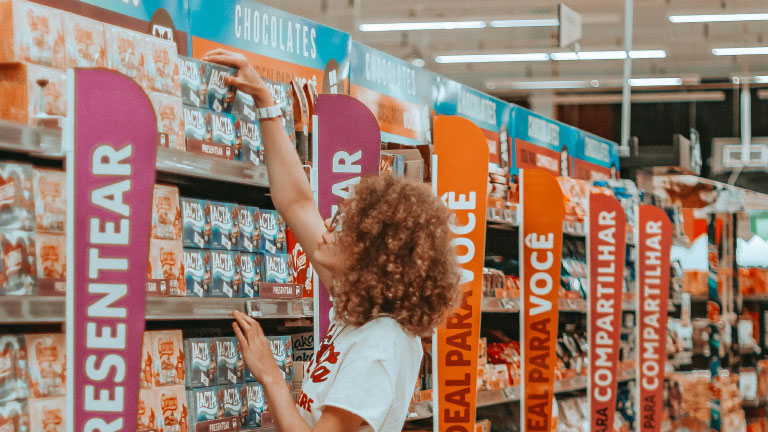
In the context of the retail experience, when products are positioned higher up on shelves, consumers need to raise their heads. That movement can interact with their personal power-related disposition and, thus, affect their choices.
Upward head turns are related to greater dominance and positive emotions, such as joy and pride
How does a consumer's sense of power interact with the many other factors involved in the retail experience?
Such phenomena are defined as person-environment interactions. While environmental cues, such as shelf position, may influence consumers' sense of power, consumers also bring their own personal-power-related characteristics and dispositions to retail environments.
People react differently to power postures depending on the context and personal traits, which have been shown to vary by gender, body size and shape, testosterone levels and innate sense of power or dominance level, among other things.
In other words...
In person-environment interactions, we may find a match (or mismatch) between the person's own sense of power and the sense of power induced by the environment – for instance, a vertical head movement when trying to locate a product on a store shelf.
Mismatches between a consumer's personal sense of power and the environmentally-induced sense of power can result in an uncomfortable experience. For example, in the store, an upward or downward head movement to locate a product high or low on a shelf can induce feelings of power or a lack thereof, which can lead to a mismatch with the individual's power disposition. This results in a state of affective discomfort.
What are the implications?
We hypothesise that affective discomfort generated in this mismatch between the induced vs. the personal sense of power will redirect consumers' preferences toward more indulgent products when they are choosing between a vice, such as a piece of chocolate cake, or a virtue, such as a healthier choice like fruit.
Negative moods reduce self-control
We base our hypothesis on evidence linking affect and self-control, where negative moods – such as the discomfort generated by the power mismatch – reduce self-control, making it more difficult for consumers experiencing a power mismatch to resist the indulgent options.
How did you test this idea?
We conducted a series of experiments in student populations from South East Asia, the US and Spain. The basic procedure was similar in all the studies: we invited participants to enter a mock store, where they were instructed to imagine that they were standing in front of a supermarket shelf.
The difference between the experiments lay in the task to be completed: product evaluation, choice-making between healthy vs. indulgent snacks and similar choice-making but with a previous inducement of either high or low power.
In addition to these tasks, we evaluated the participants' activation of power through their head movements, both implicitly, through a word completion task, and explicitly, using the personal sense of power scale.
Participants who had to look up to evaluate the snacks chose the indulgent option more often when their sense of power was low
What were the results?
As expected, shelf position had a significant impact on respondents' choices. We found that participants who had to look up to evaluate the snacks chose the indulgent option significantly more often when their personal sense of power was low.
However, when we primed participants with a high sense of power before they completed the snack-choice task, those choosing from the higher shelf position were less likely to choose the indulgent option (cake) vs. the healthy one (fruit).
We tested the power mismatch by priming participants with a high personal sense of power before randomly assigning them to a shelf position – high for a power match, low for a power mismatch, or eye level as a baseline.
Participants in the power-mismatch group were more likely to choose the indulgent option than those in the power-match group. Participants in the power-mismatch group also reported more discomfort-related feelings compared to the other group.
What are the implications of these results?
Consumer responses to retail product displays are not as simple as we previously thought. Consumers' retail experiences are based on a complex configuration of motivational states. We helped elucidate the role of these motivations in determining in-store product choice.
Some of these data came from the Esade Decision Lab, right?
Yes! I conducted part of one of the studies here, so this is the first time that data generated at the Decision Lab have been published!