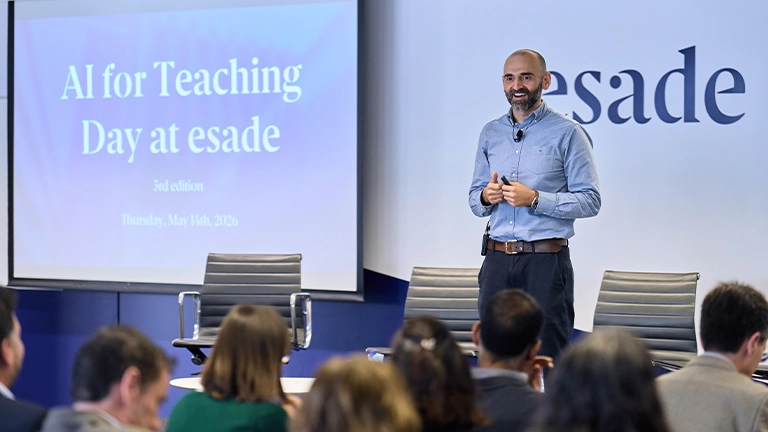
AI is already in the classroom. Now what?
The third edition of AI for Teaching Day made one thing clear: the debate is no longer whether artificial intelligence will change education. It’s who leads that change, and how fast.
Imagine a student who stops raising their hand in class — not because they’re shy, but because they already know the answer is just a prompt away. This is no longer a hypothesis. It’s something Esade’s faculty is managing right now, and one of the reasons the school brought together professors, deans, and administrators at its Sant Cugat campus for its annual AI for Teaching Day.
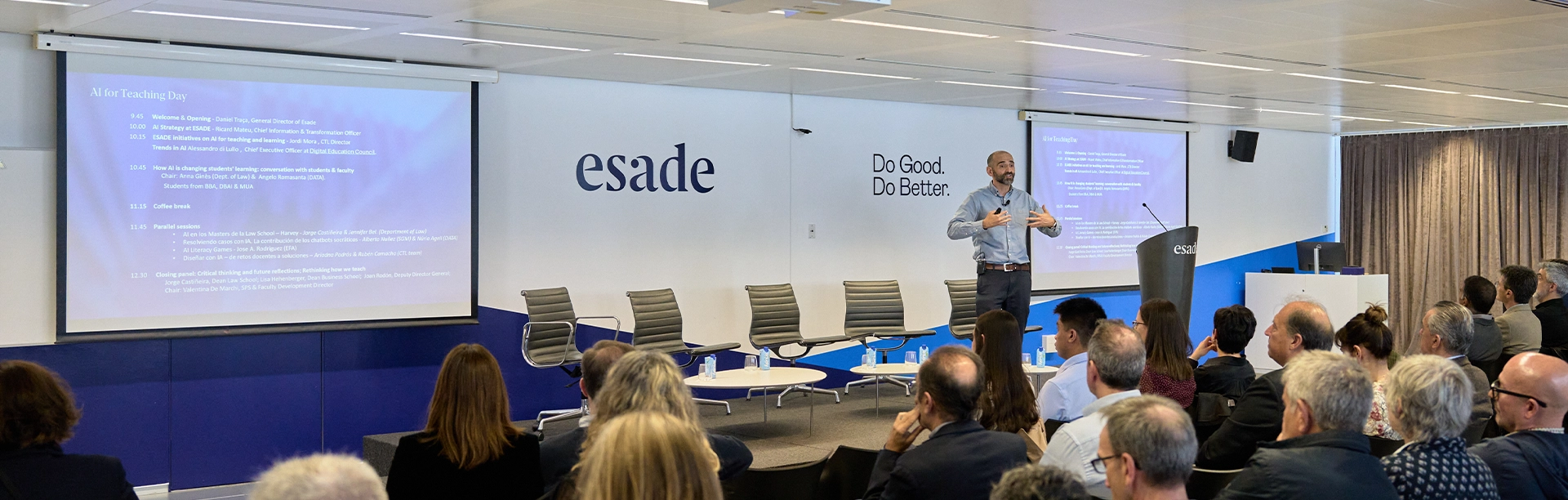
The event, organised by the Centre for Excellence in Teaching and Learning (CTL), combined strategic presentations with parallel sessions where faculty shared pilot projects, results, and open questions. This was the third edition. The first focused on understanding what was happening with AI. The second, on experimenting. This one arrived with a different weight: Esade came with a plan.
“Our system’s credibility is at stake”
Daniel Trаça, Esade’s Director General, opened the event by sharing what his own students had told him over lunch. Some use AI, others don’t, and those who do get better grades. “The system is no longer credible,” he said. “That’s why we have to move — and move very fast.”
Traça announced that the school is working on a new institutional policy on AI and assessment, to be implemented before the end of the academic year. His message left little room for ambiguity: better to move fast and make some mistakes than to move slowly and fall behind.
The risk isn’t using AI. The risk is losing direction.
That line came from Ricard Mateu, Chief Information & Transformation Officer. His first point was the most direct: Esade has deliberately avoided having a separate AI strategy. The goal is to integrate AI into the existing strategic plan — not to bolt something on the side and call it transformation.
A four-quadrant model — and an honest diagnosis
The framework Mateu presented maps AI’s impact across four areas: the student experience inside the classroom, outside it, the faculty experience, and operational excellence. Within each, three levels of depth: productivity, process redesign, and genuine competitive differentiation.
The honest part came when he showed where Esade actually stands. Most of what the school has done so far sits at the productivity layer, with some process work in learning and operations. The transformational quadrant — the one that truly changes what and how the school teaches — is still, largely, ahead.
“If we want to push toward the transformational level,” said Mateu, “we need to make decisions. Not just run initiatives.”
What is already underway
Some of those decisions have already been made. At the Law School, Harvey — a platform designed specifically for the legal field — is now available to all faculty and master’s and postgraduate students. The project forces a harder question than “how do we use this tool”: what does legal education mean when AI can already do much of what junior lawyers are trained for.
In September, the school plans to launch a pilot student portal with AI capabilities, designed to simplify how students interact with the institution. Anyone who has had to navigate the administrative systems of a large university will understand why this matters.
The CTL has been driving faculty training, publishing responsible-use guides, and pushing through academic governance a set of student regulations. There is now an AI Office with a dedicated director, José Torre. Governance structures — boards by quadrant — are in place and operational.
The school also runs a small-grants programme for faculty who want to experiment with AI in their classes. Simulations, avatars, GPT-based materials: a dozen funded projects across two rounds. The explicit goal is to turn individual experimentation into collective practice.
The uncomfortable data coming from outside
Alessandro Di Lullo, CEO of the Digital Education Council — a global network of more than 180 higher education institutions of which Esade is a founding member — joined by video from a leadership summit in Paris.
His research paints a picture that is hard to ignore. 72% of employers believe AI will lead to fewer jobs. The most affected sectors: marketing and communications, data analysis, finance. Three areas that have historically driven the career paths of business school graduates.
Only 3% of employers believe universities are adequately preparing their students for what is coming. That number is either a reproach or an opportunity, depending on who is listening.
Di Iullo also pointed to something subtler happening inside classrooms. AI is becoming an intermediary layer between students and the outside world — even between students and their professors. Shyer students no longer need to ask questions in class; they ask their AI instead. The risk of isolation is real, and it doesn’t announce itself when it arrives.
The question nobody has fully answered
Esade has a governance structure, an AI Office, pilot projects with names and people behind them, and a Director General willing to say out loud what many are thinking. That is more than most institutions have.
But the closing panel — with deans Lisa Hehenberger and Jorge Castiñeira, and Deputy Director General Joan Rodón — was called Stop, Reflect, Share for a reason. The school knows it has built a foundation. What it has not yet resolved is the hardest problem: how to move from dozens of individual faculty experiments to something that genuinely changes the fabric of its programmes.
That work is still ahead. Mateu was clear that the leap from personal productivity to collective institutional capability is where the real bet is placed — and where most transformation processes quietly stall.
The third edition of AI for Teaching Day sounded less like a celebration and more like a public commitment: to a change that has only just begun.