
The battle for our attention and the risk of the ‘filter bubble’
Generative AI has captured the spotlight, but recommendation systems remain the invisible infrastructure that “organizes” the internet. What happens when that logic becomes not only algorithmic, but conversational?

Generative artificial intelligence now dominates headlines, attracts major investment and shapes strategic conversations at the highest political levels. In a very short time, tools capable of answering questions, writing text or generating images have moved from the lab into everyday life. We are, therefore, entering a new phase of the digital revolution.
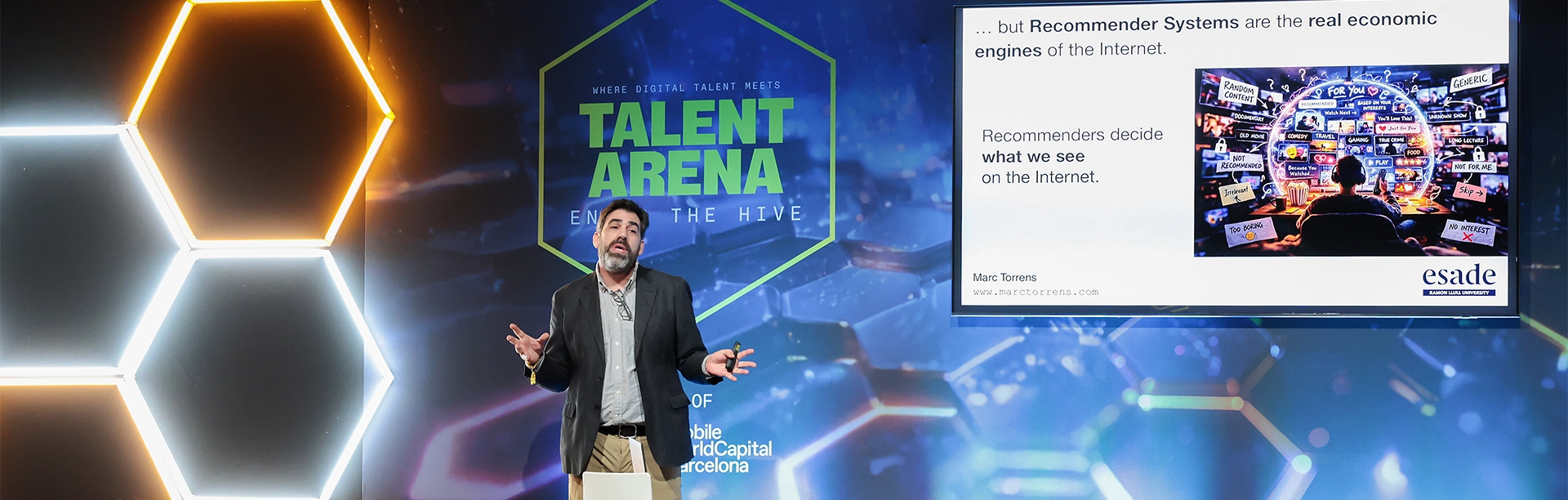
Yet while public debate focuses on AI that speaks, writes or summarizes, another far less visible technology continues to shape much of our online experience: recommendation systems. This was one of the key ideas highlighted by Marc Torrens, Associate Professor in the Department of Operations, Innovation, and Data Science at Esade, during a session at the Talent Arena held as part of 4YFN. His focus was on how generative AI may transform — or intensify — the logic through which the internet is filtered and “organized.”
Algorithms decide which songs we listen to, which series appear first on our screens, which products we see when entering a platform and which news reaches our feeds. As Torrens emphasized, they remain the true economic engines of the internet.
The question, then, is no longer just what generative AI can do. It is also what changes when it overlays the systems that have long filtered, ranked and prioritized what we see.
From abundance to saturation
The internet fundamentally transformed the logic of mass markets. For much of the 20th century, supply was limited, and most consumers operated within a relatively small catalogue of products and content. Digitalization broke that constraint, opening the door to an almost infinite supply.
Music was one of the first domains where this became evident. Today, through streaming platforms, anyone can access almost the entire global music catalogue. But the same pattern applies to films, news, online courses, consumer products, digital knowledge and even personal relationships.
The so-called “long tail” — a business and SEO strategy focused on offering a wide variety of niche products rather than a few mass-market hits — transformed scarcity into overabundance.
For a long time, this expansion was interpreted as a promise of freedom. More options meant greater choice and, in theory, a more personalized experience. But that equation does not always hold.
The Internet’s invisible infrastructure
In this context, recommendation systems become essential. They are not a peripheral feature of the digital environment, but the infrastructure that allows us to navigate a saturated ecosystem of alternatives. Their role is to filter complexity and suggest possible pathways within a volume of information that would otherwise be unmanageable.
Their evolution has been rapid. Early systems relied on collaborative filtering, comparing users with similar profiles. This was followed by techniques such as matrix factorization, capable of representing users and products in shared latent spaces. More recently, advances in deep learning have enabled the integration of more complex signals and the optimization of interaction patterns with unprecedented precision.
The result is a highly effective technology for organizing abundance and directing attention.
But that efficiency comes at a cost. The more precise recommendation systems become, the more they tend to show content aligned with our existing preferences. What we gain in convenience and personalization, we may lose in diversity. We end up accessing only a small portion of what is available — filtered according to the likelihood that we will engage with it.
The risk of the ‘filter bubble’
This is where the concept of the “filter bubble” comes into play. Popularized by Eli Pariser, Torrens uses it to describe a highly personalized information environment in which users are mainly exposed to content that reinforces their habits, interests or beliefs.
The problem is not only that we see fewer different things. It is that we stop encountering the unexpected — or perspectives that challenge our own.
The paradox is clear. The internet promised unprecedented access to diversity. But when that diversity is mediated by systems designed to maximize affinity and engagement, the experience can become narrower. In some cases, this dynamic leads to echo chambers, where certain ideas are reinforced through repetition while others fade from view.
What changes with generative AI
The emergence of large language models (LLMs) has reshaped the technological debate, but it does not automatically replace recommendation systems.
A generative model can interpret instructions, produce natural language and maintain fluid conversations. However, it is not designed on its own to rank large catalogues or manage the balance between exploring new options and exploiting known preferences.
As Torrens puts it, an LLM suggests, while a recommendation system optimizes rankings for users.
This is why one of the most plausible scenarios is that generative AI becomes a conversational layer on top of existing recommender systems. Interaction with users will become more natural — and likely more persuasive — but the underlying engine will remain the algorithm that orders results and personalizes the experience.
When the ‘filter bubble’ starts talking
This shift matters because it changes how influence operates.
Until now, personalization has appeared mainly through lists and rankings. A conversational layer can transform that filter into a more fluid, immersive experience.
This opens up two possible scenarios.
The first is that the problem intensifies. Generative models adapt to the user’s tone and respond convincingly. If this capability is combined with systems optimized to reinforce preferences, recommendations may evolve into more subtle forms of persuasion. The bubble no longer just organizes the experience — it begins to speak. Torrens warns that this layer could deepen the phenomenon through personalized narratives and persuasive framing.
The second scenario is more promising. That same conversational layer could be used to introduce context and expose users to less predictable perspectives. Generative AI could also help mitigate the filter bubble — if it is designed to broaden the user’s horizon.
A question of design — and power
Technology alone does not resolve the dilemma. Everything depends on which objectives are prioritized and how this mediation is designed.
For years, the success of recommendation systems has been measured primarily in terms of performance: more clicks, longer engagement and higher conversion. But when these systems play such a central role in shaping our relationship with information, those metrics are no longer enough.
The deeper question is what kind of digital ecosystem we want to build. One that simply reinforces preferences and maximizes convenience? Or one that, while remaining useful, preserves space for discovery and critical thinking?
In the age of generative AI, the battle for our attention will not be fought only through chatbots. It will also be decided in the invisible architecture that organizes what appears before us — and in how that architecture becomes conversational.
The most influential AI may not be the one that speaks the most, but the one that selects and prioritizes what we pay attention to.
For that reason, the future of recommendation is no longer just a technical issue. It is increasingly an ethical one.