
What AI agents mean for business
Generative AI is rewriting the rules of technology adoption. But the real shift is coming: autonomous AI agents that act, decide, and reshape how companies operate.

Generative AI is the fastest-growing consumer technology in history, according to estimates by UBS, with ChatGPT reaching 100 million users within two months of its launch. Companies have been quick to adopt this new technology but the next stage in its development—personalized AI agents capable of acting autonomously and executing tasks —might fundamentally change the way they operate.
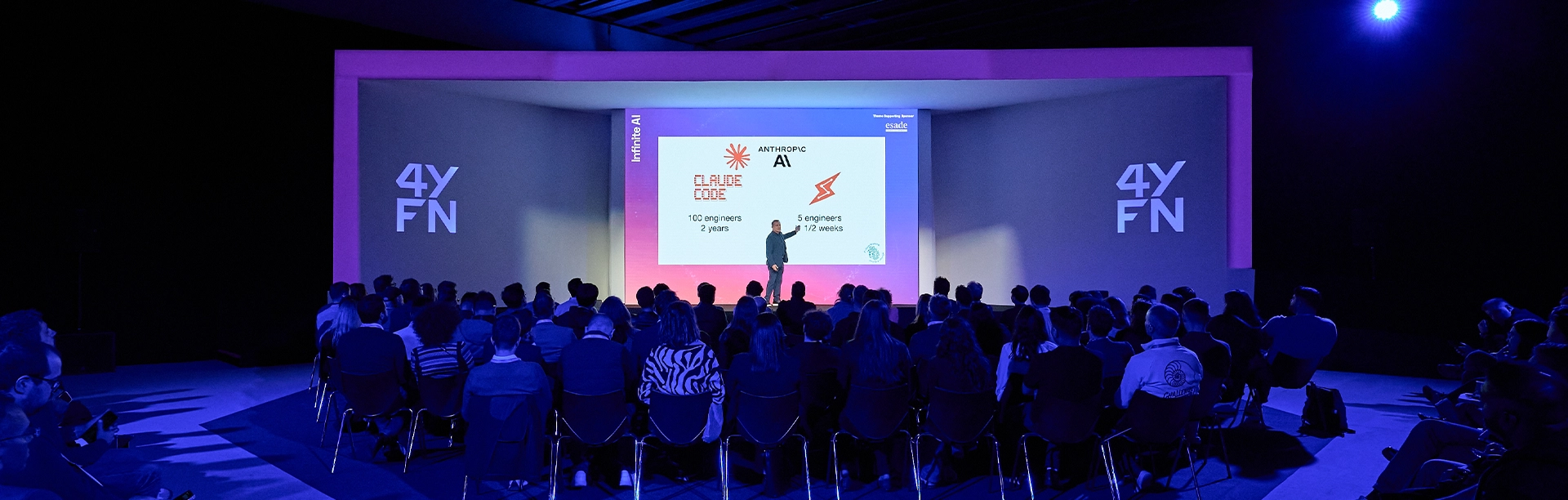
At the 4YFN event, during Mobile World Congress Barcelona, Esteve Almirall, Professor of Innovation, Operations and Data Science at Esade, explored this coming transformation. The chatbots currently used by many businesses can assist users by generating text or answering questions but agents can go further, taking action, coordinating processes, and carrying out complex workflows.
Mere access to AI tools will not automatically lead to a competitive advantage, cautions Almirall. Companies that move beyond simple usage and integrate AI into their operating models are the ones that will gain a competitive advantage.
How companies can get the most out of AI
AI is now commonly used throughout business—employees are more effective when AI helps draft reports, summarize documents, or analyze data. AI also supports customer service. Productivity and work quality are undoubtedly enhanced. Researchers at MIT, for example, found that generative AI can increase productivity in certain knowledge-based tasks by as much as 40%.
That’s all well and good, but, if every business is leveraging the same tools, then the benefits are similar across companies, and no single organization gains a real, distinguishable advantage. As Almirall says, it produces “competitive parity.”
The most powerful way for companies to reap the benefits of AI is to move beyond simply allowing employees to use general AI tools and to integrate AI into their core, making it a structural component of the organization. This means redesigning workflows, processes and operating models.
AI agents inside organizations
Cue AI agents. These ‘agents’ are a step up from chatbots because they function autonomously. They can perform tasks that previously only humans could do, such as analyze information, make decisions, and operate across multiple systems simultaneously.
AI agents are already in use. The Swedish fintech company Klarna is using them as customer service agents to manage large volumes of inquiries. And Klarna says, the AI agents are doing the work of hundreds of human customer service agents while maintaining high levels of customer satisfaction. Customer support platform Intercom is also leading the way with AI agents capable of handling routine queries, qualifying leads, and directing customers to useful resources.
“We are going to have not only humans, but also agents in our teams,” says Almirall. The development of AI agents means that AI in the workplace will no longer consist of only human workers using software tools. And because AI agents can communicate with systems and rapidly analyze vast quantities of data, they reduce the need for traditional hierarchical management to ensure that tasks are completed efficiently. Organizations will need to change how they coordinate work.
Redesigning business models for an AI future
The impact of AI agents extends beyond operational efficiency. In many cases, they are also transforming the underlying economics of businesses. When productivity increases dramatically, traditional business models based on labor-intensive work begin to change.
Take business models based on labor-intensive work, such as consulting: they usually bill by the hour, but with AI taking over the workload, the number of hours to complete a task will be greatly reduced. Some firms are now looking to introduce results-based billing instead of hourly.
Internal processes that previously required large human teams can now also be completed quickly by AI agents. Mundane tasks such as compliance monitoring, contract analysis, and financial auditing often involve reviewing thousands of documents and identifying anomalies. With AI, this can be completed round-the-clock and at scale.
One example discussed by Almirall involves revenue management tasks in which AI systems automatically analyze contracts to detect unusual clauses or nonstandard terms. Instead of employees manually reading each contract, the system reviews documents overnight, highlights potential issues, and suggests appropriate actions. This reduces routine administrative work while allowing professionals to focus on higher-value analysis and strategic decisions.
AI-driven research and innovation
“R&D is the next frontier,” says Almirall. “It's where everybody is trying to work.”
In fields such as biotechnology, pharmaceuticals, and materials science, researchers are already experimenting with systems capable of generating scientific hypotheses and testing them computationally.
“The agent has its own bio lab … and produces the experiments, which it evaluates automatically without human intervention,” explains Almirall.
Experiments can even be conducted digitally before being carried out in physical laboratories, which serves to narrow down the number of hypotheses and thus accelerate the research process. With investment from major technology companies and research institutions, the hope is to shorten innovation cycles that traditionally required years of experimentation.
So, what are the implications? A decrease in the cost of R&D means that research can explore more possibilities. According to Almirall, “What we’re witnessing is an expansion of the innovation frontier.” Companies that adopt these tools early may gain the ability to innovate faster and at lower cost than their competitors.
A widening innovation gap
Companies now face a strategic choice. They can remain at the level of generic adoption, using AI tools to improve productivity without fundamentally changing how they operate. Or they can redesign their processes, workflows, and business models to fully integrate AI into their activities.
The difference between these paths may determine which organizations thrive in the coming decades. As Almirall observes, major technological shifts eventually reform entire industries. “At the end of any generic disruption… you only have two types of organizations: the ones that adopt and the ones that are dead.”