From discourse to action: How foundations are transforming themselves to change the system
A study by the Esade Chair in Social Impact analyses the experience of six foundations and the changes they are making to their strategy, evaluation and organisation in order to address the root causes of social problems.
Over the past decade, systems change has become one of the most influential ideas in philanthropy. It promises to transform the conditions that perpetuate major problems, such as the climate crisis, growing inequality, conflict and democratic backsliding. But what does working in this way actually mean? What role does a foundation play among so many actors? And how can change be measured when it is not immediate, is sometimes diffuse, and is shared?
These are the questions addressed by Philanthropy in transition: Moving from discourse to action on systems change, the latest annual report from the Esade Chair for Social Impact, produced by researchers Leonora Buckland, Deborah Gold and Chiara Andreoli. It is the Chair’s first research project, and one of its main conclusions is that working towards systems change requires foundations themselves to transform: how they make decisions, how they support the organisations they fund, and how they evaluate results.
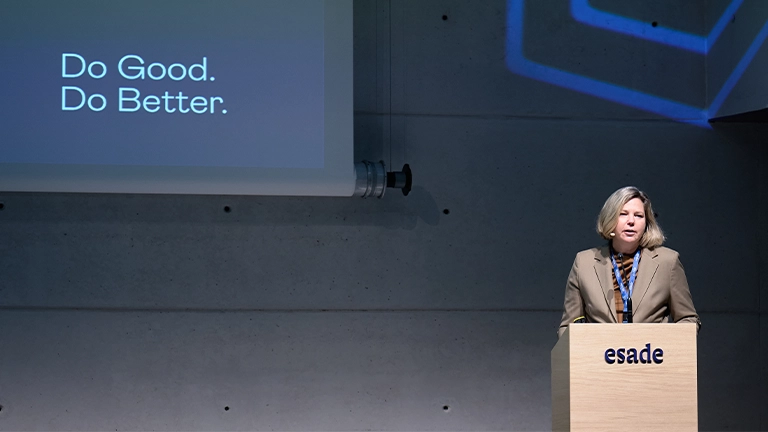
At the presentation event at Esade, Leonora Buckland, a senior researcher at the university, described the study as “an in-depth look at the reality on the ground and how European foundations are approaching systems change”. She also highlighted the importance of philanthropy: “Although it is a very small part of the many actors influencing systems change initiatives, it continues to play a very important role.”
Understanding change in order to drive it
The study is based on a qualitative analysis of six foundations: Fundación BBK, Co-Impact, Fundación Daniel y Nina Carasso, IKEA Foundation, Laudes Foundation and Robert Bosch Stiftung. Their differences in size, geographical scope, sectors and track record make it possible to explore different approaches to systems change. Between late 2025 and early 2026, the team conducted more than 50 interviews with foundation staff, some of the funded organisations working in this area, and sector experts.
One of the report’s most distinctive contributions is that it gives a voice to partners and funded organisations. Their message is clear: they are often ahead when it comes to systems change and how it is measured, and foundations can learn more actively from them and alongside them.
To organise the findings, the authors use the metaphor of a cell: the nucleus represents how the foundation understands systems change; the membrane, how it gathers, shares and uses evidence; and the cytoplasm, the structures and culture that sustain its work. The framework connects three dimensions that need to evolve together: strategy, evaluation and internal organisation.
Practice moves faster than language
One of the key findings is that systems practice often develops before a shared language does. Some foundations have been working for years on the root causes of problems without agreeing on what they mean by systems change. Some even avoid the term.
The authors do not argue for a single, fixed definition, but they do call for clarity about what is to be changed and how they expect to contribute to it. Sharing these assumptions helps guide decisions and collaboration with other actors.
Based on the interviews, the report identifies five principles that foundations mention time and again:
- Address root causes, not just symptoms.
- Promote inclusive change rooted in its context.
- Harness philanthropy’s convening power.
- Support exploration and experimentation through flexible, long-term funding.
- Learn from experience and adapt interventions to what is happening.
These principles provide a shared direction, but do not assume that foundations should lead change. Defining who should play which role is, precisely, another challenge.
Finding a role in a collective effort
Working towards systems change means recognising that a foundation is part of a collective effort and that its contribution will not always be replicable or take centre stage. One expert interviewed for the report sums it up: “If you look at the impact created, there is always someone hidden in the background, without whom things would not have happened.”
The study identifies different ways of taking on this role. In approaches such as Co-Impact’s, the organisations receiving support play a central part in diagnosing problems and shaping action. Other foundations, such as Laudes Foundation and IKEA Foundation, take a more active role in identifying areas for intervention and coordinating efforts. Fundación Daniel y Nina Carasso and, from a place-based perspective, Fundación BBK in Bizkaia combine elements of both approaches.
Rather than prescribing one strategy for every situation, the report stresses the importance of making the chosen role explicit. If it is not defined, different expectations may emerge within the foundation and in its relationships with the organisations it supports.
Other widespread practices include policy advocacy and the coordination of networks and partnerships. The major outstanding challenge is to reach the system’s deeper, less visible layers: power relations, mental models and narratives. The organisations receiving support call for an approach more focused on social justice and led by communities. The question is not only who participates, but who can influence priorities and decisions.
Measuring to learn
Evaluation is one of the areas in which foundations express the greatest uncertainty. How can they know whether an intervention is contributing to change that depends on many actors and whose results may take years to become visible?
The report describes a field in the midst of experimentation. Teams need to interpret what is happening and learn throughout the process, even as boards of trustees continue to demand quantitative indicators. They must also build a shared picture of progress without overburdening funded organisations with reporting requirements.
From attribution to contribution
The most profound change concerns who defines success. In systems-oriented measurement, the questions designed to support learning are shaped by organisations, local actors and communities, and accountability is no longer directed only upwards. One foundation puts it clearly: “Learning for whom? Are we learning for ourselves as a foundation or for the people doing the work? Who defines the questions?”
For this reason, a systems strategy cannot simply be “added” to a traditional organisation.
Foundations underestimate the structural and cultural change required to work with systems. Bolting a systems strategy onto a long-standing operating model is, the authors say, a classic mistake.
What is needed are less siloed structures that are closer to the ground, a culture based on humility, listening, patience and trust, and teams with the right capabilities. The goal is not for all staff to become experts in systems thinking, but to move from being an organisation that thinks systemically to one that practises systems change. Foundations do not have to look far for inspiration: their own partners often have deeply rooted collaborative and equitable cultures.
The final point, therefore, is governance. When teams work systemically but boards of trustees expect the same old indicators, a gap emerges. As one voice from the sector puts it: “We have a team that lives and breathes systems thinking and a board that does not understand the word ‘systemic’.”
A call for humility and courage
The report closes with a central message: business as usual is not an option. Philanthropy must accelerate its own transformation from within, carefully and through collective learning, if it is to avoid being seen as a slow-moving sector that prefers talking about systems to acting on them. It must do so by decentralising, rethinking power dynamics and recognition, while also reconsidering its value and distinctive role.
The authors acknowledge the study’s limitations: it reflects the perspective of philanthropy and relatively large foundations, and the Chair hopes in future to broaden the range of voices from other actors in the system, such as communities and public administrations. But its invitation is clear: to learn together with partners, with humility and seriousness, and to dare to believe that philanthropy can help redesign systems for future generations.