Europe and the United States: Understanding the rival before negotiating
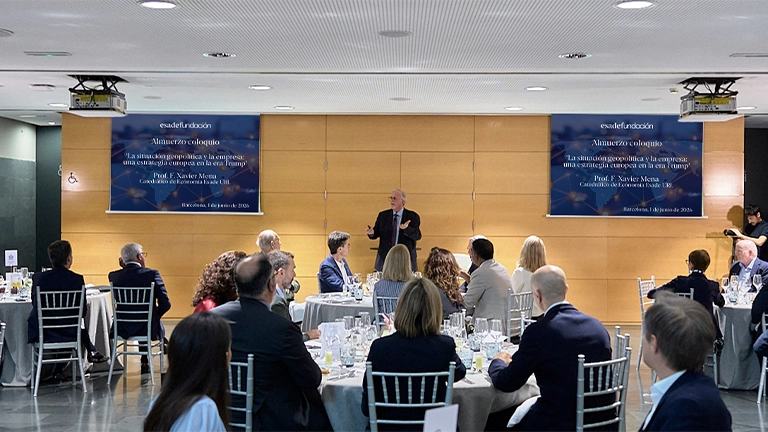
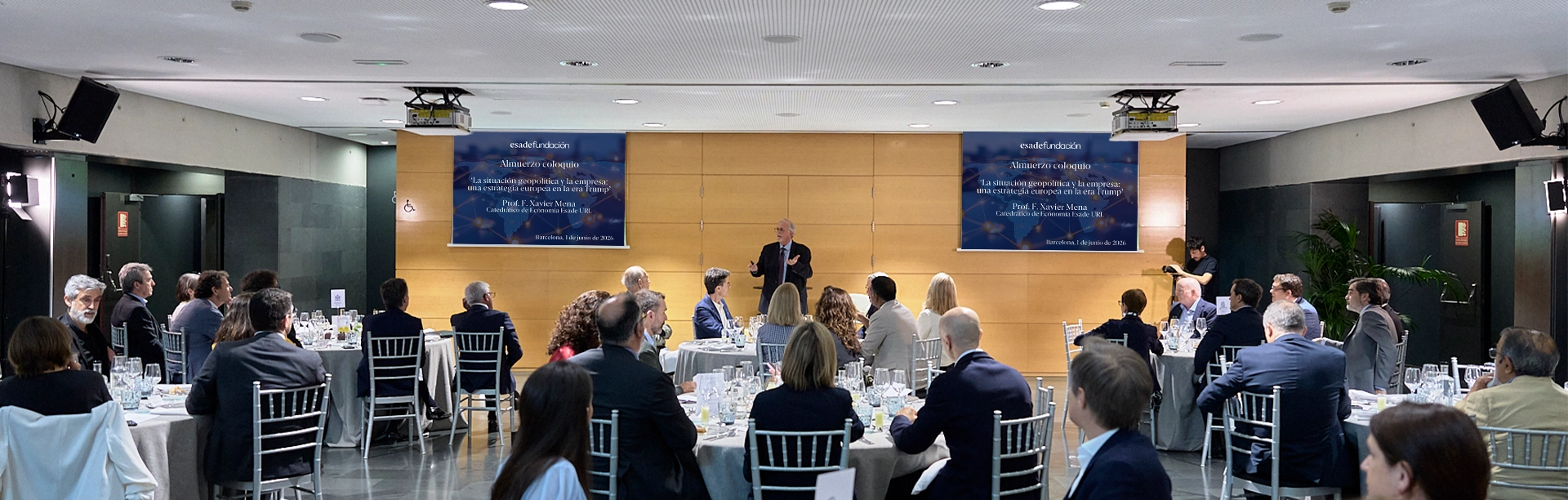
Professor Xavier Mena broke down, at Fundación Esade’s Board of Trustees Assembly, the historical conflicts behind transatlantic trade tensions and the challenges that lie ahead for Europe.

Europe and the United States have spent decades accumulating trade frictions. The Trump administration’s tariffs are not the cause, but the latest chapter in a much longer story. That was the central thesis put forward by Xavier Mena, Full Professor in the Department of Economics, Finance and Accounting at Esade-URL. “I’m not saying we should convince ourselves of anything, just that we should look at this relationship differently,” Mena clarified. His thesis, grounded in game theory, calls for an exercise that is uncomfortable but necessary: understanding American interests without, as a result, endorsing them. Only that way, he argued, is it possible to build a real strategy.
To design a European strategy against Trump, you first have to put yourself in the shoes of the United States
A history of accumulated grievances
Mena ran through as many as twelve historical conflicts that have steadily built up American discontent toward Europe. These are not anecdotes, but structural clashes that explain the White House’s current stance:
- The agricultural clash: After World War II, Europe shielded its agriculture to make sure no one would ever go hungry again (1957, Treaty of Rome). But what was a matter of survival here was experienced in the U.S. as a trade slap in the face that shut them out of 25% of the market.
- Sovereignty vs. protectionism: From quotas on American films to protect local culture to the rejection of GMOs, the U.S. has read European regulation as a disguised barrier against its products.
- Strategic challenges: The creation of the euro was seen as an attack on the dollar’s hegemony, while Airbus’s success was experienced by Boeing as unfair competition funded with public money.
- The new digital front: Differing views on privacy have led to multimillion-euro fines against American tech companies, deepening the rift.
“Europe didn’t do any of this to annoy the United States,” Mena insisted. “It did it for legitimate reasons: food security, cultural sovereignty, fiscal stability. But the result, as perceived, was always the same: exclusion.”
Why Americans vote for Trump
Part of the talk was devoted to explaining the electoral phenomenon that brought Trump back to the White House. Mena pointed out that the argument that has resonated most with American voters isn’t tariffs in the abstract, but trade reciprocity (“if you sell me 100, you have to buy 100 from me”). It’s an idea Trump attributes to the Founding Fathers, and one that strikes a deep chord in the industrial states of the Midwest, where offshoring meant shuttered factories, lost jobs, and entire communities left without a future.
Europe knows what it has to do. The problem is that it doesn’t do it
“Globalization’s defenders said those workers would end up at Google or Facebook,” Mena recalled. “While others said they’d end up with a can of beer, watching baseball and using fentanyl.” The second forecast proved more accurate, and that has had electoral consequences.
Energy: technology calls the shots, not politics
There’s a paradox between political rhetoric and market reality: despite Trump’s rhetoric against renewables, the U.S. Energy Information Administration estimates that 93% of new power generation in the United States in 2025 will come from green energy and batteries. In this case, the economy is moving faster than politics.
“In Texas, there are already more jobs in the renewable sector than in oil,” Mena noted. He added that hydraulic fracturing — fracking — which Trump champions as an emblem of American energy sovereignty, wasn’t his invention: Obama himself had to give in to it nearly two decades ago. The conclusion is clear: it’s each technology’s competitive advantages, not political rhetoric, that ultimately determine the market’s direction.
For Europe, however, Mena raised an additional warning: dependence on critical minerals and rare earths. “We’ve taken on a very serious vulnerability,” he warned, by not controlling the supply chain for the materials needed for the energy the continent wants to produce.
Europe’s problem isn’t the diagnosis
Mena wasn’t kind to Europe. “We’re experts at writing reports. We know what needs to be done. The problem is that we never actually do it.” The Draghi Report, he noted, clearly sets out the priorities: completing the banking union, advancing the fiscal union, building capital markets with critical mass, and creating European industrial champions capable of competing with the United States and China.
Politicians think about the next election, not the next generation
The obstacle isn’t technical, but political. European leaders, he said, tend to think about the next election, not the next generation. And the European Commission negotiates with Washington under pressure from the industrial lobbies of Germany, France, and Italy, while the interests of countries with different trade profiles — like Spain, which runs a trade deficit with the United States — are pushed into the background.
“Kissinger used to ask who you’re supposed to call when you want to speak to Europe,” Mena recalled. The answer is still unclear. The president of the European Council? The president of the Commission? Macron? That fragmentation is a structural weakness in any negotiation with a power that speaks with a single voice.
Get ahead or fall behind
What should a European company do in this context? For Mena, the key isn’t prediction, but anticipation: building scenarios and making decisions before circumstances force them.
Quoting Machiavelli, the professor noted that the best way to predict the future is to shape it yourself. In a world that’s rapidly reorganizing, the institutions and companies that end up best positioned will be the ones that started moving before the new order is set. Those that wait for the rules to become clear will arrive too late.