

AI agents: The future of artificial intelligence
The creation of value in the AI sector is rapidly shifting toward specific applications—an area where, for now, everything is yet to be built.

It is evident that we are in the midst of one of the most transformative disruptions in history: the rise of generative artificial intelligence. Just as happened with electricity, combustion engines, the internet, or smartphones, this technology will amplify our capabilities and automate many of the tasks currently performed by humans. These are all technologies that have changed history, the future of humanity, and even the very definition of fundamental aspects of our nature, such as socialization and communication. Until now, there remained a last stronghold—shrinking by the day, but still present—of what we call intelligence, even without fully understanding what it is. This seemed to make us unique and different from other species. But today, we see that stronghold crumbling before our eyes, torn between awe and panic.
However, the defining characteristic of disruptions is not just their ability to astonish us but their transformative potential. This potential manifests itself in their impact on numerous specific tasks, redefining them in the process.
The role of agents in AI
Agents are software applications that, through language models, can reason and act on our behalf in complex situations. This ability to make decisions and take action gives them enormous transformative power.
For example, these agents will be able to book a restaurant table and negotiate the time, manage the purchase of train or plane tickets under the best conditions, reserve hotels, summarize scientific literature, alert us to changes in financial markets, grade exams, or even act as personalized tutors. While many of these functions are already possible with language models, the key difference lies in their ability to assess context, make autonomous decisions, and act accordingly. This makes them more specialized and less generalist but also more powerful and autonomous.
Technological disruptions: a framework for understanding AI
Looking at past technological disruptions, we can identify three levels in their evolution:
- Infrastructure: These are the foundational technologies on which the entire ecosystem is built. In the case of the internet, this includes protocols like TCP/IP, HTML, or SMTP/POP3, as well as hardware advancements such as Ethernet, 3G, or ADSL.
- General-purpose technologies: These enable the creation of specific applications. In the the internet, browsers and languages like JavaScript or Flash played this role.
- Specific applications: These generate real societal transformation. From Wikipedia to e-commerce, search engines, email applications, or mobility services—these define the ultimate impact of a disruption.
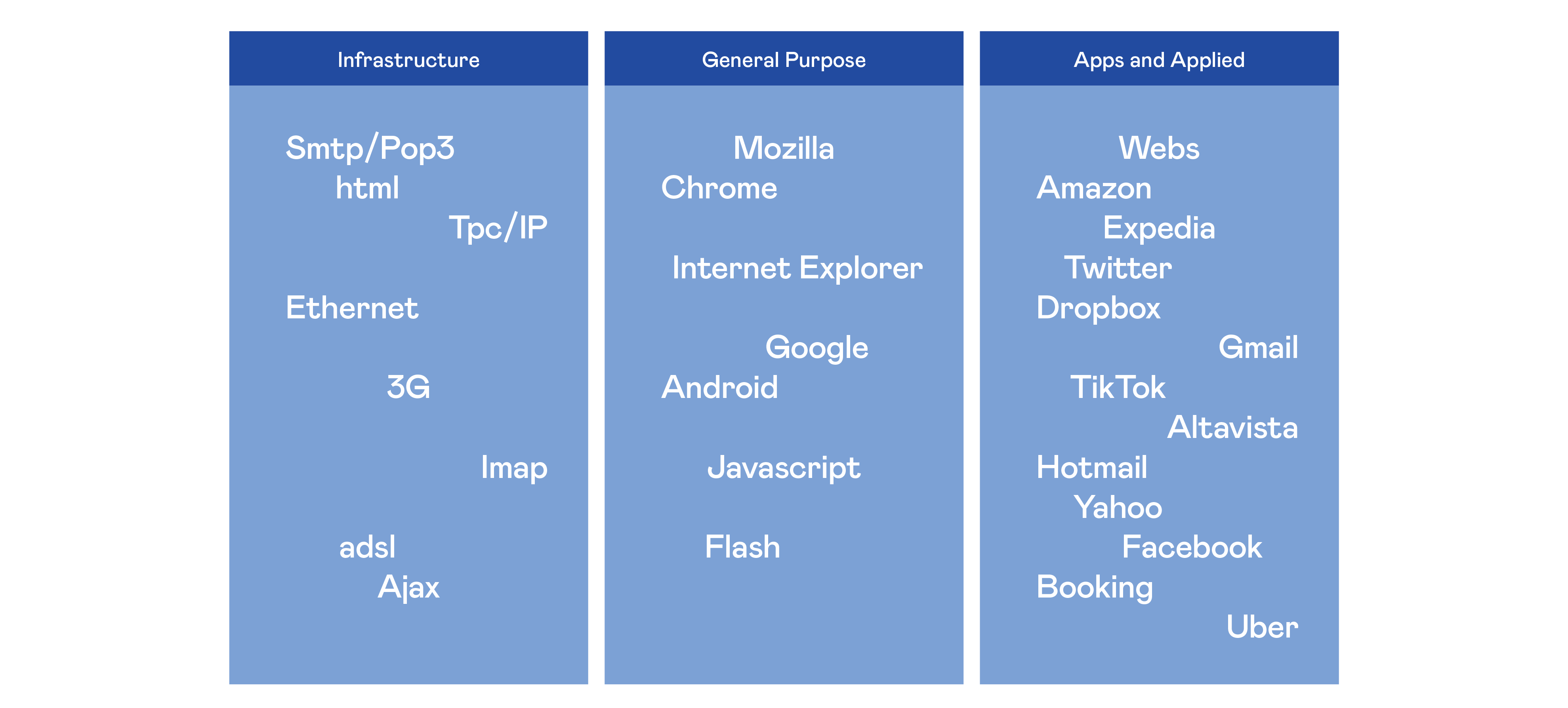
Although infrastructure and general-purpose technologies tend to concentrate economic value in a few hands, true value creation at a societal level comes from specific applications, which redefine entire sectors and transform organizations.
Generative AI
In the case of generative artificial intelligence, infrastructure is expanding rapidly. Companies like Nvidia and AMD dominate the hardware sector, while cloud platforms like AWS and Azure provide the necessary environment for these technologies to develop.
The real action is in general-purpose technologies, mainly represented by chatbots and programmatic access to models via APIs. This is an area where network effects and "winner-takes-most" market dynamics lead to near-monopolistic situations.
We see a dual scenario with open-source models like Llama or vLLM coexisting with proprietary ones. This coexistence is common and reflects the different value capture strategies of the organizations leading them. If the value capture is direct, as in the case of OpenAI, companies tend to start with a proprietary model—although sometimes open source is used to gain internal and external recognition, something with high value in China as exemplified by DeepSeek. On the other hand, if value capture happens through application, companies tend to prioritize the growth and use of the technology, as seen with Meta or Google.
However, when we look at the market for specific applications, we find a vast blank space. Everything is yet to be built:
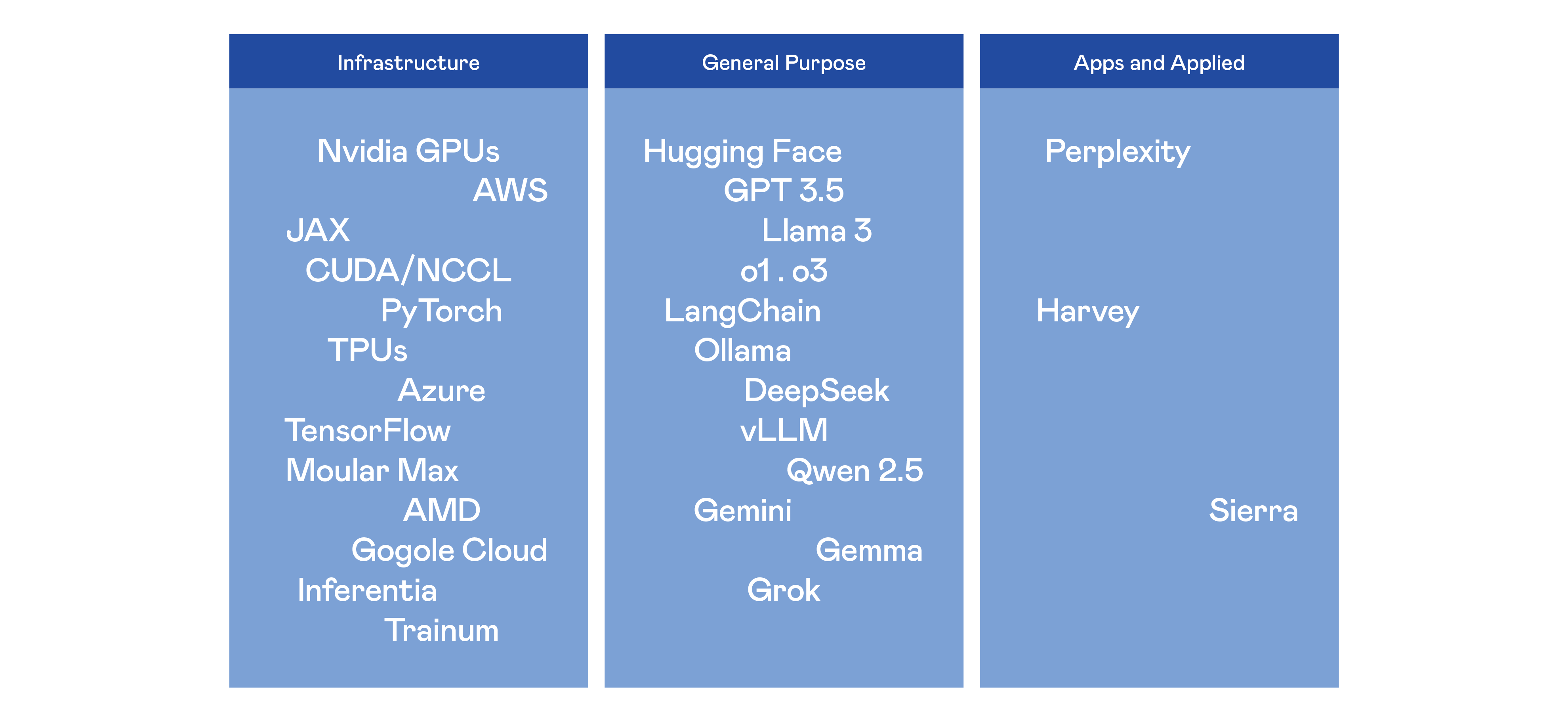
The true growth and value creation in AI in the coming years will occur in specific applications. We are already seeing the emergence of some general-purpose agents, like OpenAI’s Operator, or sector-specific ones, like Harvey in the legal field. But most sectors—medicine, education, personal assistants, team management, government bureaucracy, university administration, and internal automation tools—remain largely untapped.
Two trends will have particularly profound social impacts:
- The replacement of the traditional graphical interface (point & click) with a dialogue-based interface. Interacting with technology will become much more natural, without menus or buttons, but rather through personalized conversations tailored to our level.
- The automation of customer service and user interaction. We will witness a radical transformation in customer service, sales, and marketing, with conversational agents taking a leading role.
As with the previous case, the line between general-purpose technology and specific applications is a continuum. Where do we place Perplexity—under general-purpose technology or applications?
Europe and the AI challenge
If value creation lies in applications, the conclusion is clear: everything is yet to be done. The disruption of generative AI is just beginning, and its full deployment could take a decade or more. While generalist chatbots like ChatGPT already have more than 400 million regular users, more specialized applications in legal, education, healthcare, mobility, personal assistants, and many other sectors have yet to be developed.
This innovation process will largely determine future economic growth. The growing gap between the US and Europe is not so much due to differences in the productivity of traditional industries but rather to the absence of a high-productivity digital sector in Europe.
Our opportunity does not lie so much in competing directly in infrastructure or general-purpose technologies—though that is also important—but in capturing value through applications. This is our best option and our challenge to remain relevant in the 21st century.