AI for marketers: Rethinking competitive advantage

AI for marketers: Rethinking competitive advantage
Innovation & technology 20 March 2026
AI has commoditized marketing optimization, erasing traditional advantages. To stand out, brands must now compete on trust, emotional resonance, and relevance—now judged by both people and algorithms.

Watch the full video of the talk here
Marketing has traditionally been driven by data, optimization, and efficiency. The challenge for businesses was always how to target niche audiences, create automated campaigns, and boost conversion rates. Companies with this specialized knowledge had a competitive advantage. Today, that advantage is diminished because AI tools that can optimize content and target campaigns at scale are accessible to all.
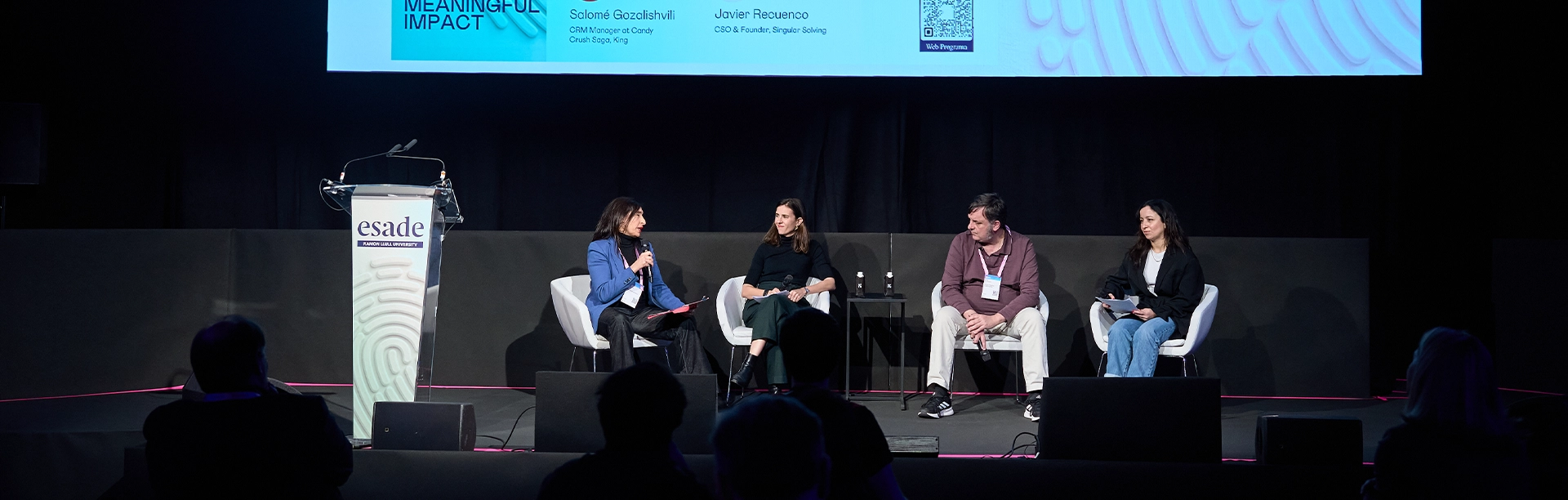
So, if AI is every business’s marketing superpower, how can any brand stand out? And are AI marketing tools really more effective than old-school human marketing teams? These questions were posed by Ana Valenzuela, Professor of Marketing at Esade, in a seminar discussion with Salomé Gozalishvili, CRM Manager at Candy Crush Saga, Javier Recuenco, CSO & Founder of Singular Solving, and Olivia Calafat, Marketing Director at Wallapop, during the recent 4YFN event in Barcelona.
When optimization becomes a commodity
“Optimization won’t be such an advantage as it was before,” says Calafat. AI is leveling the playing field. According to McKinsey, in 2024, 65% of organizations were already using generative AI in at least one business function, with marketing and sales leading its adoption.
“AI-led creatives and human-led creatives are delivering similar results. And of course, one has a much lower cost,” explains Calafat.
This means that optimization—once a source of competitive advantage—is increasingly a commodity. It’s still something companies need to do, but it won’t propel them ahead of the competition any more.
The rise of brand in an AI-driven world
So where does the competitive advantage come from? “I think in this new world, what really matters is brand,” says Valenzuela.
When a customer chooses a brand, it’s not just about preference, but also trust and emotional resonance.
Calafat concurs that “what really matters is brand… not just for users, but also for AI agents.” This is an important evolution. Decisions about which brands to choose are no longer solely in the hands of consumers. Increasingly, AI systems filter options and recommend products. In this context, a brand is perceived not only by people but also by algorithms.
However, this dynamic only works if consumers trust the AI systems guiding those recommendations. The Edelman Trust Barometer found that trust significantly increases openness to AI and influences how people engage with technology. What this means in practice is that trusted brands are more likely to be selected by users and by AI systems.
As a result, businesses are investing more in strengthening their brand. Previously, it was tricky to analyze ROI on brand investment, but as creating a strong, trusted brand is now the key to competitiveness, companies are working hard to ensure their brand creates an emotional connection with their customers.
Personalization—simple in theory, complex in reality
Making a brand feel personally relevant to customers is a sought-after goal. Personalization sounds straightforward. In practice, it is far more complex. As Gozalishvili explains, “Sending the right message in the right moment to the right customer… sounds so simple, but when you deep dive, it’s hard because you have to really identify those high-value moments when you will amplify that journey for the individual customer.”
Personalizing a marketing campaign does not simply mean sending emails that greet customers by name or superficially segmenting an audience. That does not foster an emotional connection to a brand. Salesforce data shows that despite widespread AI adoption, 84 per cent of marketers admit they still run generic campaigns, and although 79 per cent of marketers use AI to personalize content, they are failing to create meaningful experiences.
Successful marketing understands what truly matters to customers in different contexts. At Candy Crush, the focus is on progression within the game—the core of the user experience.
When personalization aligns with what users value, it enhances engagement. When it does not, it becomes unwanted noise. The difference lies in relevance, not data volume.
Context and emotional intelligence
Marketers strive to make brand messaging resonate with everyone it reaches, but it’s a complex and nigh-on impossible goal. “Mass personalization is a dream at the end of the rainbow that most of the industry has been trying to reach without much success,” says Recuenco. “The industry has been chasing a rabbit that it cannot put into a cage.”
Even AI can’t solve this problem. “Data travels, context does not,” surmises Recuenco. AI struggles with context unless users actually provide it. Why is that important? Because the same person acts differently in different contexts. Someone browsing online to plan a work trip has different needs and motivations than someone planning a romantic holiday. Creating a brand message that resonates with the same person in different contexts requires real-time insight and, often, direct user input.
AI still lacks the emotional intelligence to fully navigate the nuances of human signals, moods, and emotions. Recuenco also highlights the need for transparency. If users aren’t told they are interacting with a machine, the interaction with AI could feel “creepy” if it fails to respond with human authenticity.
Consumer welfare
Algorithms can certainly guide consumer decisions by presenting appealing options, but the flip side is that consumer experience can become narrower because these systems rely heavily on past behavior. Valenzuela describes this as the “death of serendipity.”
A visit to a video store, for example, might lead to an unexpected recommendation or a spontaneous choice. These moments of surprise have always played an influential role in driving consumer actions.
Today, the challenge is to find ways to reintroduce unexpected discoveries to consumers so that recommendation algorithms don’t reduce diversity over time.
Why companies are slow to leverage AI
Ultimately, successful adoption depends on leadership. Organizations that create urgency, support experimentation, and embrace new ways of working are more likely to translate technological potential into meaningful impact.
But AI uptake in business is still tentative. Calafat acknowledges that although AI tools are available, companies’ organizational structures can hinder experimentation.
“We have to change how we work,” she says. “We also have to change the operating system—experiment more. And we should provide incentives—playing around with AI takes a lot of time. We should create hackathons, for example, or make AI experimentation a priority within the OKRs.”
Rediscovering what moves people
Marketers can all use AI to perfect optimization, but their next challenge is to focus on developing their brand and to combine human emotional intelligence with AI's capacity for data analysis. The overarching goal is to not only improve targeted messaging but also to create a meaningful experience for consumers.
There are two paths: rely too heavily on AI and risk losing serendipity, or combine human marketing intelligence with AI’s analytical power to open up new creative possibilities for connecting with audiences. Either way, AI is changing the future of marketing.