The invisible shift: How AI and automation are reshaping human values
As AI enters realms once reserved for human belief and identity, it’s starting to challenge spiritual frameworks, redefine which core human traits we value in ourselves, and even shift our social attitudes on topics like migration.

An unusual spiritual guide recently took up residence in a church in Lucerne, Switzerland: a holographic ‘AI Jesus.’ Located in a traditional booth, the chatbot-powered projection invited visitors to a confidential conversation to receive spiritual advice, available in 100 languages. Some visitors said it was enlightening. Others called it blasphemous. But regardless of public response, what is now clear is that people are turning to artificial intelligence not just for information or to enhance productivity, but for meaning and life guidance.
This scenario relates to a question posed during Professor Adam Waytz’s (Kellogg School of Management, Northwestern University) keynote at Consumers + Technology Dialogue 2025 at Esade: What happens when machines begin to do things once thought uniquely human? Waytz’s work suggests that AI isn’t only changing how we live by increasing efficiency—it’s changing how we see ourselves and others, and it’s even affecting our belief systems.
Is AI a new God?
One of the more surprizing effects of AI is its connection to society’s detachment from religion. While belief in God has been diminishing across much of the world for decades, Waytz’s co-authored research shows that this decline has quickened in regions and countries where AI and automation are most used.
Multiple studies back this up. In a global dataset of over 2 million people, countries with higher robot installation saw sharper drops in religious belief, even when controlling for wealth and education. Similar results were found at the city level in the US and among people who worked more closely with AI tools. Tracking people’s beliefs showed that those entering careers in programming or automation-related fields were more likely to become less religious over time.

Why does this happen? AI isn’t telling people to abandon religion. One reason is that automation may diminish the practical need for religion. People turn to religion less for guidance or comfort when machines begin to offer real-world solutions and even spiritual-sounding advice. Moreover, chatting with AI doesn’t always feel like conversing with a machine. Participants in the studies described automation as enabling people to ‘do things that we have never been able to do before,’ granting them ‘superhuman abilities’ and even allowing them to ‘break laws of nature.’ As noted by Waytz, this challenges the perception of human exceptionalism—the belief that only humans can think, feel, or create meaning. When machines develop the ability to rival human capabilities, some begin to question the necessity of divinity altogether.
What we value in ourselves is shifting
Automation is also altering how we think about our own abilities. In a time when AI can code, design, and write, people are rethinking which skills still make them stand out. Waytz’s research shows that when people feel threatened by automation, they tend to emphasize creativity over technical or even social skills.
Creativity may be seen not just as a skill, but as a kind of human signature in a digital world
One study showed that graduating STEM students who read about AI taking human jobs were more likely to highlight their creative abilities, such as imagination or innovation, on their résumés. In the same research, an experiment with professional graphic designers found comparable results: those who were shown that automation was a threat to their jobs were more likely to enrol in online courses to learn design thinking or creative problem-solving, rather than technical training.
This is evidence of a significant psychological shift. Creativity is seen not just as valuable, but as resilient—a uniquely human trait that AI might complement, but not completely replace. As the researchers note, “Creativity may be seen not just as a skill, but as a kind of human signature in a digital world.”
The assumption that human creativity is immune to automation may be overly optimistic. Generative AI tools like Midjourney and ChatGPT have already demonstrated surprising creative range. The point, though, is not what AI can do, but what humans believe it can do.
Can working with AI lead to bias against others?
Disturbingly, it appears that exposure to AI and automation affects our views of other people, especially outsiders. Waytz’s team found that people who feel threatened by AI and automation are also more likely to hold and express anti-immigrant sentiments.
Participants afraid of automation were more likely to blame immigrants for cultural decay
It’s not just about competition for jobs. It’s about a symbolic threat—the idea that societal change, driven by technology, disrupts identity and values. In several studies, participants who feared automation were more likely to support punitive immigration policies and more likely to blame immigrants for cultural decay. In one study, people asked to imagine their job being replaced by a robot were more likely to decide that immigrant workers should be the first to lose jobs.
The authors describe this as a zero-sum mindset: the belief that if technology or outsiders make progress, locals must lose. As automation becomes more a part of everyday life, it may unintentionally fuel political shifts. Across Western Europe, regions with higher AI use have shown increasing support for populist, anti-immigrant parties—a trend that Waytz and colleagues connect to these underlying fears.
AI’s impact starts in the human mind
One of Waytz’s most intriguing questions isn’t about hardware or algorithms, but about perception. Could it be that the idea of AI is changing society more than the AI technology itself?
Evidence suggests yes. As The New Yorker reported, political systems have been transformed not necessarily by what AI can do, but by the fear that it could manipulate elections. Mutual shaping, a concept from science and technology studies (STS), argues that human belief systems and social norms influence technology’s impact just as much as design or utilization.
On the other hand, unwitting users may not realize that AI can serve as an echo chamber. Recommendation engines, search algorithms, and chatbots often amplify what we already believe, solidifying confirmation bias instead of challenging it. As humans chat with and consult more with machines, our values may not adapt and change, but stagnate and ossify around our own perceived truths.
Our beliefs shape our reality
As AI evolves, the biggest challenge society faces may not be technical—it may be psychological. While it’s clear that AI and automation are altering human belief systems, the deeper question is whether these shifts stem from what AI actually does, or from the power we imagine it holds. As we continue to project superhuman traits onto machines, it may be our perceptions, not the technology itself, that are driving the most profound changes in how we think, work, and relate to one another.
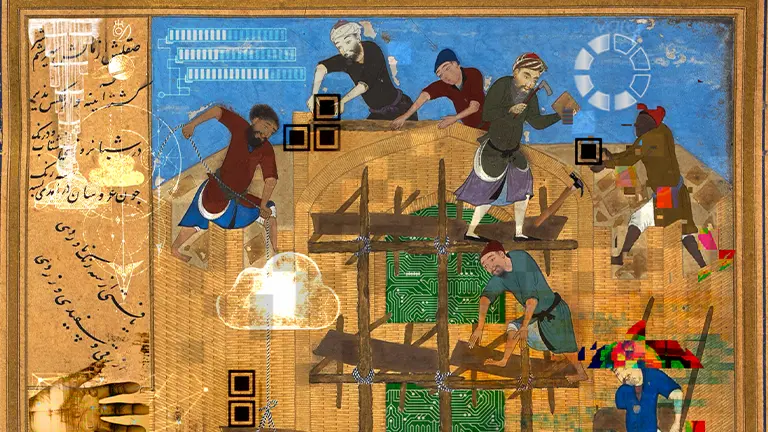
Header image: Shady Sharify / Who is AI Made Of / Licenced by CC-BY 4.0