The advantage of redesigning the system
At Singularity 2026, Esteve Almirall argues that adopting AI only guarantees competitive parity: the advantage goes to those who redesign their systems, coordinate without standardizing, and learn faster.

Amazon could have tried to get its warehouse workers to pick orders faster. Instead, it chose a different approach: rather than sending people to the shelves, it brought the shelves to the people. Today, its warehouses operate with a fleet of around one million robots. Improving the task would have delivered a modest productivity gain, but changing the system produced a leap in performance that no individual optimization could have achieved.
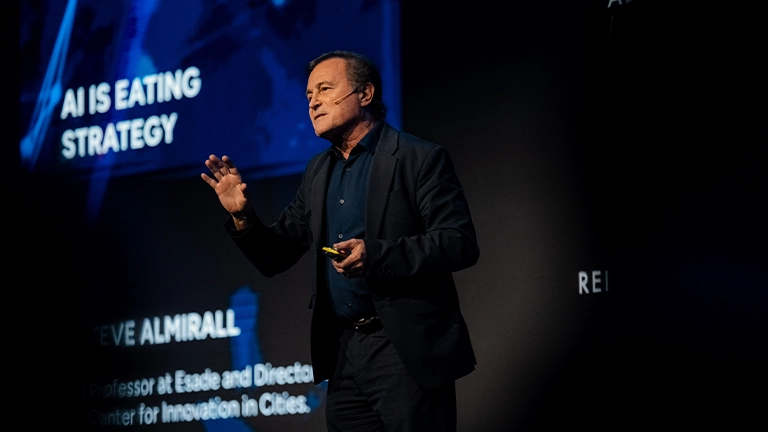
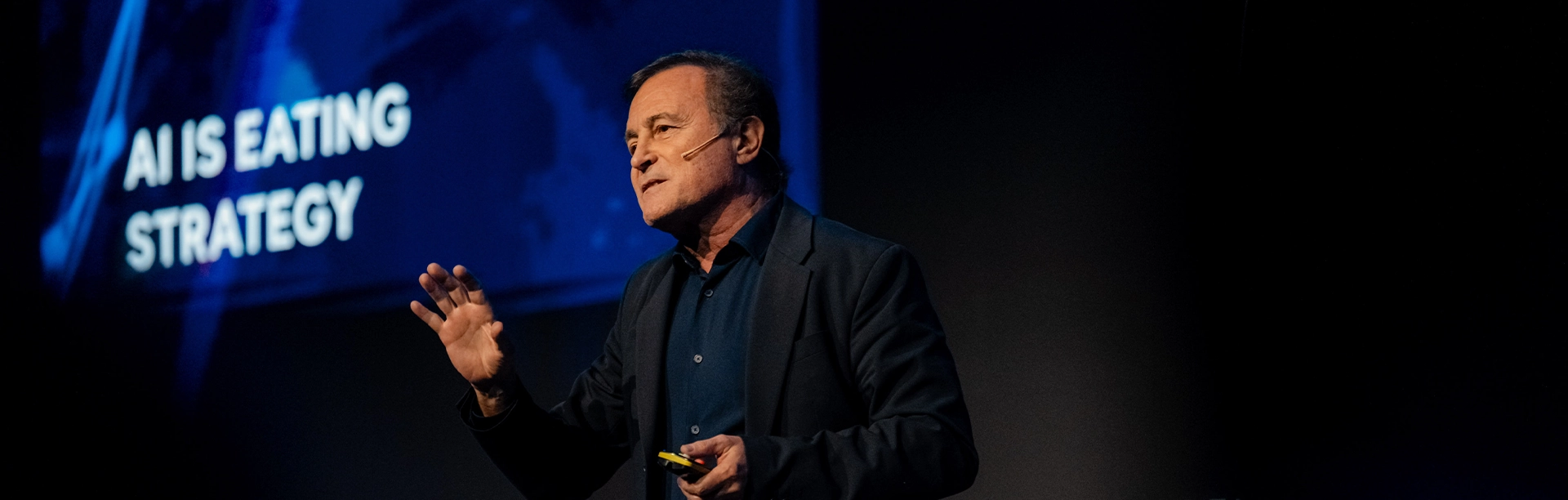
That difference between speeding up a task and redesigning a system is essentially what separates companies that use artificial intelligence from those that gain an advantage from it. This was the thesis put forward by Esteve Almirall, Professor of Data, Analytics, Technology and Artificial Intelligence at Esade, Full Professor at URL, and Director of the Center for Innovation in Cities, in his presentation at the Singularity 2026 event, held in Madrid.
What happens when knowledge is no longer scarce
Fear of losing one's job as AI advances at an accelerating pace is widespread, and the prospect of our roles becoming obsolete can seem like an imminent threat. However, Almirall points out that what is actually changing is what generates value within a company. Historically, that value lay in expertise—that is, a person's command of a particular subject. Today, it increasingly lies in the ability to make decisions.
The professor stressed that technology has always created new professions. There were no software engineers before computers, no data analysts before databases, and no influencers before social media. Looking at professions over time, from 1940 to the present, 60% of them have disappeared, while the remaining 40% have changed completely. This phenomenon, therefore, is nothing new. It is a continuation of history. Artificial intelligence will follow the same pattern. What is different this time, he stressed, is not the phenomenon itself, but its speed.
In this context, professional expertise is no longer about accumulating knowledge. Models can find, combine and select information; what remains in human hands is the ability to understand it and make decisions. The judgement to apply what one knows is becoming more valuable than knowing it. Almirall illustrated this with Anthropic: Claude Code was developed over two years by a team of 100 engineers, while Claude Cowork, a by-product of Claude Code, was built in a week and a half by a team of five.
Using AI does not set anyone apart
A model available to everyone, often free of charge and easy to replicate, provides what Almirall calls competitive parity. It is necessary to avoid falling behind, but it is not enough to stand out. He compared it to the Red Queen in Through the Looking-Glass, who has to run as fast as she can just to stay in the same place.
Competitive advantage, by contrast, stems from a cumulative learning loop. The idea is to use tools to create new tools, and data to improve them, and then repeat the process. This takes time, which is why it cannot be copied as easily as a model. In software development, the build phase has already been dramatically compressed. The next step, he noted, is beginning to come into view: autonomous agents that work and verify results on their own. They are still at an early stage in management and economics, but more advanced in biology and engineering.
Coordinating without standardizing
For Almirall, coordination is the foundation of markets. His historical example is the shipping container. Standardization, driven in part by the logistical needs of the Vietnam War, dramatically reduced transport costs and created new demand. Within companies, algorithmic coordination is already making processes faster and safer, but it has its limits. It requires standardization and only works under the control of a company or a platform.
The new development is that AI makes it possible to coordinate without standardizing. If several hospitals use different formats, such as a PDF, a message or a JSON file, an intelligent system can understand them and adapt on the fly. The implications extend to companies, public administrations and communities operating at different speeds and with different technologies. They also reopen a classic question in business schools: if markets work well, why do companies exist? The traditional answer was that coordinating externally cost more than it was worth. Those costs had already fallen with platforms and, in a world of agents, are falling further still. The consequence, according to Almirall, is that there will be many more companies.
Change the system, not the task
Using AI to improve a task increases productivity, but only to a limited extent, because human capacity is constrained by time and attention. Almirall drew on a basketball analogy, explaining that the three-point line did not make players faster; it changed the game. The test of whether a strategy is sustainable, he suggested, is whether AI is embedded in the product, with network effects, rather than added as a marketing layer.
This translates into concrete decisions. In customer channels, the point is not to put a chatbot on a website, but to be where customers already are, such as WhatsApp, WeChat or Slack. In the supply chain, it means rerouting distribution in real time, as is already happening in some cases in China. In marketing, it means engaging with customers and prioritizing the most relevant ones, rather than producing copy faster. The professor also noted that companies are moving beyond designing solely for people and are now designing for agents as well; rigid workflows are giving way to systems capable of understanding intent, tone and purpose, as seen in the new generation of CRM systems. In the public sector, Singapore already allows a personal agent to handle administrative procedures on a citizen's behalf.
Adoption is not optional
Economics tends to picture the innovation frontier as a continuous curve. The reality, Almirall warned, is uneven, and that frontier is expanding under the impetus of agents and emerging technologies. Positioning oneself at the frontier entails significant risk, constant experimentation and a willingness to accept failure. In Anthropic's case, for example, models lose their value within a matter of months because no one uses an old one. Another approach is to observe the best examples from different places and adapt them to one's own business.
What is not optional is adoption. As happened with the internet and mobile phones, the pattern is repeating itself: either you adopt, or you are left behind, and delay always comes at a price. The digital revolution generated an enormous amount of value, captured by those who adopted earlier and more effectively. Adoption does not guarantee success, but it is a prerequisite for being part of the global game.
The advantage lies in knowing how to redesign
Almirall closed his presentation with Chinese humanoid robots as a symbol of a country moving forward at great speed. His message was clear: “we have to do better, push harder and do a little more”.
AI is within reach of almost every company, so the advantage does not lie simply in using it. To improve their results, executives should ask themselves not how to do what they already do faster, but what system they would build if they could start from scratch with these capabilities.