

An 1865 paradox behind our AI photo trend of the 1980s
The trend of recreating the 1980s with AI revives the Jevons paradox: as generating images gets cheaper, we use the technology more. The problem is not each photo, but the scale of total consumption.

A few weeks ago, social media began filling up with photographs that looked rescued from a 1980s family album. Impossible hairstyles, denim, studio lighting, slightly faded colors. The difference is that many of those photographs never existed. They were current images reinterpreted by generative artificial intelligence tools.
The so-called 1980s AI photo trend has spread rapidly across social media using tools such as ChatGPT or Gemini. As happened previously with the images inspired by Studio Ghibli, all it takes is uploading a photograph, writing a few instructions and waiting a few seconds. What for us is practically a click triggers, however, a far more complex computational operation in some data center.
And that raises an interesting question: how much does our digital nostalgia really cost?
The most rigorous answer is probably the least attractive one for a headline: we don’t know with precision. And, for that reason, we should avoid claims such as “every photo uses 29 ml of water” that have been circulating frequently these days.
The cost we don’t see
An AI-generated image seems intangible. There are no visible raw materials, transport, packaging or waste in front of us.
But the digital world also has a physical infrastructure. Every generation requires specialized processors, electricity, cooling systems, communications networks and data centers. To this we would have to add the impact associated with manufacturing chips, building those facilities and maintaining an infrastructure that must respond practically instantaneously to millions of requests.
The specific cost of an image, moreover, varies enormously.
A study published in 2025 compared 17 image-generation models and found differences in energy consumption of up to 46 times between them. Even doubling the resolution could increase consumption by between 1.3 and 4.7 times depending on the model. Something apparently as simple as asking “how much energy does an AI-generated image consume?” therefore has no universal answer.
The model used, the hardware, the resolution, the data center, its location, the source of electricity and the cooling system all matter.
That is why we should be cautious about some spectacular figures circulating on social media about the liters of water or watts consumed by each query. They often mix different models, different technological moments or estimates made under specific conditions and turn them into supposed universal constants.
What we do have, however, is data that helps us understand the magnitude of the situation.
Google published an estimate in 2025 according to which a median “text” request to Gemini used approximately 0.24 Wh of electricity (equivalent, for example, to leaving a 60 W light bulb on for about 14 seconds), generated about 0.03 grams of CO₂ equivalent and consumed approximately 0.26 milliliters of water. But there are two fundamental caveats. First, we are talking about text, not image generation. Second, Google claimed that energy consumption per request had decreased 33-fold in just twelve months, while its carbon footprint had been reduced 44-fold.
At first glance this seems like great news. And it is.
But it is only part of the story.
A paradox from 160 years ago
In 1865, in the midst of the Industrial Revolution, the British economist William Stanley Jevons published The Coal Question. Jevons observed something seemingly contradictory: improvements in the efficiency of steam engines were not reducing British coal consumption. On the contrary, by making its use more profitable, they were extending its applications and increasing aggregate consumption.
Today we know this phenomenon as “the Jevons paradox.”
More efficiency reduces the cost of using a resource. That lower cost facilitates new applications, expands the market and increases the number of uses. If that growth exceeds the savings achieved thanks to efficiency, total consumption ends up increasing.
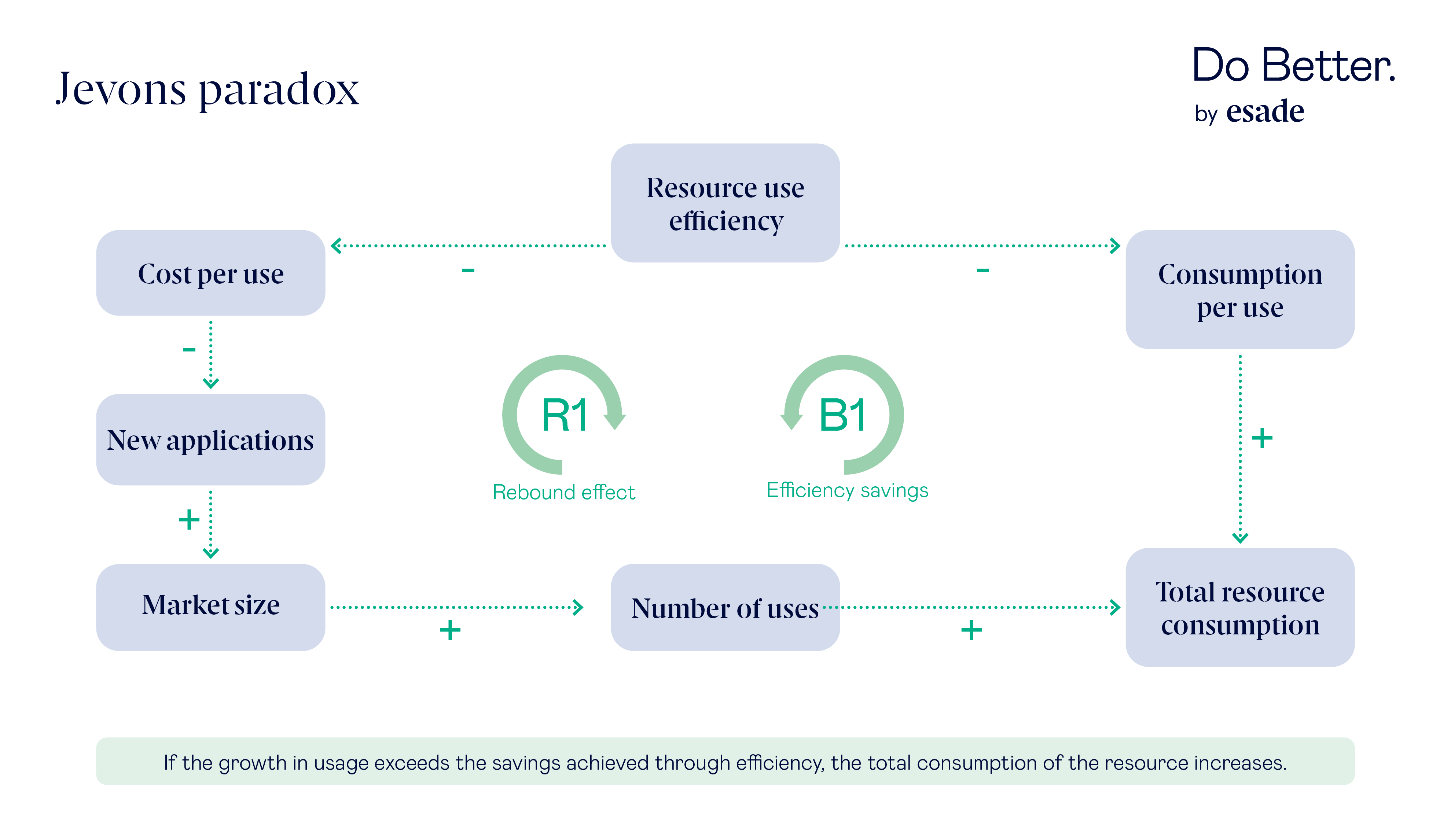
Figure 1. Jevons paradox: rebound effect of efficiency on total resource consumption. Source: author’s own elaboration, based on Jevons (1865), represented through a causal diagram of system dynamics.
More than 160 years later, Jevons can help us understand something that is happening with artificial intelligence.
Models are increasingly efficient. Hardware improves. Algorithms are optimized. The cost of inference falls. But, precisely for that reason, we use AI for more and more things: some extraordinarily useful and others, shall we say, somewhat less essential to the progress of humanity, such as, for example, finding out how we would have looked with a mullet in 1987.
We generate a photograph. It doesn’t convince us, so we generate another. We change the background. Then the hairstyle. We try out how we would look in the eighties, how we would look when older, or how we would appear transformed into a movie character.
The marginal cost perceived by the user is practically zero. And when the psychological and economic price of generating an image approaches zero, our demand can approach infinity.
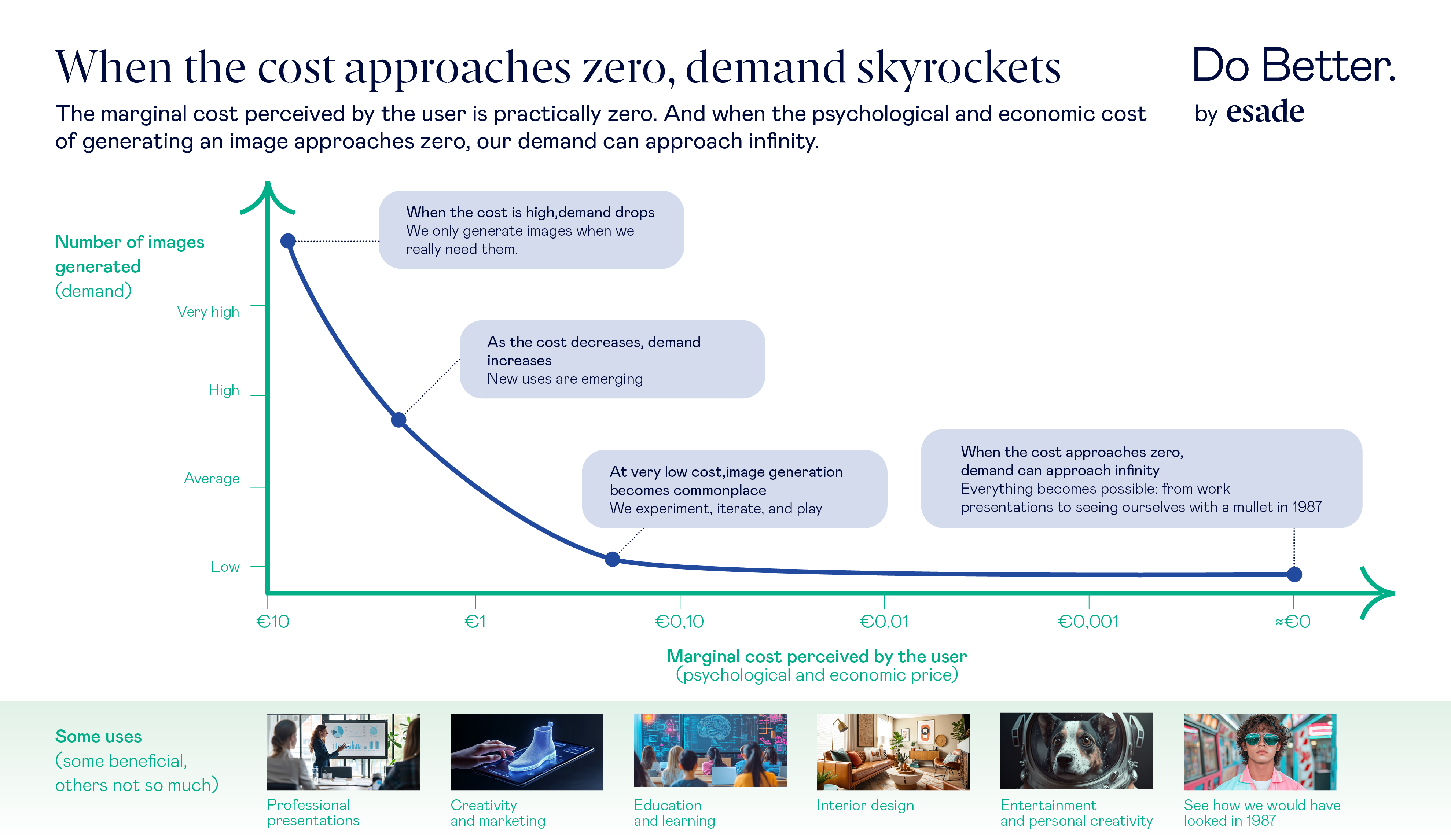
Figure 2. Conceptual relationship between perceived marginal cost and demand for AI image generation.
*Note: Conceptual and illustrative representation. The curve is not based on empirical data and does not claim to establish a quantitative demand function.
Researchers such as Alexandra Sasha Luccioni, Emma Strubell and Kate Crawford have explicitly applied the Jevons paradox to the environmental debate around artificial intelligence. Their argument is relevant: “improving technical efficiency does not in itself guarantee a reduction in environmental impact,” because that efficiency can stimulate an even greater increase in demand.
The problem, therefore, may not be our eighties photographs: the problem is scale.
From cost per prompt to the cost of the system
During the first years of the current AI revolution/democratization, an important part of the sustainability conversation focused on the cost of “training” large models.
We are now entering another phase.
Once a model is trained, millions of people can use it continuously. Every query, every image, every video and every agent executing tasks requires inference. An individual operation may become ever cheaper, but multiplied by hundreds of millions of users, companies and applications it can represent an extraordinary volume of computation.
The International Energy Agency estimates that data centers consumed approximately 460 TWh of electricity in 2024 and projects that their demand could exceed 900 TWh in 2030. In its central scenario, consumption would grow by around 15% per year until then, more than four times faster than the growth in electricity consumption of all other sectors. AI is one of the main drivers of that increase.
The IEA’s most recent estimate maintains practically that same trajectory: around 950 TWh in 2030, close to 3% of global electricity, while the consumption of data centers specifically oriented to AI could triple between 2025 and 2030.
It is also worth putting these numbers into perspective. AI is not responsible for all data center consumption, nor do all its uses have the same impact. And artificial intelligence itself can help optimize power grids, improve industrial processes, develop new materials or reduce consumption in other sectors. Turning the debate into “good AI” versus “bad AI” would be excessively simplistic.
The interesting question is a different one: what do we use the additional computing we are creating for?
Efficiency is not the same as sustainability
Here there is an important lesson for companies as well.
We are used to measuring technological efficiency through unit indicators: cost per transaction, energy per operation, time per query or cost per million tokens.
They are necessary indicators, but insufficient.
A company can cut the energy consumption of each operation in half and, at the same time, multiply the number of operations by ten. Technically it will be much more efficient. In absolute terms, it will consume five times more.
That is why, with AI, we should look simultaneously at efficiency, volume and value generated.
It makes little sense to blame the user for generating a fun photograph from the eighties. That approach would turn a systemic problem into a question of individual responsibility and would probably keep us from understanding what is truly important.
The photo is interesting because it makes visible something that normally remains invisible.
Every time a technology radically reduces the cost of doing something, we tend to do it much more.
When storing photographs was expensive, we selected which ones to keep. When digital photography made taking a picture practically free, we started producing thousands. When sending information became practically free, we exponentially multiplied the data we generate and store.
With AI we are probably entering a similar dynamic, but applied to cognition and artificial creation. Texts, images, videos, analyses, simulations and decisions that used to take minutes, hours or days can now be generated in seconds. That represents an extraordinary economic and social opportunity.
But it also means that we cannot rely exclusively on the next chips or models being more efficient to solve the environmental impact of artificial intelligence.
Jevons already warned us about this 160 years ago. Perhaps that is why a seemingly innocent photograph that takes us back to the eighties contains a much more contemporary lesson: the true cost of artificial intelligence does not depend solely on how much each operation consumes, but on what happens when doing it becomes so easy and cheap that we decide to do it millions (or billions) of times.
The next big question about AI sustainability may not be how much it costs to generate an image. It could be deciding how much value we are capable of generating with all the computing we are willing to consume.