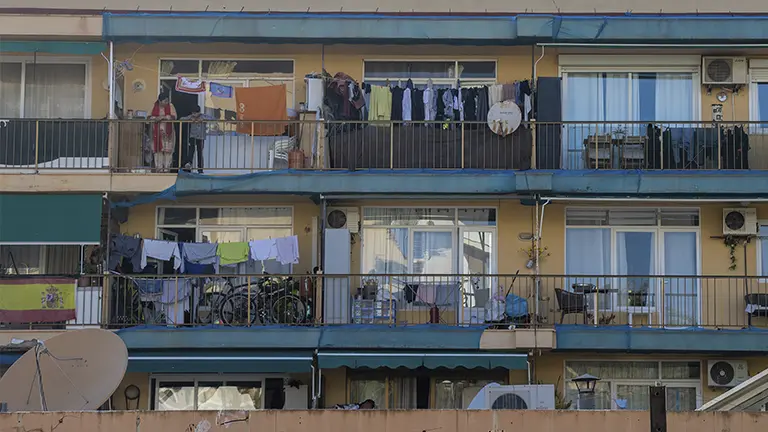
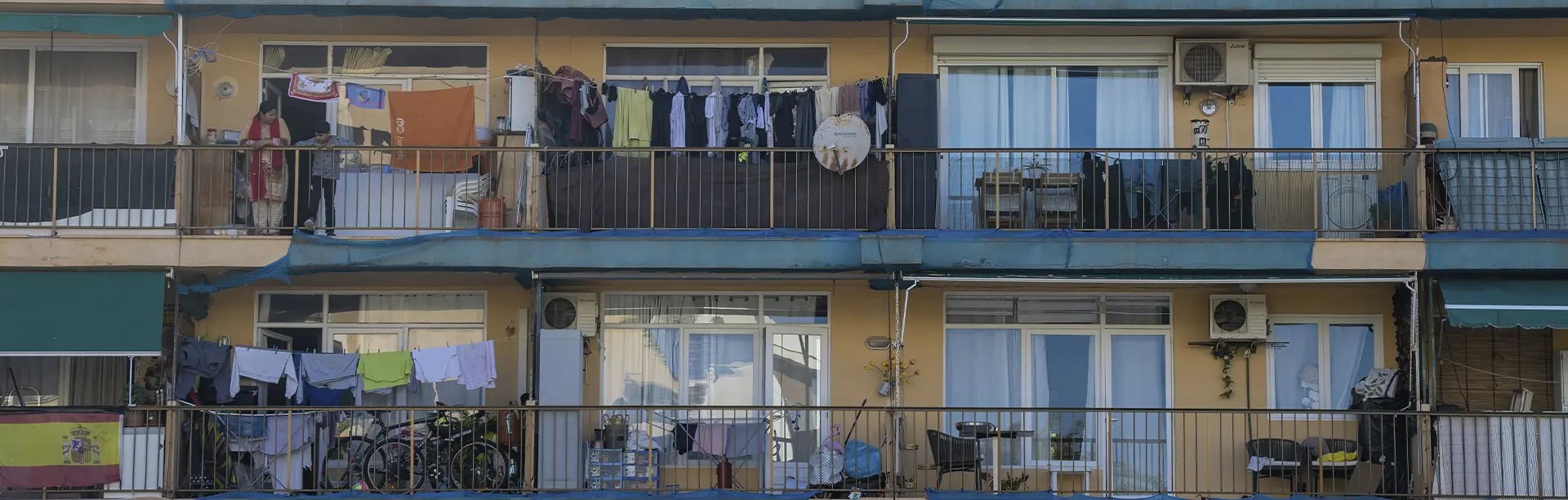
To talk about poverty, we must talk about housing
The lack of access to adequate housing has become a catalyst for social exclusion and the main gap in the welfare state. Addressing it is essential to tackle the problem of poverty.

October 17. Thirty-two years ago, this date was declared the International Day for the Eradication of Poverty by the United Nations General Assembly. Although awareness has increased over the years, poverty and social exclusion continue to shape the lives of millions in Spain and around the world. As stated by the UN in its preface to the Guiding Principles on Extreme Poverty and Human Rights: "In a world characterized by unprecedented levels of economic development, technological means, and financial resources, it is a moral scandal that millions of people live in extreme poverty."
Today, in Spain, 26.5% of the population is at risk of poverty or social exclusion—almost 13 million people. This figure, reported by the Spanish Network for the Fight Against Poverty and Social Exclusion (EAPN-ES), reflects a persistent trend over the years. Similarly, homelessness—the most extreme form of poverty—has continued to grow in recent decades.
A structural problem
Poverty cannot be understood as merely an individual issue but as a structural problem. Its persistence reveals the state’s inability to ensure the most basic rights for its citizens. Additionally, poverty doesn’t only affect those who suffer from it directly. Considering poverty as an individual problem rather than recognizing its structural nature is misleading. More worrying still is the assumption that this reality will not have consequences for society as a whole.
The housing model of recent years has been a powerful generator of poverty in our society
First, poverty directly impacts birth rates. We’re already seeing this in Spain, where low birth rates are closely linked to the profound economic crisis that hit the country over a decade ago. According to data from the FOESSA Foundation, the annual extra cost of raising a child between 0 and 3 years old is around €5,000, increasing to €6,000 for teenagers. In a context of financial hardship, many families simply cannot afford to have more children.
Second, poverty negatively affects public health. People living in poverty face greater exposure to diseases, have a lower life expectancy, and experience higher infant mortality rates. These issues don’t just affect those directly suffering from them; they impact society as a whole, as became evident during the COVID-19 pandemic, when public health was a collective concern.
Third, poverty also has a profound impact on education. A society where a significant portion of the population lacks access to adequate education—both formal and informal—has fewer opportunities for child development, creativity, and innovation.
Finally, poverty generates segregation dynamics that can perpetuate precariousness and impact communities and even public safety. These are just a few of the many consequences of poverty.
Housing, a catalyst for poverty
It is essential, therefore, to tackle poverty with courage. And addressing the housing issue is a necessary step in this effort. Contrary to the belief that Spain has not implemented public housing policies, the real problem is that these policies have prioritized speculation over the right to decent housing. Over the past few decades, both in Spain and globally, we have witnessed a radical commodification of housing.
As explained by Future Policy Lab in its housing report, this process has been driven by three main dynamics at the national and international levels: promoting individual homeownership, disinvesting in public and affordable housing, and increasing speculative activity. These factors have triggered various crises, from Japan’s housing bubble in the 1980s to the 2008 global financial crisis, and in more recent years, successive waves of evictions in Spain. This has contributed to an ongoing access crisis that continues to impact housing affordability severely. This model has been a powerful driver of poverty in our society.
A paradigm shift is essential, moving toward the decommodification of housing
Particularly alarming is the situation in the rental market. According to the Bank of Spain’s 2022 annual report, 48.9% of Spanish households living in rented housing are at risk of poverty or social exclusion. Spain ranks as the EU country with the highest percentage of tenants in this situation, according to Eurostat data. Moreover, 41% of Spanish tenants now spend more than 40% of their available income on housing, compared to the European average of around 20%.
Housing has now become a black hole in the welfare state. Any policy aimed at combating poverty will not achieve the desired results until the fundamental issue of access to housing is addressed. To talk about poverty, we must talk about housing.
A paradigm shift is essential, moving toward the decommodification of housing. Housing has become one of the most profitable financial assets, offering a higher return than Treasury bills or investment fund shares. According to the Bank of Spain, the constant price increase in recent years has led to housing yielding nearly 8% returns. Evidence of this is that in Spain, nearly half of the homes purchased since 2008 are owned by companies holding more than eight properties. The only way to reverse this situation is to prioritize the right to housing over real estate market profits.