Iran at the center of the geopolitical chessboard: Internal uncertainty and global tension
The regime’s deep internal crisis, combined with escalating tensions between the United States and Israel, threatens to reshape the geopolitical balance in the Middle East with global repercussions.
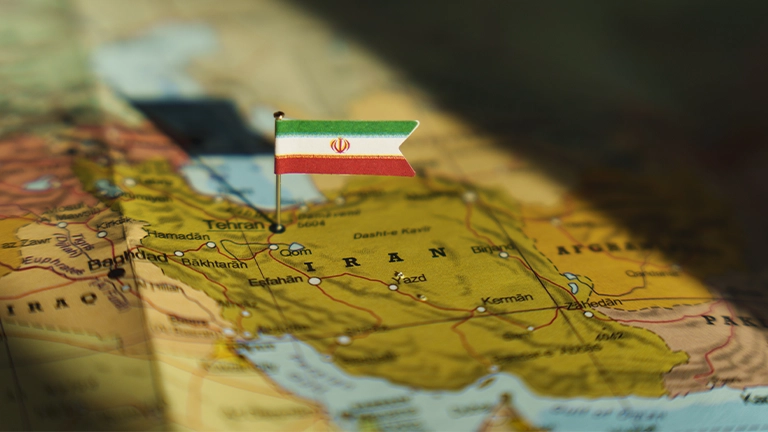
Iran is experiencing one of the most delicate moments of the past decades. In recent weeks, US and Israeli military strikes against Iranian targets — including infrastructure linked to its nuclear program — have intensified a conflict long in the making. Military operations launched at the end of February triggered a series of Iranian retaliatory attacks against military installations and targets in Gulf countries, alongside a sharp rise in tensions in the Strait of Hormuz, one of the world’s most critical energy arteries.
The consequences have been immediate. Maritime traffic in the region has been severely disrupted, and oil prices have surged in a matter of days, reflecting fears of a prolonged interruption in global supply.
Angel Saz Carranza, Director of Esade’s Center for Global Economy and Geopolitics (EsadeGeo), and senior fellow Juan Moscoso del Prado reflect on the situation.
A crisis with global implications
Iran’s strategic relevance extends beyond its regional influence. It plays a central role in the global energy system. The Strait of Hormuz, separating Iran from Oman, channels roughly one-fifth of the world’s oil consumption and serves as a key route for global liquefied natural gas trade.
Iran’s response capacity will be decisive in determining how the conflict evolves. As Saz Carranza notes, “We need to see whether Gulf countries — Qatar, the UAE, Saudi Arabia — eventually step in and join Israel and the US in attacking Iran.”
The most immediate risk, however, lies in the potential disruption of maritime traffic in the Persian Gulf.
“The Strait of Hormuz is the key. How long will it remain closed? Around 25% of global oil passes through it. The impact on oil prices will depend on how quickly the Strait reopens,” explains Saz Carranza.
An effective closure would have direct consequences for global inflation, energy costs and the stability of supply chains.
Current protests in Iran are the largest, most intense, and sustained since the Islamic Revolution of 1979
A regime under internal pressure
The geopolitical crisis coincides with mounting domestic unrest. In recent years, Iran has witnessed some of the most intense protests since the 1979 Islamic Revolution, driven largely by a young, educated population increasingly disillusioned with the regime.
According to Juan Moscoso del Prado, “The current protests in Iran have been the largest, most intense, and most sustained since the Islamic Revolution of 1979. Notably, they are led by a generation under 30 — who represent half of Iran’s population — many of them women and highly educated.”
This discontent has multiple causes. The economy is in deep crisis — inflation is hovering around 40% and the currency has sharply depreciated — despite the country possessing some of the largest energy reserves in the world. Frustration has also accumulated after decades of reform promises that never materialized.
The feminist movement, particularly active since the 2022 protests over women’s rights, has become one of the most visible drivers of social unrest. At the same time, traditionally pro-regime sectors such as the bazaar — the network of urban merchants and entrepreneurs — have begun to distance themselves due to the economic impact of international sanctions and ongoing deterioration.
A fragmented opposition
Despite the scale of social discontent, Iran’s opposition remains deeply fragmented and lacks clear leadership capable of articulating a political alternative.
“It is difficult to define opposition factions, which are barely recognizable domestically. The main dissidents inside Iran have been widely persecuted, imprisoned and silenced, leaving no clear alternative forces,” Moscoso explains.
Some figures have gained prominence in exile, such as Reza Pahlavi, heir to the last Shah of Iran. His visibility has increased during recent protests. However, his connection to internal political dynamics remains limited, and his legitimacy within the population is difficult to gauge.
The absence of organized leadership complicates any potential transition scenario.
Regime change?
External pressure and domestic unrest have led many analysts to raise the possibility of regime change. Yet such a scenario is far from straightforward.
The alignment of the forces that sustain power means that an internal revolution has a limited probability of success.
As Saz Carranza warns, “It creates significant medium-term uncertainty. The objective may be to topple the regime, but without a clear successor. There does not appear to be a figure comparable to Delcy Rodríguez in Venezuela, and the opposition is highly fragmented.”
Moreover, the Iranian regime retains a key element for survival: cohesion among its coercive structures.
The question is unavoidable: how has the system not collapsed despite economic tensions, sustained protests and repression?
The answer lies in the alignment of the forces that uphold power. The regular army, the Revolutionary Guard, the Basij militia and other security apparatuses continue to back the regime. While internal tensions may exist, these groups maintain significant economic and political privileges they are unwilling to relinquish.
In this sense, Iran is not merely a political regime; it is also an economic power structure that benefits those who sustain it. As long as these structures remain cohesive, the likelihood of a successful internal revolution remains limited.
Implications for the international order
The crisis also raises broader questions about the future of the multilateral system. The collapse of the Iran nuclear deal (JCPOA) during Donald Trump’s first presidency marked a turning point in relations between Washington and Tehran.
According to Saz Carranza, “Leaving aside the reprehensible nature of the Iranian dictatorship, from a multilateral perspective Trump unilaterally withdrew from the nuclear agreement (JCPOA) during his first term and is now attacking Iran without regard for the UN Security Council. It appears to be yet another nail in the coffin of the United Nations system.”
European criticism regarding the legality of recent strikes reflects a deeper debate about the erosion of the rules-based international order and the growing dominance of power politics in global affairs.
A turning point for the Middle East
Iran now faces profound vulnerability, both internally and externally. The loss of regional allies, weakening influence networks and damage to military and nuclear infrastructure have altered the region’s strategic balance.
Yet the trajectory of the conflict remains highly uncertain. Its outcome will depend on multiple variables: Iran’s capacity for response, the evolution of domestic protests, the role of regional powers and the increasingly remote possibility of returning to diplomacy.
In an increasingly fragmented international environment, the Iranian crisis is shaping up to be one of the defining geopolitical tests of the 21st century.