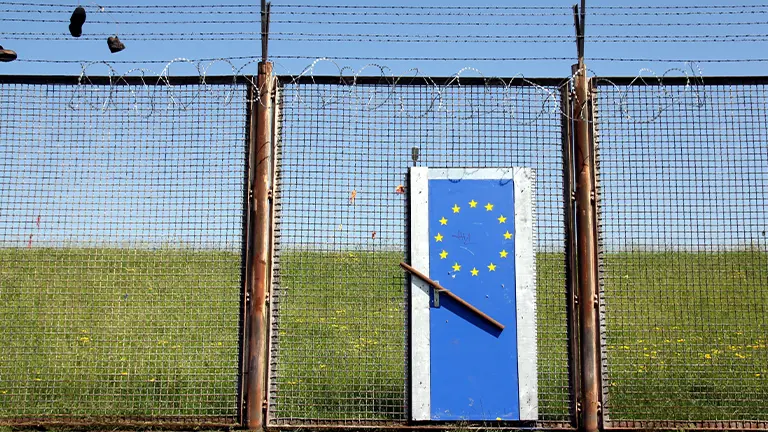

The evolution of asylum: Will the EU’s migration pact cross the political divide?
After many decades of frictions and dissent, it remains unclear if the New Pact on Migration and Asylum will find its way to unite European countries behind common humanitarian principles.

Italy’s far-right prime minister Giorgia Meloni became mainstream last month when the country’s plan to tackle illegal immigration was endorsed by European Commission President Ursula von der Leyen.
Meloni has declared Italy’s policy, which processes people claiming asylum in offshore centers, as “a model to follow.” The remarks come six months after the EU Asylum and Migration Pact was agreed by the European Parliament. But despite a growing consensus against migration amongst Europe’s leaders, many claim the pact fails to deliver.
Will Europe ever be united on the issue of migration? In a case study published by the Esade Center for Global Economy and Geopolitics (EsadeGeo), researchers Ana Olmedo Alberca, Anna Fonts Picas and Walid El-Khatib look back on the evolution of asylum policy in the EU in an attempt to decipher its future.
Attempt at unification
The EU Asylum and Migration Pact was proposed in 2020 and came into force in May 2024. Despite being heralded as a much-needed “fresh start”, critics claim it simply rehashes the Common European Asylum System (CEAS). Multiple attempts have been made to reform CEAS, the majority of which were never implemented. Will the new pact finally achieve the EU’s goal of unifying migration policy?
A steady increase in the number of people attempting to enter Europe has caused ongoing friction among member states
A look back through history suggests not. The origins of CEAS are in the early 90s, when an increase in asylum seekers from Asia and Africa prompted an attempt to unify European immigration policy. A steady increase in the number of people attempting to enter Europe has caused ongoing friction among member states, and multiple attempts to harmonize policy have had varying levels of muted success.
The development of CEAS was broadly split into three five-year phases, each characterized by division and a series of major migration events. The first phase laid the foundations for unification: 1995’s Schengen Agreement removed borders; the 1997 Dublin Convention set out the common criteria for processing asylum applications; the Treaty of Amsterdam in 1999 transferred migration policy power from member states to European Community institutions.
An “unmanageable” influx?
The second phase was designed to deepen cooperation and streamline appeals and access to social benefits — a period that coincided with the arrival of hundreds of migrants in Ceuta, Melilla and the Canary Islands. New initiatives focused on standardizing the criteria for granting refugee status and creating an appeals procedure and sanction mechanisms in case of illegal returns. Also, access to social benefits, integration programs and labor coverage was facilitated by funding from the European Refugee Fund.
This stage also laid the foundations of the Asylum Support Office (EASO), aimed to support Member States in fulfilling their obligations and managing their asylum and reception systems, especially those under particular pressure.
The final phase, which began in 2010, saw the introduction of further reforms geared towards improving the application process and conditions for asylum seekers. But by 2011, the uprisings in North Africa had seen a 50 percent increase in the number of people seeking asylum. States bordering the Middle East and North Africa complained of “an unmanageable influx”, and after 25,000 Tunisian asylum seekers arrived on the Italian island of Lampedusa in 2011, member states began to revolt.
Since 2014, at least 30,838 people have died or disappeared in the Mediterranean trying to reach Europe
In the face of the increasing arrival of people seeking refugee, French president Nicholas Sarkozy demanded a review of the Schengen system, Belgium, Germany and Austria threatened to reintroduce border controls, and France suspended Schengen to prevent the entry of trains from Italy. A coalition led by France and Germany also blocked access from Bulgaria and Romania.
This era was marked by recurring humanitarian catastrophes, the most prominent of which took place on the coast of Lampedusa in 2013. In a matter of a week, two consecutive shipwrecks caused more than 600 deaths, with at least 60 children among them. The tragedy did not spark any substantial change in European policy. The Italian government, though, launched a rescue operation named Mare Nostrum. During the span of a year, it rescued 156.000 people at sea before being cancelled due to lack of funding and an increasing anti-immigration sentiment.
During 2023, at least 3,155 people were confirmed dead or missing in the Mediterranean trying to reach Europe. Since 2014, the figure has reached 30,838 people, according to data from the International Organization for Migration.
Crisis of response
The weaknesses of CEAS were further laid bare during the so-called European migration crisis in 2015, when 1,812,200 people entered Europe via five sea and land routes. The EU attempted to financially support overloaded states, and in 2017 approved the relocation of 120,000 asylum seekers from Italy and Greece across the EU. Nevertheless, the mechanisms to manage the increasing arrival of people proved insufficient.
The relocation was a source of further tension and did little to appease northern and eastern states. Austria, Belgium, Denmark, Slovenia, Hungary, Norway, Sweden and Germany suspended Schengen, Croatia closed border crossings with Serbia, and Hungary, Slovenia and Northern Macedonia erected border fences.
A series of sweeping reforms to CEAS were proposed in two packages — the majority of which were never implemented due to the ongoing disagreements between states. This gridlock continued until the EU agreed to introduce the New Pact on Migration and Asylum.
A relatively fresh start
In an attempt to settle longstanding arguments and ease the burden on countries with the largest influx of asylum seekers, the new pact introduces mandatory contributions from all member states. It also places increased responsibilities on countries at the EU’s external borders, which will be responsible for the reception, screening and processing of people seeking asylum.
The emphasis on stronger border and migration management through partnerships with third countries will see enhanced support and resources for border states and their neighbors. And to address the decades-old issue of inconsistent implementation, the pact replaces existing directives with new regulations.
They include:
- The screening regulation for irregular third-country nationals, enabling national authorities to conduct health and vulnerability assessments and determine appropriate procedures.
- The asylum procedures regulation to streamline asylum, return, and border processes.
- The asylum and migration management regulation — a mandatory but flexible solidarity mechanism triggered during times of disproportionate pressure.
- The crisis and instrumentalization regulation, which grants member states the ability to deviate from standard rules during crisis situations.
- Monitoring, tracking and enforcement using Eurodac, the EU’s asylum fingerprint database.
Still divided
Perhaps unsurprisingly, given the fractious history of European migration policy, the pact has attracted widespread criticism.
The majority of responsibility for receiving refugees still lies with external border states, and subjective wording allows for waivers depending on the interpretation of the instruments. And, despite the longstanding aim to unify policy, the pact places significant decision-making powers into the hands of member states.
Member states also have the option of making financial contributions instead of hosting — allowing those with the available means to effectively buy their way out of responsibility.
The gap between support and opposition remains wide: Germany and France are in favor; Spain, Italy, Greece, Malta and Cyprus remain skeptical; Eastern European states staunchly object.
A failure in human rights?
Among the shortcomings of the New Migration Pact, many claim it falls short of minimum human right standards. The agreement allows member states to avoid full compliance whenever a “crisis”, “instrumentalization of migrants” or “force majeure” arise, although these concepts remain undefined.
Human right organizations worry that the pact poses a significant threat to the right to asylum. It allows detaining asylum seekers for up to 12 weeks, during which they’re legally considered to be outside European territory. Also, it introduces expedited border procedures that risk proper procedural standards and may limit applicants’ access to legal advice and appeal of decisions.
In addition, the introduction of the novel concept of “safe third country”, which loose definition is up to each member state to decide, enables the rejection of applications if alleged protection and no risk of persecution or removal are ensured in a different country.
Based on these examples, over 160 civil society organizations have condemned the pact, claiming that it severely limits the right to asylum and jeopardizes access to justice. After almost five decades of friction and infighting, it remains to be seen whether Europe will finally unite behind common humanitarian principles.