The face we don't want to see, but it has a name and surname
Nobody admits to being aporophobic, yet the rejection of the poor is part of everyday life: in those forced to sleep on the streets and in the way we look away.
| Click here to access the official publication Miradas sobre la aporofobia, produced by the Decent Housing Observatory, Esade Institute for Social Innovation, together with IQS, Ramon Llull University, and in collaboration with the “la Caixa” Foundation. |
For a long time, anyone who felt rejection toward a poor person didn't even have a word for what they were doing. They could call it prudence, safety, public order. Any term that would allow them to justify that rejection. They could call it anything except what it was. The philosopher Adela Cortina had to go back to ancient Greek —ápōros, without resources, without a way out; phóbos, fear— to coin in 1995 a word that is now repeated in forums, reports and over the dinner table: aporophobia.
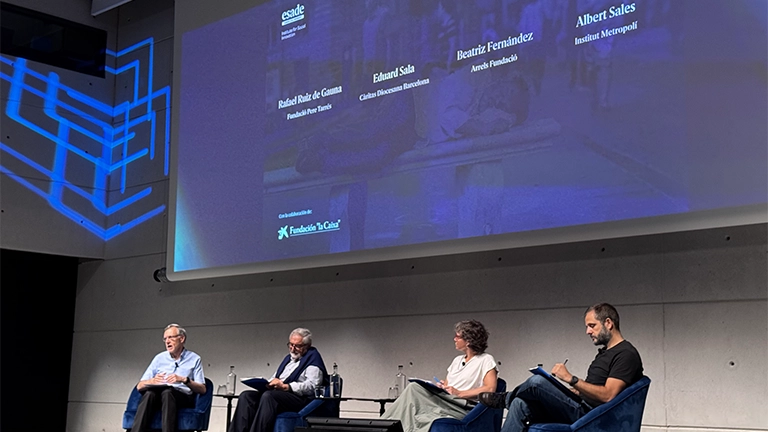
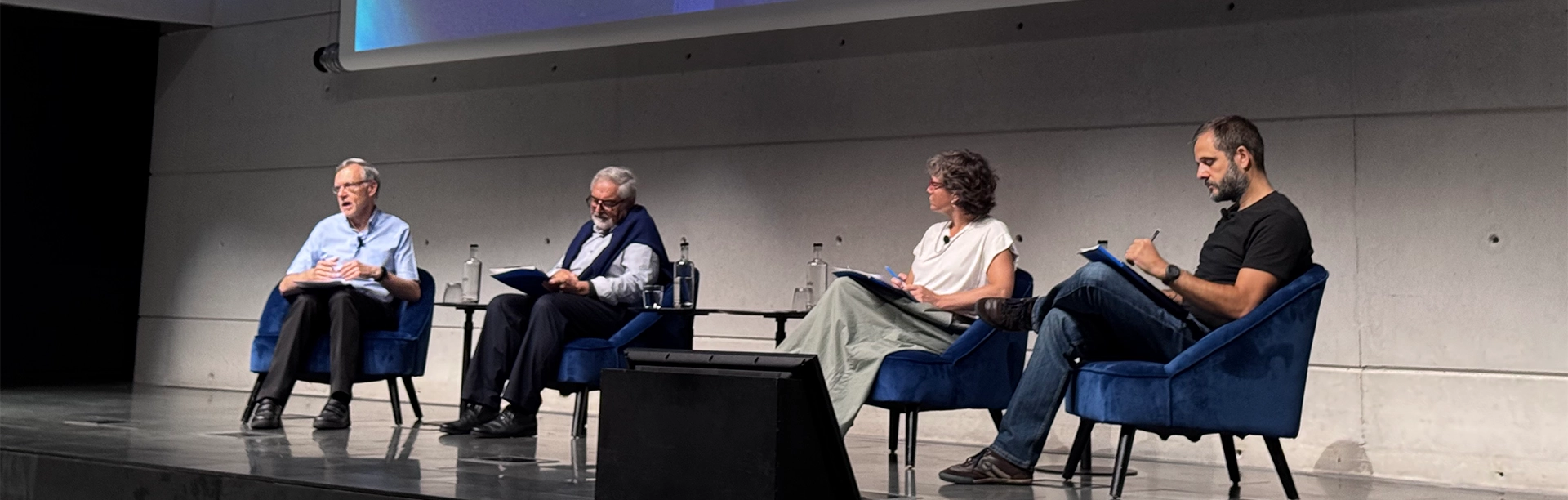
It is not the same as xenophobia, although the two often go hand in hand. The foreigner who arrives with investments, with a footballer's passport or with petrodollars does not necessarily provoke rejection. The one who may arouse contempt is the one who arrives empty-handed, who doesn't seem to have anything to offer in return. That is why aporophobia is not, as Rafael Ruiz de Gauna reminded us in his opening remarks at the event Miradas sobre la aporofobia, organised by the Decent Housing Observatory at Esade, the Institute for Social Innovation, and IQS, in collaboration with the “la Caixa” Foundation, a mere discomfort with poverty as an abstract problem. It is something more intimate and more uncomfortable: it is the way we look at the specific poor person and decide, almost without realising it, whether they deserve to be treated as someone with dignity or as a threat, a burden, a nuisance.
That precision matters because, as long as we speak only of "poverty" as a phenomenon, we can go on feeling generous, understanding, supportive in the abstract. The problem begins when that poverty has a face, a name and a specific story. That is where it is tested whether we truly believe in people's dignity or merely preach it.
Rejection in our everyday lives
The most disturbing thing about aporophobia is not necessarily the insult shouted in the street —that, at the very least, can be heard— but its domestic version: the one that creeps into a form, a requirement, an office schedule. Beatriz Fernández, head of Arrels Fundació, explained it with examples that anyone could imagine and which, nevertheless, we do not always identify as discrimination: an appointment that can only be requested online, which matters little however good your coverage is if you have neither data nor battery. Or, beyond that, if you don't even have an electronic device; a procedure that requires a fixed address in order to access aid intended, precisely, for those who have no fixed address; a document that can only be issued by an office other than the one requesting it, forcing you into an administrative pilgrimage that anyone with resources would resolve in an afternoon and, in some cases, with the help of a lawyer.
The procedure, on the face of it, is the same for everyone. But the starting point is not, and a neutral procedure applied to unequal people does not produce equality: it can produce exclusion with the appearance of legality.
Fernández also put on the table a particularly illustrative example: certain offences can carry a fine that has very different consequences for someone with resources than for a person without them. When certain financial obligations cannot be met, the consequences can worsen. The example served to show how the same rule can have very different effects depending on the economic situation of the person who must comply with it.
And then there is suspicion, that invisible filter applied to those who ask for help but not to those who ask for a mortgage: having to prove that you are "trustworthy", that you deserve the help before receiving it, when nobody else is required to prove that they deserve what they already have.
The city that keeps order by expelling
Aporophobia has its urban planning, too. Albert Sales, who has spent years studying the management of public space, pointed out an asymmetry as simple as it is revealing: the same drunken episode can be a weekend anecdote or a punishable offence, depending on whether it takes place on a bar terrace or on the bench next door. The act doesn't change. What changes is who commits it.
The so-called civility ordinances —which proliferated from the early 2000s— were viewed critically during the event. Sales questioned whether these policies have helped resolve the root causes of certain problems of coexistence, and he pointed to the risk of building a "showcase" city: clean, orderly, attractive to tourists, but more uncomfortable for those who live in it without consuming in it. Talking about "urban cleanliness" when what is really meant is homeless people, or about "insecurity" when the underlying problem is access to housing, can shift the debate toward individual behaviour and push structural causes into the background. For Sales, that is one of the keys: turning a social problem into a problem of individual behaviour.
Because that is also where the trap lies that, according to the participants, upholds part of this architecture: convincing us that if someone lives on the street it is because of something they did, not because of something that happened to them. We individualise poverty —merit, effort, personal success as the only explanations— and so we stop looking at the structural causes: the price of housing, the labour market, protection systems that fail to reach people. When someone asks "what must this person have done to end up there?", they are in fact formulating the question that lets them avoid feeling responsible for anything.
The hatred we have inherited without fully buying into it
There is an idea running through much of this conversation that is especially uncomfortable: young people do not invent rejection of the poor, they inherit it. Eduard Sala, of Cáritas Diocesana de Barcelona, spoke of a generation raised with an "anaesthesia of hope", which has received from adults the message that there is no future, that it is every man for himself, that failure is always personal and never structural. That ignorance about the real causes of inequality is not exclusive to young people —adults, he said, share it to the same degree— but on social media it finds an unforgiving loudspeaker: short messages, without nuance, designed to generate a sense of belonging through a common enemy.
And hatred, when it needs an enemy, can find it sooner in the person in front of us than in the institution that is really failing: the poor neighbour, the migrant, the one who "is going to take" our job or our home. It is easier to point at whoever is in front of us than to demand accountability from those who design public policy. Sala compared it to Berlin in 1932: an exhausted society, a real discontent, and someone offering an enemy before a solution. You don't need a century's distance to recognise the pattern.
That is where aporophobia becomes intertwined with racism and xenophobia without being confused with them. Beatriz Fernández insisted on a key distinction: rejection may be directed at the condition of poverty before it is directed at foreign origin. And when both conditions coincide —the undocumented migrant, with no network, no address— the difficulties multiply in a circle that is hard to break: administrative and employment barriers can reinforce one another. Migration policies and social inclusion policies, when they do not talk to each other, can contribute to making situations of vulnerability chronic.
Hope as a task, not a feeling
Faced with such an uncomfortable diagnosis, none of the three offered easy comfort. They offered tasks. Sales called for defending unapologetically what already works —Housing First policies, unconditional cash transfers to people experiencing homelessness, which have for years been showing results wherever they have been tried— instead of surrendering to the discourse of merit and suspicion. Sala asked for something harder still: not to give an inch to hate speech, because discrimination is never "just information" or "just opinion". Fernández closed with what may be the simplest and most difficult idea of the whole afternoon: raising awareness of vulnerability and dependence, and understanding that guaranteeing rights cannot depend on goodwill, but on mechanisms that make them enforceable.
None of us has always been strong, always solvent. None of us has always been safe. We have all depended, as children and even as adults, on someone deciding to care for us without asking anything in return; many of us will depend, in old age, on that same willingness in others not to look at us with suspicion. Aporophobia is not a character trait of especially cruel people: it is a collective, learned habit that can disguise itself as common sense. And like any learned habit, it can be unlearned. The question left hanging after hearing all this is not so much what the poor person must have done to be there, but what we can do so that ceasing to be there does not depend on proving that one deserves it.