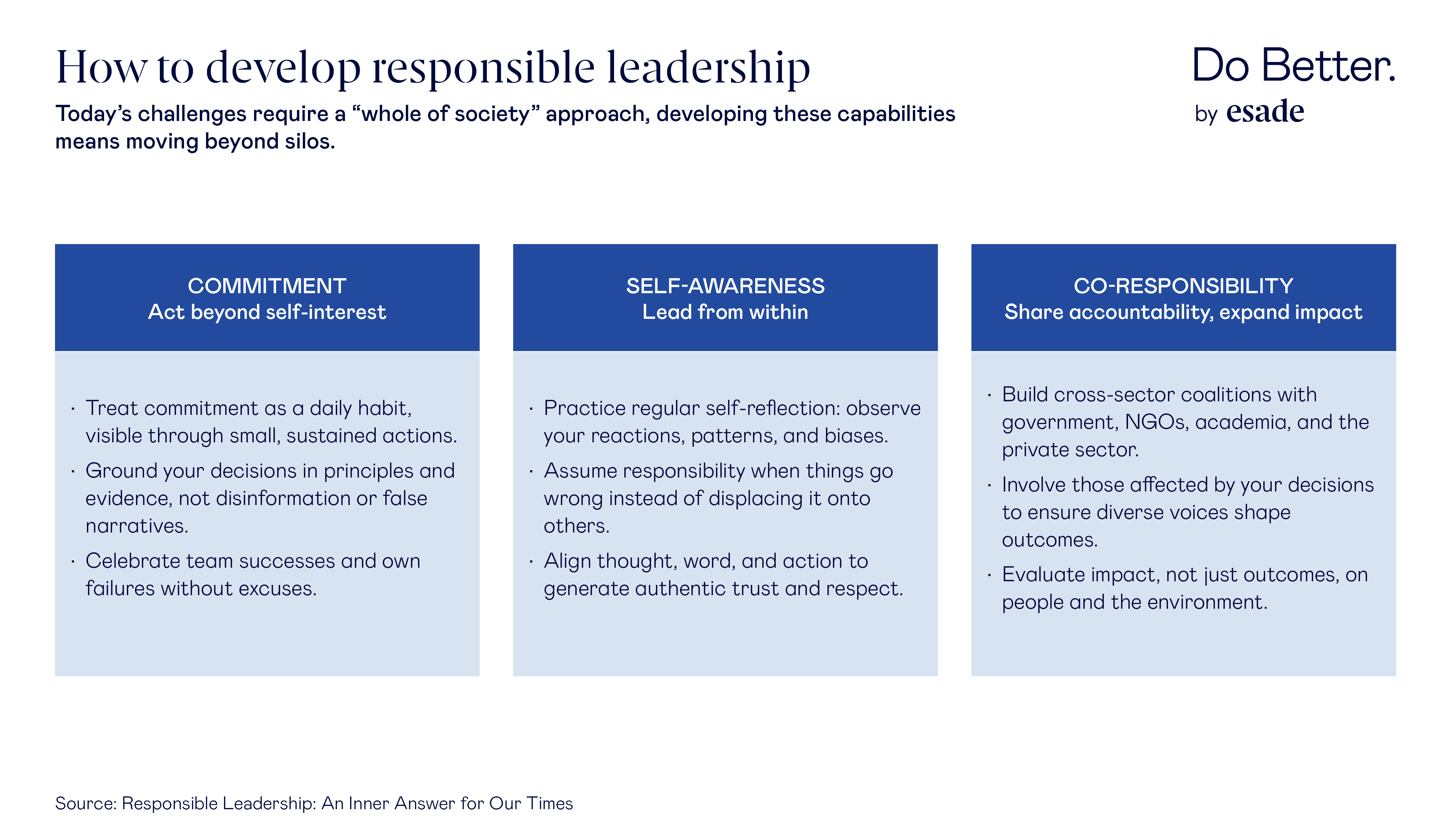

Responsible Leadership: An inner answer for our times
The world is confronted with global challenges. Inequality, climate change, pandemics: too big to be tackled at national level, they require a whole of society approach, which can only be achieved through trust.

Today’s defining challenges—inequality, climate change, pandemics, and displacement—are global in scale and too complex for governments to solve alone. They demand a whole-of-society approach in which the public sector collaborates with businesses, NGOs, academia, and civil society. Such cooperation depends on shared accountability and trust across institutions and communities.
The Edelman Trust Barometer, which has tracked public trust for 25 years, shows a steady erosion of confidence in institutions and leaders. Its 2026 edition highlights a further decline marked by growing insularity: distrust has become the default, with only one-third of people believing most others can be trusted. Dialogue and compromise are giving way to polarization, nationalism, and a focus on individual gain over collective progress.
Economic insecurity driven by globalization and technological change has deepened political divides, while many believe governments and businesses serve only the wealthy. The COVID-19 pandemic fueled skepticism toward authority and science, and rising geopolitical tensions have strengthened nationalist attitudes. In this climate, renewed cooperation among governments, businesses, media, NGOs, and multilateral institutions such as the United Nations is essential to rebuild trust and enable sustainable growth and prosperity.
This study has been conducted by Roque Adrada, Career Lead for Undergraduates at Esade Business & Law School; Irene Orce, Life Coach; and Jordi Passola, Chief of Private Sector Partnerships Service Europe at UNHCR, the UN Refugee Agency.
Emerging as a necessary response
There is a need for collective intelligence to enable coalitions across interconnected areas including climate, development, displacement, security, and technology. There is a need for long term view, based on principles, scientific evidence and reason versus disinformation, false narratives and short-term vested interests.
Against this backdrop, responsible leadership emerges not as an abstract ideal, but as a practical and necessary response to today’s global challenges. Unlike traditional leadership models primarily focused on authority, efficiency, or short-term performance, responsible leadership is grounded in a deeper sense of commitment, self-awareness, shared accountability, and ethical decision-making. It recognizes that leadership is exercised in relationships with others and that its impact extends beyond organizational boundaries to society at large.
Understanding how responsible leadership manifests in practice—and how it can be developed at all levels of an organization, is therefore essential to restoring trust, enabling collaboration across stakeholders, and delivering sustainable, long-term value.
Leadership should not be defined by authority or position, but by the quality of the decisions individuals make and the impact those decisions have on others and on society. In an increasingly complex and interconnected world, responsible decision-making cannot be improvised; it is the result of a set of foundational leadership capabilities that shape how leaders think, relate, and act.
Understanding responsible leadership
A connected leader does not use people as pawns in a cold game; rather, recognizes that the human dimension is what generates real change and promotes the desired transformation. Tools such as active listening, presence, and conflict management mark the path of the authentic leader. And it all begins with self-knowledge. A good leader knows what they have and what they lack, has integrated their talents and accepted their limitations. Moreover, they understand that the team always adds more than the individual. In short, they know who they are, where they are going, and have learned to master their own mind.
Leadership and power go hand in hand, but authentic power does not lie in giving orders but in integrating the team's vision into common objectives. Only in this way can one move from rowing a galley to leading a rowing team and thus reach safe harbor.
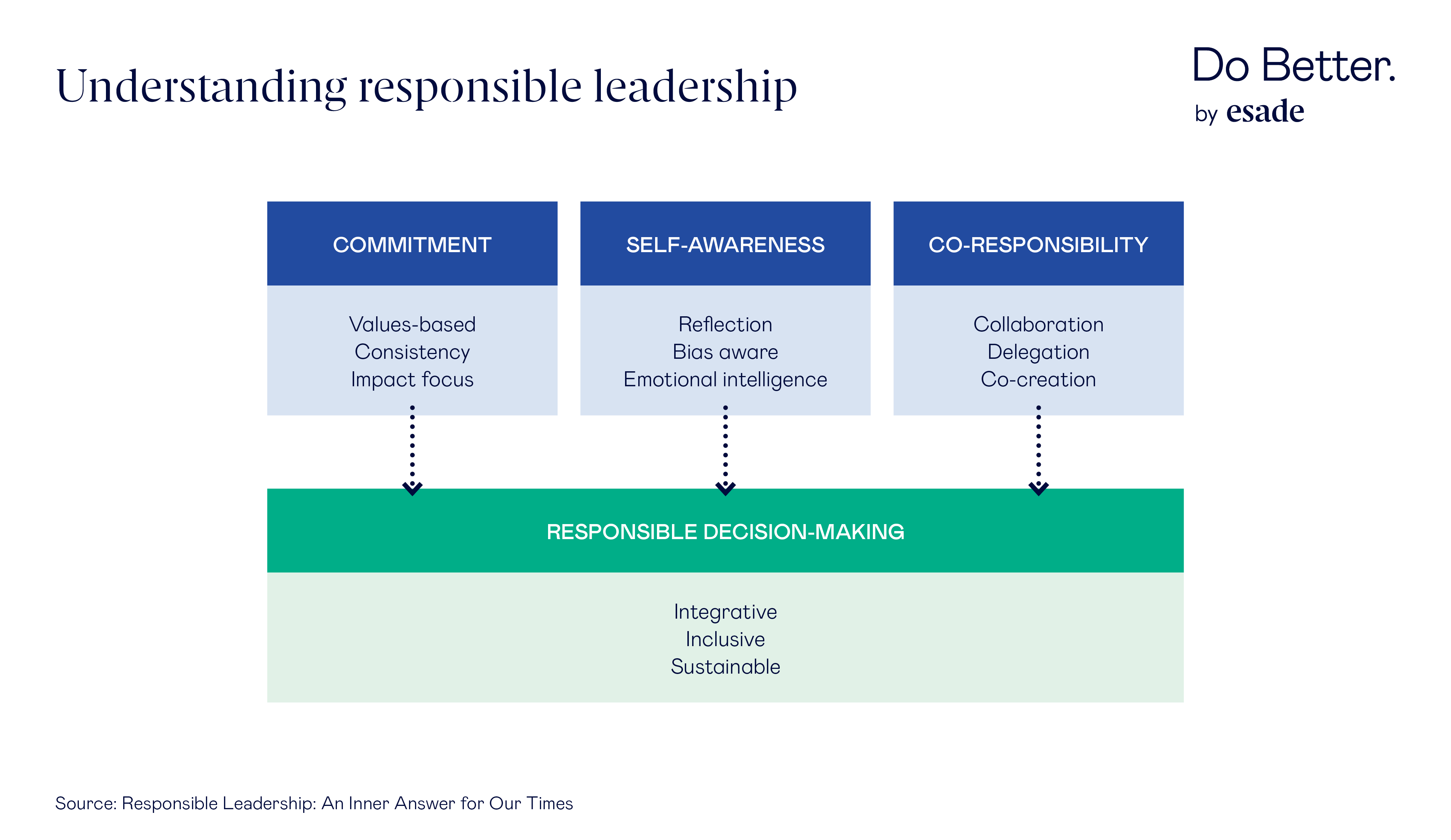
How responsible leadership manifests: the three pillars
Unlike traditional models that prioritize authority and short-term efficiency, responsible leadership is grounded in the quality of relationships and the long-term impact of a leader's actions. It manifests not through a title but through the integration of three foundational pillars: commitment, self-awareness and co-responsibility.
Commitment
Deep commitment extends beyond personal or organizational gain to include the well-being of teams, the progress of society, and a dedication to continuous self-improvement. The first step to being a good leader is to commit to self-knowledge. To serve others and a greater purpose, we first need to learn to lead ourselves: manage our emotions, know ourselves, and act with coherence.
Aligning capabilities and possibilities, "seeing" others, and making each person who is part of the structure shine is one of the greatest responsibilities of leadership. Commitment is not a declaration, but a daily choice reflected in consistent actions: taking on challenges, making responsible decisions, and maintaining integrity even when it puts our image at risk. That way, leaders build trust, not by asking "what do I want to achieve?" but "what does each person on my team need to achieve their goals?"
Self-Awareness
Commitment is guided by self-awareness, a foundational capability that shapes how a leader thinks and relates in an increasingly interconnected world. Research suggests that leaders with high levels of self-awareness tend to achieve better results and, also, generate greater satisfaction and trust in their teams. Self-awareness is not an innate trait exclusive to a few: it is a competency that can be developed. It is associated with better emotional management, greater capacity to understand strengths and limits, and better performance in team contexts.
Leadership begins within: it is necessary to ask ourselves who we are, what we need to lead with integrity, and how we align thought, word, and action. This internal coherence generates trustworthiness and respect.
Co-Responsibility
Furthermore, responsible leadership manifests as co-responsibility, where accountability is shared among shareholders and a wider circle of stakeholders, including the environment and the community. This also implies knowing how to choose the right people, delegate, trust, and empower. This is how a flexible and solid fabric is built—like a spider's web—capable of sustaining challenges and cushioning conflicts. Hence the urgency of committing to responsible leadership based on commitment, self-knowledge, and shared responsibility. Its foundation is integrative, inclusive, and sustainable decision-making.
Unlike traditional leadership, responsible leadership incorporates the team's vision, offers space to grow, and grants trust so that each member develops their own decision-making capacity.
No one is indispensable—not even the leader—so it is advisable to prepare the team to sustain their absence. In this sense, the leader adds value like an orchestra conductor: calculating tempos, managing flows, and converting collective effort into harmony.
Responsible decision-making: the convergence of the three pillars
When commitment, self-awareness, and co-responsibility are aligned and practiced consistently, they naturally converge into responsible decision-making—the ultimate manifestation of this leadership model. This is not a standalone skill that can be developed in isolation but rather the integrated result of cultivating the three foundational pillars.
Responsible decision-making is characterized by three qualities:
- Integrative: It considers multiple perspectives and seeks solutions that create value across different stakeholder groups.
- Inclusive: It actively involves those who will be affected by the decision, ensuring that diverse voices contribute to shaping outcomes.
- Sustainable: It prioritizes long-term impact over short-term gains, considering consequences not just for the present but for future generations.
In practice, this means that, before making a decision, a responsible leader asks: Does this align with my commitment to teams, society, and my own growth? Am I aware of my biases and how my values are influencing this choice? Have I engaged the relevant stakeholders and considered the broader ecosystem of impact? These questions transform decision-making from a transactional act into a relational practice—one that builds trust, repairs social fabric, and creates sustainable value.
The leadership the future needs
In times of unprecedented distrust and social fragmentation, responsible leadership is no longer an abstract ideal but a necessary strategy for survival, growth, and prosperity. As traditional institutions face mounting pressure and public confidence erodes, the need for a leadership approach that transcends organizational boundaries and embraces shared accountability has never been more urgent.
Responsible leadership is a response to the current challenges of society and organizations. Beyond hierarchical authority, it consists of serving, connecting, and transforming. This form of leadership not only improves organizational performance and effectiveness but also generates more human, sustainable, and resilient environments.
Ultimately, the leadership the future needs is one that recognizes we are all architects of the collective good. It is a leadership that understands that no single entity—whether government, business, or civil society—can solve today's challenges alone. In this vision, every decision made with integrity, no matter how small or at what level it is made, contributes to a more stable, resilient, and inclusive world. This is the leadership capable of not only responding to crisis but of building the foundation for a future where trust is restored, grievances are addressed, and prosperity is shared by all.