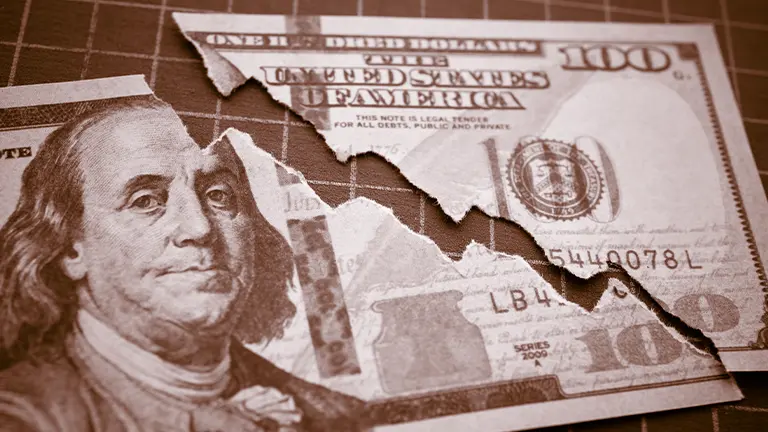

Self-inflicted damage: How Trump's political gambits undermined growth
The data available following President Trump’s tariff announcements on Liberation Day point to a self-inflicted economic slowdown and rising inflation. The risk of stagflation keeps increasing.

After months of speculation sparked by President Trump’s “Liberation Day” tariff proclamations—and the flurry of contradictory follow-up statements—the wait for hard data is over. The first quarter GDP report for 2025 is in, and it offers a sobering verdict. According to the Bureau of Economic Analysis, the US economy contracted by 0.3% on an annualized basis—the first decline since early 2022. Simultaneously, inflation surged, with the core Personal Consumption Expenditures (PCE) index climbing to 3.5%, up from 2.6% in the previous quarter. Inflation has now meaningfully diverged from the Federal Reserve’s 2% target, complicating the path ahead for policymakers.
A sudden surge in imports
A key driver of the contraction was a staggering 41.3% increase in imports—the second-highest quarterly jump on record, eclipsed only by the third quarter of 2020, in the depths of the COVID-19 economic shock. This surge reflects a wave of stockpiling by firms bracing for higher tariffs. Ironically, this rush to import goods—particularly from China—has widened the US trade deficit, the opposite of what the Trump administration claimed its tariff policy would achieve.
The rush to stockpile goods in the face of an impending tariff increase has widened the US trade deficit
From a national accounts perspective, imports subtracted 4.83 percentage points from GDP growth. But it's important to clarify a common misunderstanding: imports don’t inherently reduce GDP. In fact, imports are first counted as part of consumption (C), investment (I), or government spending (G). When a US firm imports $1 billion of goods—say, $500 million in consumer electronics and $500 million in machinery—those amounts are recorded as part of C and I. The subtraction happens later, in the net exports component (exports minus imports), to avoid double-counting. Thus, the "negative" impact of imports is more of a statistical adjustment than a direct economic loss. The recent explosion in imports distorted the GDP headline number without capturing the real shifts in economic behavior.
So where did those imports go? The data points to two main destinations: inventories and equipment investment. Inventory accumulation rose by $140.1 billion, contributing 2.25 percentage points to GDP, while investment in equipment surged at an annualized rate of 22.5%, led by computers and electronics. This likely reflects precautionary hoarding by businesses aiming to get ahead of looming tariffs. While this burst of investment may seem like a positive sign, it’s more likely a temporary spike—front-loading activity that could reverse in future quarters.
The counterintuitive effect on domestic products
To better understand underlying economic momentum, we can look at a measure popularized by former Obama economic adviser Jason Furman: core GDP, or real final sales to private domestic purchasers. This metric strips out the more volatile components of GDP, such as exports and government spending, and is often a more reliable predictor of future economic growth. Encouragingly, core GDP grew by nearly 3% in Q1—roughly in line with previous quarters—suggesting that domestic demand remains fundamentally solid.
The data suggests that consumers and firms are increasingly favoring foreign over domestic products
But the stable growth in core GDP obscures a deeper trend: substitution. The surge in imports alongside a contraction in total GDP suggests that consumers and firms are increasingly favoring foreign over domestic products. This shift doesn't immediately show up in core GDP, but it could have longer-term consequences for US manufacturing and job creation. In essence, the strong core GDP figure may be masking significant sectoral pain.
Final sales declined across both durable and nondurable goods. Notably, two sectors saw substantial drops: motor vehicles and personal computers. That’s particularly ironic, given that automobiles are one of the industries the Trump administration has prioritized for domestic revival. While businesses stockpiled computer hardware as part of their equipment investment, consumers sharply cut back on buying the same products. In fact, if we strip out motor vehicles and computers from the data, GDP would have grown by approximately 0.5% in Q1—underscoring the distortionary effect of these sectors.
Risk of stagflation
Despite the headline contraction, a recession is not imminent. The strength in core GDP points to a resilient domestic economy that still has room to grow. But growth is likely to decelerate in the coming quarters as the sugar high of precautionary investment fades and the full drag of trade uncertainty kicks in. A more realistic outlook for Q2 is modest growth, perhaps around 1%.
The US economy remains fundamentally strong—but it’s being tested by self-inflicted wounds
The bigger concern is inflation. The 3.5% reading on core PCE suggests that prices are already absorbing the effects of anticipated tariffs. And this is just the beginning. Real-time price trackers show that inflation is accelerating, with several indicators pointing to a possible rise toward 4% by year-end. If tariffs continue to roll out as planned, inflation could remain elevated well into 2026.
This sets up a classic stagflation risk: inflation rising, growth slowing. For the Federal Reserve, this is the worst of both worlds. Hiking interest rates to fight inflation could further weaken an already slowing economy. But cutting rates would only fuel price increases. To make matters worse, the Trump administration has already begun pressuring Fed Chair Jerome Powell to lower rates. If growth stalls further, these attacks may intensify, threatening the Fed’s independence—one of the pillars of US monetary credibility. Undermining that independence could send shockwaves through financial markets and erode global confidence in the dollar.
In short, the US economy remains fundamentally strong—but it’s being tested by self-inflicted wounds. The first 100 days of the Trump administration have delivered a painful lesson in economic cause and effect. A recession is not yet on the horizon, but it is inching closer with each trade barrier. Unless tariffs are rolled back after the current 90-day pause, the full brunt of these policies will be felt in 2025 and 2026. This is the first negative dividend of Trump’s return to the White House—and it took less than four months to arrive.