

Universities and plant-based diets: A necessary shift for climate action
Our animal food system raises several ethical concerns regarding climate change, inequality, and animal cruelty. Universities should be at the forefront to close the gap between the values we profess and the ones we act upon.

“A vegan diet is probably the single biggest way to reduce your impact on planet Earth” — Joseph Poore, University of Oxford.
Universities play a crucial role in shaping societal norms and values. They are not only centers of education but also incubators of ideas and drivers of social change. In recent years, the global educational agenda has increasingly addressed the climate crisis with the purpose of generating integrative solutions to this imminent threat. However, institutional efforts to transform our unsustainable food system are still missing, particularly in relation to animal agriculture.
Despite the ample scientific evidence of the animal-based food contribution to climate change (IPCC), it seems there is a lack of awareness in universities of the necessary food system change. On the one hand, sustainability curriculums do not give sufficient attention to the food system and the greater ecological impact animal-based food generates in contrast to plant-based food. On the other hand, university menus predominantly offer animal-based foods, upholding the current unsustainable dietary norms instead of advocating for healthier choices for our planet Earth, humans, and non-human animals.
Sustainability curriculums do not give sufficient attention to the food system
Then, what is the role of universities in addressing the unsustainable and degenerative animal-based food system?
In accordance with a recent LANCET Committee report, I suggest that universities should lead the transition toward a plant-based food system. This includes a progressive change in cafeteria menus and catering at conferences, seminars, and events. The committee highlights that research shows how universities can significantly reduce their ecological impact, reduce costs, and provide healthier and more inclusive diets. Meanwhile, universities can play an active role in changing unsustainable behaviors at the societal level as they are microcosms where habits are formed, attitudes are shaped, and ideas for the future are generated.
Animal agriculture and the environment
A recent study by Oxford University scholars unveiled the ecological impact of several agricultural foods (from production to disposal). Results show that animal products such as beef, dairy, poultry, and fishery generate a greater environmental impact than plant-based foods. As shown below, land use changes for animal agriculture and farm activities account for the most significant ecological damage.
The most direct influence of animal agriculture on land use is related to deforestation, which affects important biological and chemical cycles while destroying habitats for thousands of species. In fact, according to World Wide Fund (WWF) research, animal agriculture is the single greatest cause of deforestation globally. Extensive cattle activity is estimated to account for approximately 80% of deforestation in the Amazon rainforest.
Greenhouse gas (GHG) emissions from farming activities are another relevant aspect to consider. It has been argued that even if all non-food GHG emissions were halted immediately, emissions from the food system would still fail to achieve the Paris Agreement targets. And the problem is not only about carbon dioxide (CO2): another heat-trapping gas is methane, which is 30 times more powerful than CO2 over a period of 100 years. This gas is mainly produced by cattle and sheep, ruminants that have a complex digestive system.
Transportation only accounts for 0,05% of the total emissions generated by livestock
Others may argue that eating Km0 meat is more sustainable as transportation emissions are slowed down. Km0 refers to goods produced and consumed within a certain radius, usually not more than 100km (approximately 62 miles). However, did you know that transportation only accounts for approximately 0,05% of the total emissions generated by livestock?
Furthermore, water pollution is a central element in discussing animal agriculture. Animals generate large quantities of manure, which contains nitrogen and phosphorus. Due to rain and water infiltration processes, the manure can wash off fields and end up contaminating water bodies. The imbalance of these elements is destabilizing global nutrient cycles and ecosystem processes.
Also, raising livestock demands a lot of water. A study by the University of British Columbia shows that animal agriculture requires significantly more water than legumes, fruits, and vegetables. One pound of beef takes around 1,800 gallons of water (39 full bathtubs) in contrast to 49 gallons of water for a portion of black beans. In times of water scarcity and severe droughts in many parts of the planet, this should also matter.
Animal agriculture, society, and your health
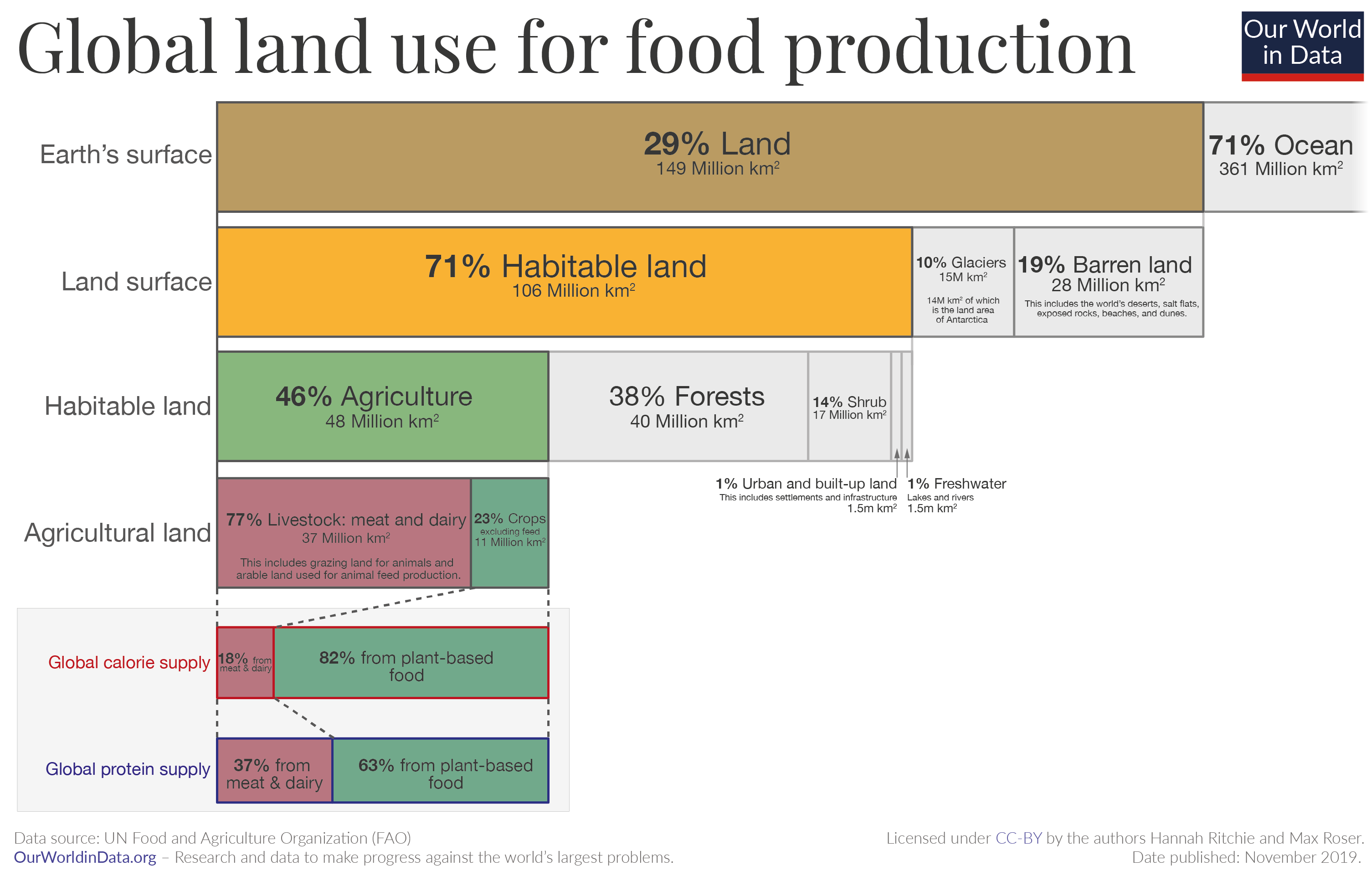
There is a long list of ways in which animal agriculture impacts society. Besides the clearest example of GHG and overall global warming, it also increases food accessibility inequalities. Did you know that livestock occupies 77% of agricultural land but only contributes to 17% of global calorie supply and around 33% of protein supply? This disproportionate ratio shows that we are using a huge number of resources, polluting ecological systems, and killing trillions of animals for a relatively low nutritious contribution. In the case of the EU, approximately 62% of cereal crops are used as animal feed, 12% for biofuels and industry, and only 23% goes for human consumption.
You may be wondering, ‘Well, what about our protein sources?’ — which was the first thing my grandmother asked me when I told her I’m eating plant-based. We can obtain sufficient and healthy amounts of protein from a variety of plant-based sources. For example, legumes (beans, lentils, peas), soy-based products, nuts and seeds, and whole grains are rich in protein.
According to the LANCET Committee and a vast amount of existing and emerging research, a balanced plant-based diet can help lower the risk of diabetes, heart disease, blood pressure, and certain types of cancer. In fact, it has been suggested that people who follow a carefully plant-based diet, incorporate dietary characteristics associated with longevity benefits and lower disease rates. Thus, universities that embrace plant-based menus can help improve overall campus well-being in the long term while generating awareness of a necessary shift.
Ethical dimension and final thoughts
In addition to the environmental and social reasons for universities transitioning to a plant-based food system, diverse ethical concerns also come into play. Social justice and resource distribution is another ethical consideration. It’s noteworthy that the livestock industry continues to receive substantial subsidies.
A recent analysis of lobbying and subsidies in the EU showed that novel technologies for animal-based food receive 1,200 times more public funding than plant-based food. This undermines the possibility for innovation and investment in a more sustainable and healthier food system. Universities can make a clear divestment from the animal-based food system and instead redirect funds to innovations around plant-based food. Actions like this one on a larger scale can generate systemic change.
Another ethical issue is animal cruelty. If I hit a dog in the street, people will shout terrible things at me, maybe hit me back, or even call the police. But what if I hit a pig, cut its tail, pull its teeth out, and leave it caged for a couple of months — something that actually happens — before killing it for my BBQ? Should this be perceived as acceptable? Who cares, after all?
This occurs when we hold conflicting beliefs, something called cognitive dissonance. It also points to the ways in which our food system operates – with a cloak of invisibility. In fact, most of us are aware of how animals are treated through the entire process until they end up on our plates. We live in an age of alienation regarding where our food comes from, particularly animals raised for food.
Universities can break the cognitive dissonance between the values we profess and the ones we act upon
By adopting a plant-based food system, universities can advocate for kindness and compassion toward other animal species — remember, we are all animals, and any form of violence should not be perpetuated. Plant-based universities can help break the cognitive dissonance between the values we profess and the ones we act upon. We could then reproduce a more consistent, integrative, and sustainable value system.
Esade’s values, for instance, are based on the Ignatian spirituality that promotes integrity, compassion, diversity, the common good, social justice, and sustainability. Thereby, transitioning toward a plant-based food offering may be seen as an opportunity for our community to align these values with our dietary choices.
Undoubtedly, educational institutions are great places to enforce social movements so, why not promote a dietary change such as the one exposed here? However, these initiatives require enormous cooperation and collective action. Going back to the initial question, I encourage you to think: What is the role of university in this matter?
I’m not telling you to go vegan, a lifestyle and value system that rejects any type of animal exploitation (from animal testing to clothing). Instead, I invite you to think about plant-based universities, free of animal cruelty, more sustainable, and ethically compromised with a flourishing future. My second invitation is for you to follow the Plant-Based Universities and the Plant-Based Treaty, which are grassroots movements that put animal agriculture at the forefront of efforts in combating the climate crisis!