The UN at 80: Why it still matters—and where it falls short
The United Nations founding mission—to replace the rule of force with the force of law—faces an existential test. Can the world’s most ambitious experiment in multilateralism still hold together?

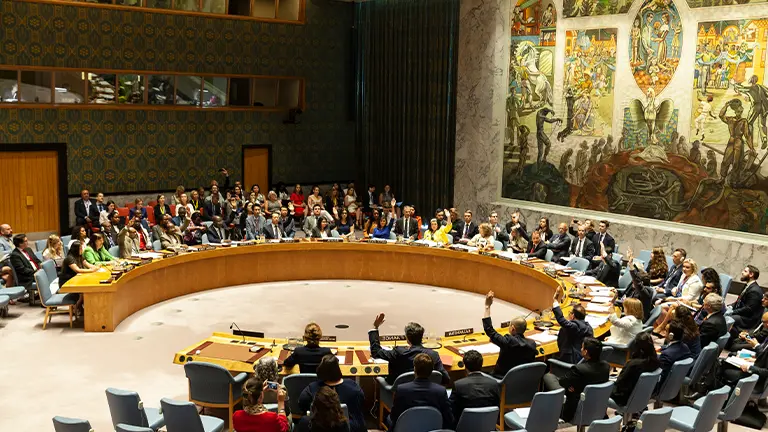
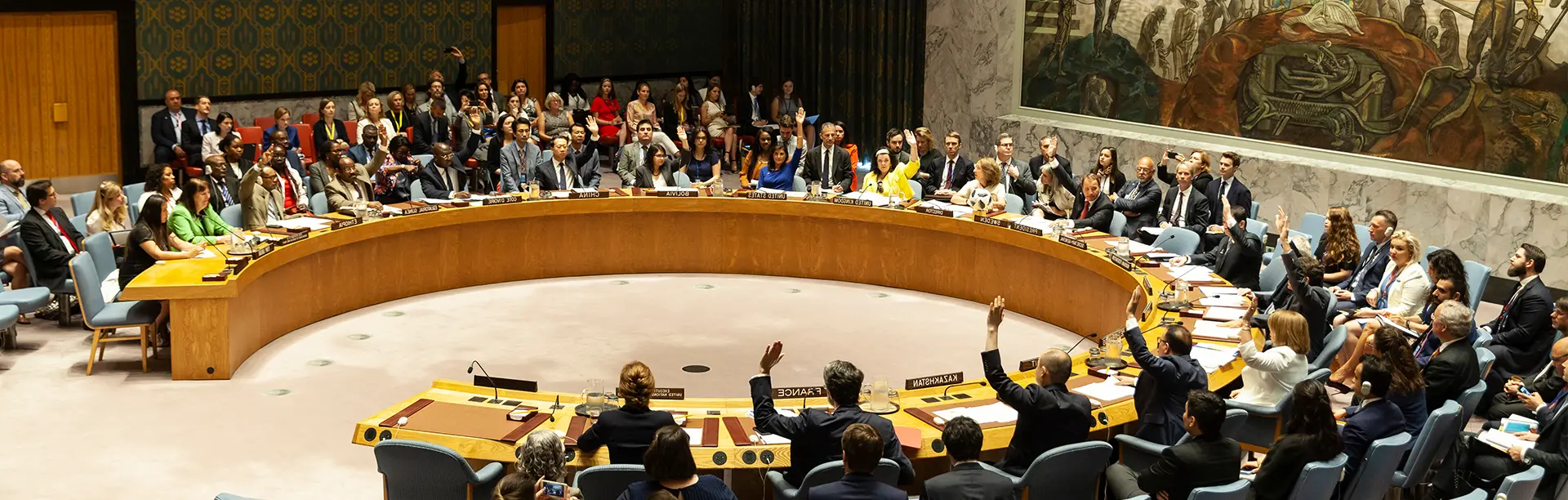
In June 2025, the United Nations Security Council convened to vote on a resolution demanding an immediate ceasefire in Gaza and unrestricted access for humanitarian aid. Fourteen members voted for the ceasefire. One did not. The United States exercised its right to veto, and the proposal collapsed. For millions of civilians suffering the onslaught of attacks, nothing changed.
This wasn’t the only time a Security Council member used its veto to block action. Russia has repeatedly blocked resolutions on Ukraine since the start of the invasion in 2022. Both Russia and China have jointly vetoed measures on Syria. Each time one or two countries override the will of the majority, leaving the Council paralyzed.
As the UN celebrates its 80th anniversary, the gap with its original purpose is stark. Since its establishment on October 24, 1945, the goal has been to replace the rule of force with the force of law. Today, its most powerful body, the Security Council, often functions like a courtroom where each judge can unilaterally dismiss the verdict. Can the UN continue to fulfill its mission of maintaining peace when the Security Council is gridlocked and confidence among member states is diminishing?
The UN in crisis
How did we get here? The cracks in the UN system are not a new phenomenon. Key events that began to damage the UN include the US-led invasion of Iraq in 2003 without Security Council approval, Russia’s war with Georgia in 2008, and the 2012 intervention in Libya, where the principle of ‘Responsibility to Protect’ was stretched to justify regime change.
The problem lies not only in one country or another preventing the UN from acting, but in the veto system itself. As the victors of World War II, the five permanent members of the Security Council—the United States, China, Russia, France, and the United Kingdom—can block any initiative that affects their interests around the world. And although the world has changed since then, none of these countries is willing to give up this privilege.
Reforming the UN today is impossible. Refounding it, unthinkable
Adding to the problem, the US—which was the driving force behind the creation of the UN at the famed San Francisco Conference—has grown skeptical and no longer sees the institution as indispensable. As Angel Saz-Carranza, Director of EsadeGeo, has written in the Spanish newspaper Expansión: “When the country that promoted the San Francisco Conference undermines the institution, the crisis is existential.”
China’s uneasy rise
If the US has lost faith, could China become the multilateral leader? Beijing has worked to increase its presence and influence in UN institutions, from the Food and Agriculture Organization to Interpol. Yet China has never sat very comfortably within the multilateral system. The UN was established in 1945, when China was weak and vulnerable before the communist revolution, leaving China with a lingering distrust of the organization. This distrust has never faded.
What Beijing has done is build parallel structures. The Asian Infrastructure Investment Bank, the BRICS New Development Bank, and the Shanghai Cooperation Organization offer alternatives to Western-led institutions. At the same time, China has cozied up to Russia and generally portrayed a more authoritarian image internationally. President Xi marching side-by-side with Vladimir Putin and Kim Jong-un at a World War II anniversary military parade in Beijing was a clear signal of where China’s political comfort zone lies.
This political posturing undermines China’s ability to position itself as the political heavyweight of the UN. Its growing authority inside the UN runs in tandem with a deliberate distancing outside it, leading to mistrust from Western and developed Asian countries.
Why reform is unrealistic
Some argue that the solution lies in structural reform. Scholars and policymakers have proposed expanding the Security Council to include India, Brazil, and African countries. Others, such as EsadeGeo researcher Dario Arjomandi, have a more ambitious approach. He recently wrote in Ethic about the Global Governance Forum proposal calling for a new UN Parliamentary Assembly, where citizens, rather than states, would be represented. Alongside the existing General Assembly, the concurrent vote of both bodies would have the power to override a Security Council veto.
But for now, the idea of reform is a mirage. Any move towards significant change is hindered by the veto powers of the five permanent members of the Security Council. The existing system still mirrors the geopolitical landscape of 1945, very different from today’s world.
As Saz-Carranza writes: “Reforming this today is impossible. Refounding it, unthinkable. The best we can hope for is to slow the deterioration, preserve what is essential, and wait for an improvement in international relations to enable marginal adjustments.”
What is worth preserving
The political machinery may be gridlocked, but other parts of the UN continue to deliver meaningful results. The technical and humanitarian agencies go quietly about their business. In 2024, the World Food Programme delivered food to 124 million people in 87 countries despite diminishing budgets and rising crises.
It is necessary to defend the parts of the UN that still function effectively while also weaving new forms of cooperation
The International Civil Aviation Organization sets global air safety standards. The International Maritime Organization regulates shipping rules that carry almost 90 percent of world trade across oceans. The UN Development Programme continues to operate in fragile states where few other organizations are present.
Thankfully, these agencies are not reliant on political consensus between the major political powers. Their work is based on practical cooperation. In a fragmented international order, they are the lifelines that deserve to be preserved.
Building outside the UN
Preserving what works inside the UN is not sufficient to counter the system’s political decay. The world needs new frameworks. Flexible coalitions and agreements—what scholars call “variable geometry” governance.
The Paris Climate Agreement, signed by nearly every country, established common goals for limiting global warming. Trade deals such as the EU–Japan partnership set standards for investment and sustainability. Public–private initiatives such as the Global Fund for health bring together governments, the private sector, and civil society to tackle diseases across borders.
These agreements are not a substitute for the UN. They lack its universality and legal force. But they can cushion shocks and maintain a fabric of cooperation at a time when global rules are fraying.
Can the UN remain a platform for peace?
The United Nations was born from ‘enlightened self-interest.’ In 1945, the United States felt that the world’s long-term stability was the biggest priority. As Saz notes, that unique convergence of power and vision will not return.
The real choice today is not between reform or collapse. It’s about defending the parts of the UN that still function effectively while also weaving new forms of cooperation that best serve the 21st century world. This task may be less dramatic than drafting a new San Francisco Charter, but it is far more urgent.
Global cooperation in today’s political landscape may look fragmented, stagnant, and often frustrating. Yet in a world dealing with increasing crises like armed conflicts and climate change, it is more crucial than ever.