
Adapting to climate change: Lessons from geography on regional vulnerabilities
Climate change does not affect all regions equally. Insights from economic geography research reveal why effective climate adaptation depends on place-based strategies and collective action.

Climate change is now having a noticeable impact on our planet. 2025 marked the third year in a row of the highest global temperatures ever recorded, at more than 1.5°C above pre-industrial levels. Events caused by extreme weather led to 765,000 deaths worldwide between 1993 and 2022, as well as catastrophic economic losses and ongoing social disruption — mounting up to around half a trillion euros, just in Europe.
But while heatwaves, floods, droughts, and storms are more frequently affecting societies, their impact is more severe in some regions than others. The current thinking on how to assess climate change impacts focuses on measuring global average temperatures, or single indicators such as carbon emissions. It fails to zoom in on the local level and evaluate how local responses are determined by economic structures, institutions, and social dynamics.
The success of strategies to address climate change will depend on key firms, individuals and policy actors moving away from business-as-usual
This is where economic geography research can help. Valentina De Marchi, Professor in the Master in Sustainability Management at Esade, has investigated why climate adaptation strategies differ across territories, reviewing the extant literature on the topic. In a new paper, published in the Journal of Economic Geography, she proposes novel research avenues that place geography, institutions, and collective action at the center of climate adaptation.
“The success of strategies to address climate change will largely depend on whether key firms, individuals and policy actors move away from business-as-usual practices and collectively embrace approaches that fundamentally transform the functioning of economic systems,” she writes.
Uneven impacts of climate change
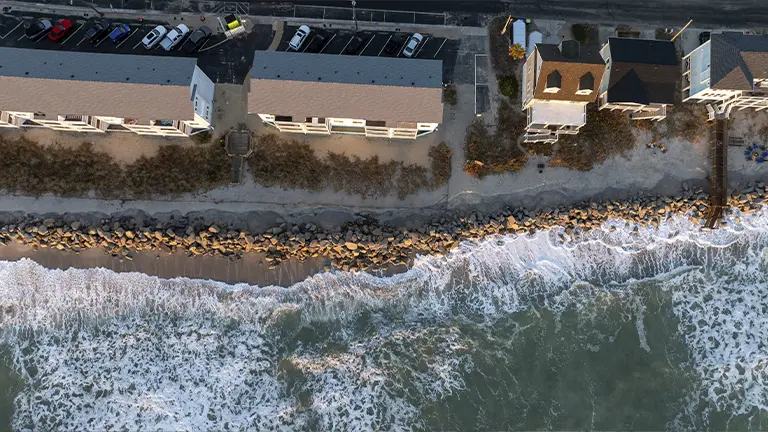
The impacts of climate change are worldwide, but some areas adjust better than others. For example, Europe is the fastest warming continent in the world, however, the Top 10 most affected countries by climate change (for fatalities and GDP losses) are all located in the so-called Global South. Geography influences exposure to events from coastal flooding and heat stress in cities to extended droughts in farming regions. Climate change has important social and economic consequences, which varies across countries. Extreme weather can damage infrastructure, interrupt supply chains, and reduce productivity, but the extent of these effects depends on local conditions. Climate impacts cascade through local economies, affecting households, businesses, and public finances. Existing inequalities worsen, and regional development slows. Furthermore, climate shocks can cause people to migrate in search of safer environments or more stable livelihoods. Extreme weather can also intensify social tensions or conflicts over scarce resources such as water and land.
Research reviewed by De Marchi highlights how vulnerability is as much a consequence of social and economic structures as of physical exposure. Not every affected area has the finance, governance, or social cohesion to recover.
Adapting to the new reality
Preparing for extreme weather has now become an unavoidable priority. Adaptation strategies range from technical measures, such as improved irrigation systems or disaster preparedness plans, to more systemic responses, including changes in production structures, innovation, and mobility.
Climate change-related migration should be considered as an adaptation strategy
Millions of people migrate to escape extreme weather, and it is often seen as a sign of distress. De Marchi suggests that we should rethink how we label migration. Rather than merely an effect of climate change, it should also be considered as an adaptation strategy. Policymakers could therefore enable migration rather than constrain it, as restrictive approaches can exacerbate climate-driven security risks.
However, adaptation isn’t a one-size-fits-all solution. Local capacities matter. “Climate adaptation is not just about technology—it depends on the economic, institutional, and social systems that determine whether solutions can actually be implemented and sustained,” says De Marchi.
The way local companies and leaders react is critical. Businesses are usually among the first to feel the effects of climate shocks, but that is also an opportunity to drive adaptation through investment, innovation, and strategic relocation. One example is insurance provider Aetna, which prepared well for Hurricane Sandy by ensuring most of its workforce could log in to the company’s central database and work from home. Other businesses relocated production or re-organized supply chain ahead of Sandy’s landfall. This shows how businesses can contribute to broader regional resilience. But where supportive institutions and networks are lacking, adaptation remains fragmented and uneven.
Collective action matters
Working together—collective agency—is crucial in helping regions adapt to climate change. Success rarely stems from isolated actions by individual actors. Instead, it emerges from coordinated efforts involving businesses, communities, and public institutions. Leadership, social capital, and knowledge exchange can align individual initiatives toward shared goals.
The starting point is local policy frameworks and institutional arrangements, which play a crucial role in enabling this coordination. Isolated adaptation efforts may have a limited impact or create unintended consequences. As De Marchi notes, “Adaptation of a territory cannot be achieved if only a few actors pursue isolated initiatives. Instead, it requires a more concerted and coordinated direction of change.”
Fishing projects in Finland provide a good example of the power of partnerships between communities and the private sector. Collaborations enable the scaling up of sustainable practices beyond individual projects, which results in benefits for the wider region. Here, collective action transforms adaptation from a series of disconnected responses into a more systemic and inclusive process.
New directions for research and policy
De Marchi proposes several directions for future research and policy on climate adaptation. One consideration is to move beyond administrative boundaries and to measure and assess climate change within ecologically defined spaces, such as river basins that cross multiple regions or countries. Climate impacts don’t occur within political borders, and policies need to reflect this reality.
Assessment of emissions should be expanded. Assessing not only Scope 1 emissions, but also Scope 2 and Scope 3 ones along production chains can reveal the truth about where climate responsibility and risk lie. There is also an urgent need to move beyond a carbon-only focus and include concerns related to biodiversity, water resources, and social justice. Climate strategies that ignore these dimensions risk creating maladaptive outcomes that only partially address the problems.
De Marchi highlights that we must cease to only measure practices and focus on outcomes. Not all adaptation measures reduce vulnerability in the long term, and some may place regions on unsustainable pathways. Integrating adaptation with mitigation and emphasizing proactive, anticipatory measures can help avoid these pitfalls. In essence, economic geography can play a unique role in this agenda by analyzing how climate strategies unfold. “Understanding these dynamics can help design policies that work not just on paper, but on the ground,” says De Marchi.
A more holistic approach
Climate change is a global challenge, but effective solutions must be locally relevant and coordinated. Reducing vulnerability and enhancing resilience requires shifting from narrow, technical fixes toward a more holistic approach that considers the immediate region. Policymakers, businesses, and communities should work together to create locally relevant strategies that reflect territorial realities while contributing to global goals. By integrating insights from economic geography, climate adaptation can become more equitable, more effective, and better aligned with the diverse conditions under which people and economies operate.