
Are we in an Artificial Intelligence bubble?
This new technological era is driving multibillion-dollar investments and unprecedented expectations. AI now commands record valuations and massive capital flows. Is this a revolution — or runaway hype?

Everyone remembers the dot-com bubble. The collapse of Lehman Brothers. The images of hundreds of employees leaving their offices carrying cardboard boxes, searching for a new job — and a new beginning. Financial history is punctuated by moments when expectations outpaced reality.
Today, many company valuations once again seem to exceed what once felt imaginable. The sheer scale of capital required to build AI infrastructure — infrastructure that could become obsolete in just four or five years — surpasses even the boldest forecasts of the recent past.
Some voices warn of an AI bubble and its risks. Others argue that we are simply witnessing the birth of a new era marked by extraordinary market growth. These are not marginal opinions. Influential figures such as OpenAI CEO Sam Altman and NVIDIA CEO Jensen Huang have publicly acknowledged what many privately suspect: “Yes, we are in a bubble.”
Bubbles tend to share a common origin: the collective feeling of standing before an unstoppable train that no one wants to miss. In markets, as in life, few fears are stronger than being left out of “the next big thing.” AI — with its ability to write text, generate images and simulate human conversation — has become that ticket to the future.
Markets do not reflect intrinsic value so much as expectations of future value: what companies might become, translated into what investors are willing to pay today. But the future is always uncertain. Imagination moves faster than reality, especially when projections promise disruptions unlike anything seen before. When promises confront facts, the landing can be painful.
We saw it with the dot-com frenzy in the early 2000s, with the housing bubble in 2008, and many now wonder whether artificial intelligence is following a similar path. What happens if the exponential growth being projected fails to materialise — or arrives much later than expected? The fear is straightforward: that the bubble bursts, leaving behind billions in losses.
The bubble as an engine of innovation
Bubbles are often seen as the unwanted by-product of hype — of speculative excess, fleeting trends (think Dutch tulips) or the abundance of cheap money.
This is a new type of disruption—one that enters the market, rapidly dominates it, and ultimately transforms society
But in this case, hype may not be an accident. It may be the mechanism.
We are familiar with technological disruptions that emerge from the low end of the market. Modest products — such as early liquid crystal displays in simple Casio watches, or the first digital cameras — evolve over decades. Eventually, they cross a threshold where they meet the needs of a sufficiently large user base, capture market share and displace the incumbent technology.
This type of disruption, extensively described by Clayton Christensen, has shaped — and continues to shape — many industries.
Today, however, we may be facing a different kind of disruption. It does not begin at the margins with humble products. It enters at the top of the market and rapidly expands until it dominates. Tesla’s electric vehicles are one example. OpenAI’s generative AI is another. In just a few years, such technologies can reshape entire markets — and transform society itself.
These hype-driven disruptions dramatically expand the industries they touch. In some cases, what looks like a bubble becomes one. In others, it becomes the foundation of lasting change.
The three phases of the cycle
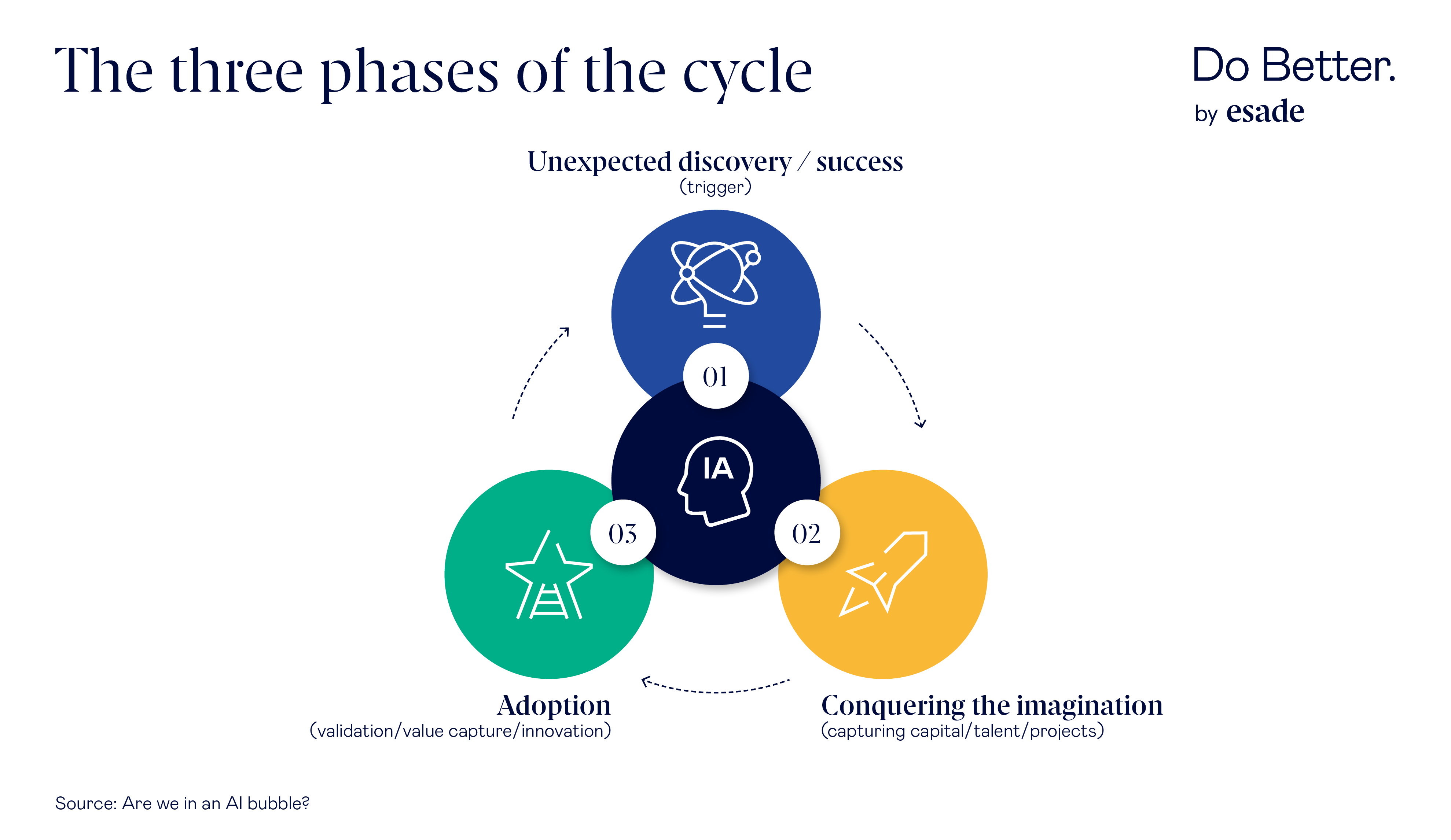
Technological bubbles typically unfold in three phases.
The first is an unexpected breakthrough: a discovery or innovation that acts as a trigger. For electric vehicles and autonomous driving, this could be traced back to DARPA’s early challenges. For generative AI, the decisive moment was the launch of ChatGPT on November 30, 2022.
That breakthrough opens a window of unforeseen possibilities, capturing the collective imagination. This leads to the second phase: expectation — or hype.
Hype has defined missions and objectives. Some are clearly positive for innovation. Others are less so. And some are simply functional.
On the positive side, hype attracts capital, draws talent and aligns organisations — startups and established companies alike — around a shared vision.
But there are downsides. Free riders emerge. Exaggeration flourishes. Fear may lead to counterproductive regulation. Inequality can widen. And if expectations are not met quickly, credibility suffers.
There are also functional effects. Hype accelerates social diffusion and encourages exploration. Unlike tightly directed government projects or “moonshots,” hype opens the field to hundreds of parallel experiments. It broadens the search for viable applications.
That exploration, however, is not cost-free. Vast amounts of capital are invested — and often wasted — on initiatives that never reach maturity.
The third phase is the most decisive: adoption.
Adoption is never a simple copy-paste of innovation. It is recombination — the adaptation of existing strategies to new technologies. It involves creativity, but also validation and value capture. This is a decisiv
This is the turning point. Successful adoption reinforces both hype and further discovery. Failed adoption leaves only speculative dynamics, while genuine innovation stalls.
So, are we in a bubble?
It is easy to confuse a mechanism of innovation with a speculative bubble — although, in a sense, the two are intertwined. Disruptions of this magnitude are propelled by expectations of transformation. Those expectations are what attract capital, talent, startups and political and social support.
But hype is built on projections of what might be. Those projections will only be confirmed — or disproven — through adoption. Until then, they remain promises, not present realities. And promises are the raw material of bubbles.
Are we in a bubble? If expectations are met — or surpassed — perhaps not. But expectations are, by definition, uncertain. Adoption will provide the answer, even if it unfolds more slowly than the hype that fuels it.
For now, collective imagination remains the engine.
This is why such cycles often end in bubbles: expectations that cannot be sustained once the technology reaches a plateau. Historically, every technology has eventually done so. None has progressed indefinitely — although some argue that AI, applied to research itself, could break that pattern for the first time.
So, returning to the initial question: are we in an AI bubble?
Probably not.
But inevitably, at some point, we will be.