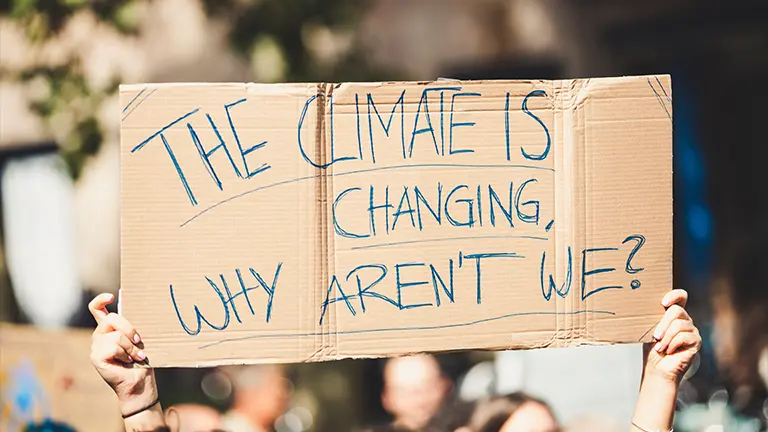

Climate change? Systemic change!
Current financial markets make it challenging to redirect investments toward a fair ecological transition. COP29 presents an opportunity to begin implementing the necessary changes.

We encounter climate change everywhere, and rightly so. If it’s not a new directive from the European Union, it’s a natural disaster, a new renewable energy investment fund, a corporate scandal linked to pollution, or the latest data on global warming. Or, as in this case, the recently inaugurated COP29 climate summit.
Sustainable finance is often cited as one of the main levers for solving the problem, and it’s true that the billions invested in the oil sector and other highly polluting industries play a significant role. But how can we shift all that money toward cleaner industries, renewable energy, and companies that are decisively committed to a fair ecological transition?
As financial markets currently operate, it’s no easy task. In a meeting with financial entities, when we asked them about the obstacles to moving their assets toward more sustainable proposals, they told us that the vast majority of their clients clearly prioritize profitability, and issues of social and environmental impact only arise if they are first assured they won’t have to sacrifice “market” returns.
Many green funds lack transparency, and most rankings don’t measure their real impact on the planet
If demand isn’t a strong enough catalyst for increasingly urgent changes, could the supply side be? There are more and more funds calling themselves ‘green,’ ‘sustainable,’ or ‘ESG,’ often offering returns similar to those of traditional funds. However, the issue here lies, on the one hand, in the lack of transparency of many of these funds, making it challenging for the final investor to understand what kind of sustainability strategy they follow—if they follow one at all. On the other hand, most ESG rankings measure how much a company is affected by environmental, social, or governance issues, rather than the positive or negative impact these companies have on society and the planet. Faced with a landscape that is not truly geared toward transformative change, what can we do?
Toward systemic change
The perspective of systemic change provides some clues. When Donella Meadows discusses the levers that can promote systemic change, she identifies some as the most effective. One of them is changing information flows so that stakeholders better understand where their resources are going, what they’re used for, and what results they generate. We can infer that greater transparency in the management and marketing of investment funds would help investors (both individuals and institutions) direct their resources toward companies more aligned with their values and goals. It’s very different to simply be shown a rate of return and a label (‘global,’ ‘green,’ ‘tech,’ ‘sustainable’) compared to receiving information about how the fund selects its assets and the impact those companies have in various areas. In this sense, the recent European Sustainable Finance Disclosure Regulation (SFDR) may help increase transparency and require investors to detail their practices and impacts.
In the sustainability of financial markets, regulation can be (and is being) a vector of change
Another lever is changing the rules of the game. If incentives change, the behaviors of the actors involved will change too. Penalizing investments in fossil fuels, granting tax benefits to companies with a positive social or environmental impact, or prohibiting certain speculative practices would push the system to operate differently. In some areas (artificial intelligence, genetics, space exploration), we often feel that legislation is always one step behind innovation or events. However, in terms of sustainability in financial markets, regulation can be—and is—an agent of change. Therefore, it’s crucial for these rules to be clear and prompt the desired behavioral changes while remaining alert to potential unintended consequences.
A third lever is changing mindsets: investors willing to sacrifice even a small amount of return to fund projects with better social and environmental impact remain the minority. This doesn’t mean they are villains—not at all. Many of them allocate part of their financial returns or wealth to social causes. So why is it so difficult to change our focus and seek financial returns—even if slightly lower—by investing in projects that care for the planet and promote well-being for all? In doing so, we wouldn’t need to later fix the damage by planting trees and funding social kitchens. Instead, we would have an economic system based not on inequality and charity but on equal opportunities (including for future generations), the planet’s health, and social justice.
These systemic changes, difficult due to the complexity of the context, have to start somewhere. And I can’t think of a better place than COP29, where many of the actors working toward these changes gather—perhaps alongside some of those who put obstacles in the way.