

How do impact investors incorporate social and environmental concerns?
Moral markets such as impact investing assign value to the social and environmental impact of the products and services they exchange, but the lack of standards for measuring those impacts can lead to impact washing or market paralysis.
As social awareness takes on increasing importance in business, the markers of success must extend beyond financial performance and take in the wider impact of operations. But with no universally agreed norms or tools to measure these metrics, how can the achievement of social and environmental goals be monitored? And how will that shape the development of these so-called moral markets?
Guillermo Casasnovas (Associate Professor in the Department of Society, Politics and Sustainability at Esade), Lisa Hehenberger (Associate Professor in the Department of Strategy and General Management at Esade and Director of the Esade Center for Social Impact) and Kyriaki Papageorgiou (Norwegian University of Science and Technology) have examined the emergence of impact investing in Spain and globally, focusing on the measurement tools that allow investors to incorporate their non-financial goals into their daily practices, and how those tools are actually influencing the development of the market.
Impact investing is the investment into companies and funds with the intention to generate both financial returns and measurable social and or environmental impact. Measurement is thus an integral part of the impact investing practice, even defining the very boundaries of the broader impact investing market.
Their research by Casasnovas, Hehenberger (who is also a professor in the MBA and Executive MBA programs at Esade) and Papageorgiou was published in the Journal of Management Studies and offers key contributions to the literature on moral markets and deepens our understanding of market evolution and impact measurement.
Impact washing
Decision-making is increasingly influenced by global challenges that transcend business priorities, extending the gap between growth and legitimacy. This conflict has driven an explosion in market solutions to social and environmental challenges—so-called moral markets. But while renewable energy, sustainable clothing, organic food and other socially aware industries may claim to focus on the bigger global picture, an absence of agreed standards prevents accurate evaluation of their achievements.
Many actors in the impact investing industry are worried about the direction that this market is taking
This lack of globally accepted set of norms leads to the risk of ‘impact washing’, with players free to claim sustainable and ethical practices and outcomes without evidence. Although many companies and investors are genuine in their endeavors, the lack of transparency prevents accountability and genuine change.
The key motivation behind this study was the realization that many actors in the impact investing industry are worried about the direction that this market is taking. Impact investing provides a way of internalizing negative externalities (as well as the positive ones) that traditional investors do not take into account. It has the potential to become a transformative approach to financing, overcoming the limitations of so-called ESG investing or sustainable investing. However, there are also risks that it becomes just one more practice that reinforces the status quo of financial markets, with investors prioritizing financial returns over all else.
Data collection
Using six years of qualitative, in-depth data from Spain’s emerging impact investment market, which currently stands at around €3.3 billion, the researchers examined how social and environmental goals can be brought to life and become actionable practices that shape workplace and market structures. The data was supplemented with a decade of detailed insights from the global investment field, and overall included interviews, observations and archives from public administrations, social service providers, fund managers, industry events, meetings with impact investors, reports and news sources.
The researchers have a privileged level of access to data from the emerging Spanish market, having played several important roles within it. Between them, they have been key in promoting impact investment in Spain; launching an accelerator program for social enterprises; working closely with the taskforce for the Spanish National Advisory Board on impact investing; sitting on several impact investment fund advisory boards, and other initiatives.
The mechanisms of impact inscription
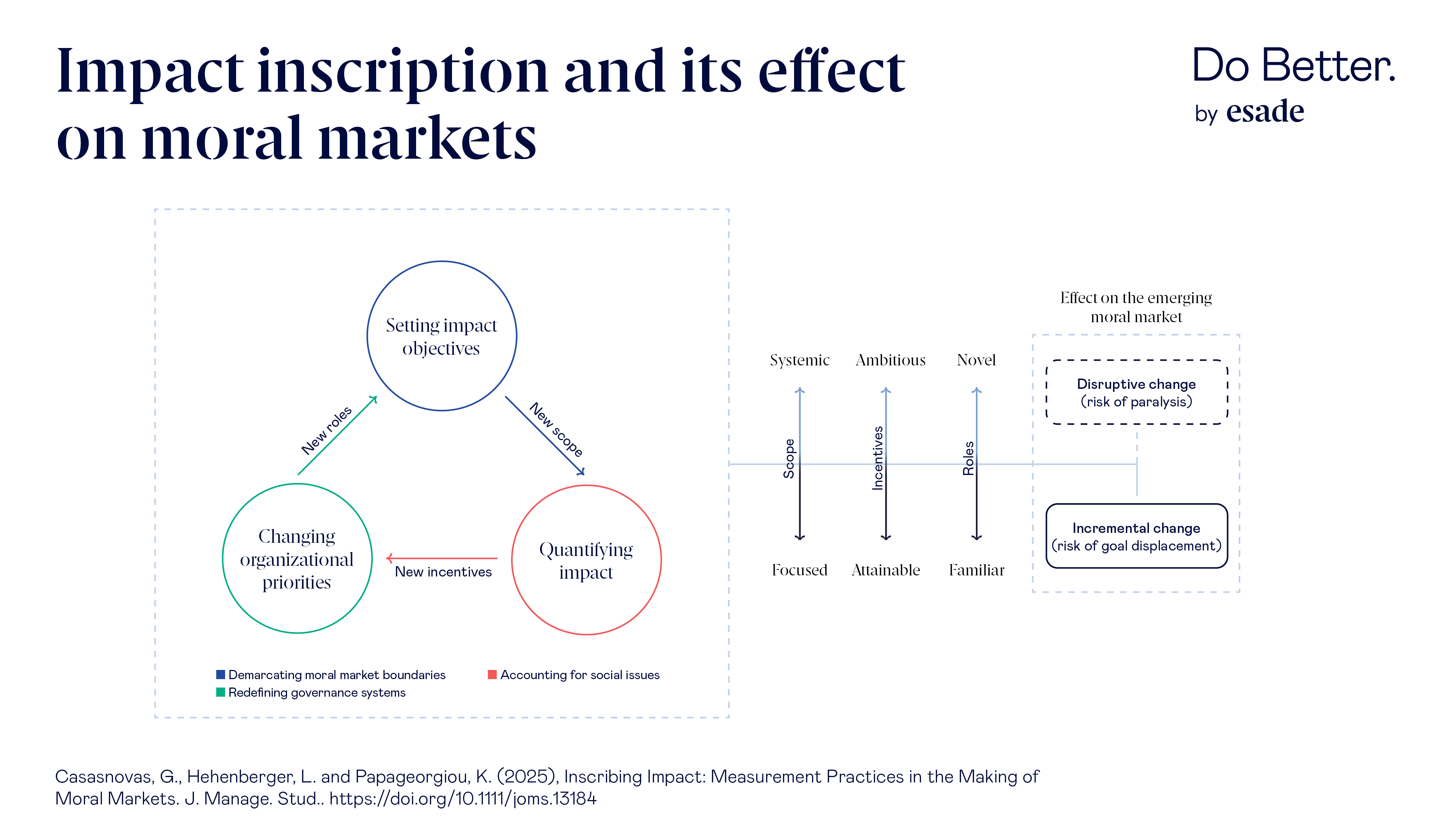
The analysis revealed three key mechanisms through which impact measurement shapes market practices: the demarcation of moral market boundaries, accounting for social issues, and redefining governance structures.
The social and environmental impact is defined by setting conceptual boundaries. To overcome the challenges of subjective interpretation of these concepts, measurement tools push actors to define specific impact objectives that promote an understanding of acceptable practices and allow actors to define the scope of their strategy accordingly. Accountabilities can then be specified and the broader ‘impact’ concept divided into manageable parts and concrete objectives. This mechanism makes impact concrete actionable, but also leaves certain elements outside of the equation.
To account for social issues, social impact is quantified and embedded within financial decision-making frameworks. When social impact is linked to incentives, impact considerations become part of the value-creation process and gain higher visibility and more significance. Impact measurement tools are key in allowing market actors to leverage concrete data that informs their practices and shapes their incentives.
When markets begin to account for social and environmental impacts, they move beyond treating critical common challenges as mere externalities
When organizational priorities change and new metrics and incentives are implemented, this redefines governance systems. New roles and practices are created, so that fund managers, public agencies, and other market actors are able to transcend previous organizational templates – for example fund managers that look beyond maximizing financial returns, public administrations that incorporate more flexibility, or regulatory agencies that embrace innovative approaches. As systems and roles develop, the enhanced understanding of impact fuels the inscription cycle and drives market change.
Market-level implications
As the article shows, depending on what impact is measurement and managed, these mechanisms can result in different scopes, incentives, and roles. As the Figure illustrates, when the scope is systemic, the incentives ambitious, and the roles novel, this will likely generate disruptive change in the market, although there will also be the risk of paralysis if market actors fail to incorporate such radical changes.
On the other hand, if the scope is focused on a very specific issue, the incentives are easily attainable, and the roles stay familiar, the resulting change will likely be incremental—with the risk of displacing the original transformational goals and potentially fueling the practice of impact washing. The theoretical model introduced by the researchers identifies and elaborates on the mechanisms that drive the inscription of impact, offering a tangible operational framework.
Apart from discussing the performative effect of impact measurement tools in moral markets such as impact investment, the article also points at how impact inscription processes can change markets that traditionally have only focused on instrumental gains for the different parties.
When markets begin to account for the social and environmental impacts of products and services, they move beyond treating critical challenges—such as climate change, public health, and the depletion of common resources—as mere externalities. Instead, these considerations become embedded in economic exchanges. In doing so, markets can shift toward long-term value creation, generating benefits for both society and the planet, and positioning themselves as drivers of the common good.

