

Envisioning a regenerative bioeconomy
At the core of the bioeconomy lies the need to prioritize human and planetary health in business models and development strategies.

In light of the multiple ecological crises we are confronting, a shift in mindset is essential—moving from an extractive approach to one rooted in ecocentric and regenerative thinking. This effort requires a transition towards more transformative development strategies in which the role of organizations and leaders is crucial.
Recently, the Esade Center for Social Impact (ECSI) hosted a research seminar with Thais Corral, a renowned social and environmental leader and founder of Sinal do Vale. This Brazilian NGO is dedicated to prototyping initiatives and fostering multidisciplinary learning in the field of regenerative bioeconomy. Thais is, likewise, co-chair of the Advisory Board for the UN Decade on Ecosystem Restoration and has recently intervened at the G20 in Rio de Janeiro 2024.
Here I provide an overview of the key concepts of the bioeconomy and the importance of moving toward a regenerative approach. I also present a conceptual framework designed to integrate diverse stakeholders' views, developed in collaboration with Thais through a series of thematic workshops held in Rio de Janeiro earlier this year.
Bioeconomy and the bio-technological vision
Bioeconomy relates to all economic activities that use renewable biological resources such as wood, crops, micro-organisms, or plants to produce goods or energy through sustainable means. Consider bioplastics, which are substitutes for fossil fuel plastics derived from petroleum. Bioplastics can be made from sugar, starch, cellulose, or wood, making their production and disposal less harmful to the environment.
Some biotechnologies may end up prioritizing economic growth at the expense of social and ecological degradation
Typically, bioeconomy relies heavily on technology, driving innovation and advancements that enable new ideas and processes. Many innovations revolve around biochemical and biophysical methods, infrastructure, and machinery which are associated to a bio-technological vision of the bioeconomy. However, critics have raised concerns about this vision as it tends to prioritize economic growth and profit maximization at the expense of social-ecological degradation (see Bugges et al., 2019).
In Brazil, one can see bio-technological strategies like the production of biofuels show the potential of the bioeconomy. Initially, government incentives promoted biofuels as a way to reduce reliance on fossil fuels. However, the growing demand for biofuels has driven deforestation in critical ecosystems to make way for expanding crops such as soy and sugarcane. This expansion has placed immense pressure on soil health, increased deforestation, pesticide use, and led to significant biodiversity loss.
Toward a regenerative bioeconomy approach
Recent research has highlighted the importance of shifting toward a bioeconomy vision that focuses on sustainability and ecosystem conservation, favoring soil health, enhancement of biodiversity, and social prosperity. This approach fosters a transition toward production systems that work in harmony with the natural environment. Some examples include agroecological systems such as permaculture and agroforestry or payment for ecosystem services (PES).
In respond to such claims, Thais was invited to the Sherpa Track at the G20 Summit in Rio de Janeiro 2024. With her expertise in regenerative sustainability, she played a key role in contributing to the discussions, focusing on how to foster a regenerative bioeconomy. Sinal do Vale made a series of actionable recommendations to the G20. One of them is the call for governments to adopt bioregional development models worldwide based on decentralized, community-driven regenerative principles. Another recommendation was the urgent need for financial mechanisms that support small and medium entrepreneurs as well as bioregional projects. Likewise, Sinal highlighted the role of biohubs in mobilizing collective efforts, enabling multi-stakeholder initiatives, and promoting environmental conservation.
The bioregional model must address global challenges such as ecosystem degradation, climate adaptation, and socioeconomic equity
These contributions draw on eight dialogues facilitated by Sinal do Vale between January and October 2024. These events brought together over 700 stakeholders—including experts, policymakers, community leaders, and climate justice advocates—to explore how the bioregional model can address critical global challenges such as ecosystem degradation, climate adaptation, and socio-economic equity.
A place-based framework for regenerative bioeconomy
During my PhD visiting period at the Federal University of Rio de Janeiro (UFRJ) and Sinal do Vale, I had the opportunity to participate in some of these dialogues around topics such as the role of women in climate leadership, indigenous peoples’ knowledge and inspiration for ecosystem regeneration, and incentives and challenges for financing the regenerative bioeconomy.
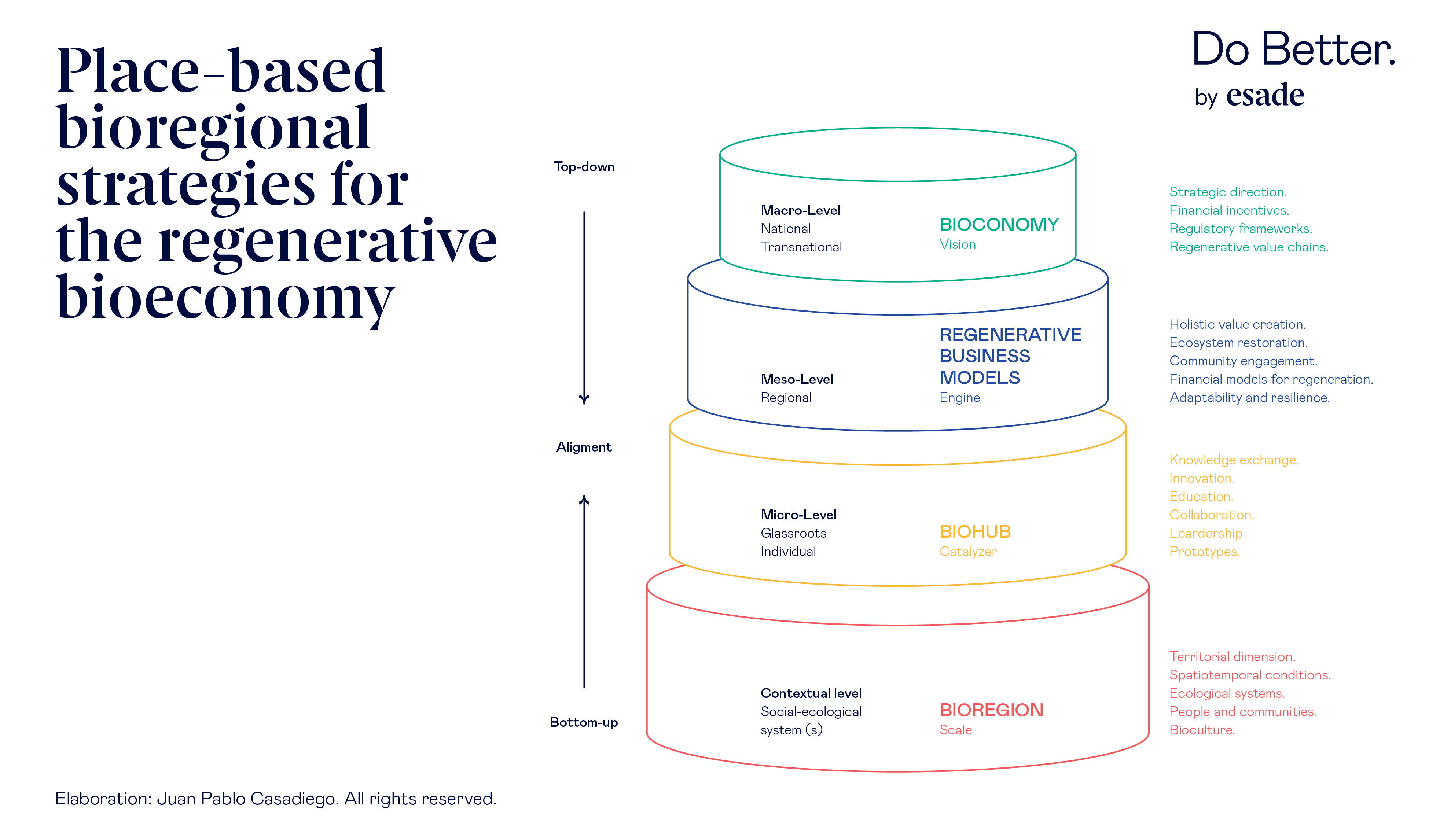
The result was a framework that illustrates how to enable a regenerative economy. It’s goal is to serve as a visual tool that articulates bioeconomy strategies, regenerative business models, and biohubs such as Sinal do Vale in enabling net-positive impact for people and nature. This framework is central to the report developed by Sinal do Vale as a major contributor the G20 Summit and was presented in a meeting last November 14, 2024. Find the complete report at the United Nations Decade on Ecosystem Restoration.
At the foundation of the framework is the bioregion scale. We argue that regenerative strategies begin here, as this level encompasses the territorial context, the characteristics of social-ecological systems, and the biocultural identities and dynamics of Indigenous Peoples and Local Communities (IPLCs).
On top of the bioregion are the biohubs that serve as catalyzers of bottom-up strategies, promote multi-level cooperation between actors, experiential learning, and prototype sustainable initiatives. We highlight the need to support the establishment of biohubs such as Sinal do Vale as they are key actors in generating enabling conditions for people and entrepreneurs to create and escalate regenerative business models.
At the meso-level, the framework portrays regenerative business models as the engines of these strategies. They are the ones in charge of holistic value creation and create economic opportunities that work by ecological regenerative rates and involve IPLCs. These models are crucial in aligning business activities with the bioeconomy strategy which must prioritize conservation efforts, regenerative supply chains, and more importantly, financial aid.
This framework was also inspired by Sinal’s flagship project called Caminho do Recôncavo da Guanabara. This project aims to develop a 110 km trail which seeks to incentivize regenerative production chains through agroecological systems and ecotourism initiatives around the Guanabara Bay, where the city of Rio de Janeiro is located. By doing so, it aims to protect and restore local biodiversity, preserve cultural heritage, and generate socioeconomic well-being.
A change of logic
There is no doubt that, during her seminar at ECSI, Thais inspired everyone, including MBA students, professors, practitioners, and members of the Esade community. We hope her efforts continue to reach new platforms, inspiring more people to embrace and replicate the regenerative mindset. In these times of crisis, it is clear that a shift from extractivist and commercial logic to ecocentric and regenerative thinking is essential. We must prioritize both human and planetary health at the heart of business models and macro-level development strategies. In driving this transformation, biohubs and regenerative leaders like Thais play a crucial role. As she stated: “Regeneration is a constant improvement of the project, the ecosystem, relationships, and improvement of oneself”.