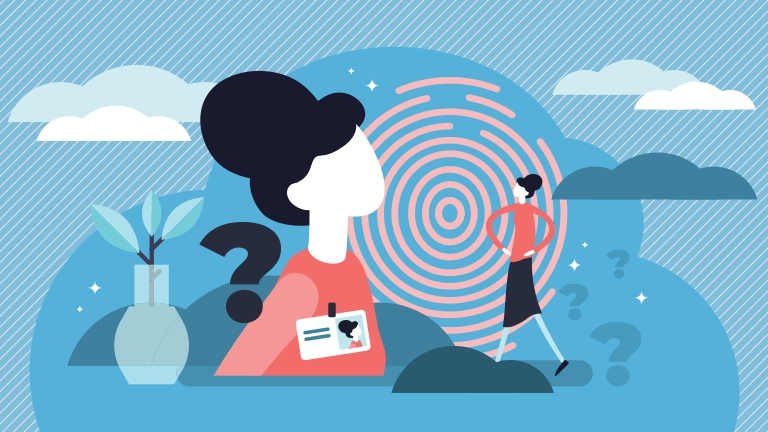

Professional Identity and Personal Identity: Two Sides of the Same Coin?
In the workplace, who we are and the role we play are not always the same. Learning how to manage this tension may be key to preventing work from becoming a source of moral conflict.
In everyday life we assume multiple roles: citizen, friend, parent, employee or executive. Each comes with expectations, norms and ways of acting that we gradually internalize. Yet few environments require such a deliberate construction of identity as the workplace. Professionalism has become one of the main symbols of social prestige. Being a “good professional” is usually associated with competence, reliability and success — often even with personal worth.
This social conception of professionalism means that at work we do more than perform tasks; we also construct an identity. It is no coincidence that the word “person” comes from the Greek term for the theatrical mask. From its origins, human identity has been linked to performance. And work, although it may not be the most important sphere of our lives, is certainly the one to which we devote the most time. For that reason, what happens there inevitably spills over into our personal sphere: the person we are at work tends to seep into the person we are at home, often carrying along the concerns of our professional life.
This raises an inevitable question: to what extent do our personal and professional identities coincide? Is it possible to prevent the identity we adopt at work from carrying over into private life? Do the two reinforce one another, or do they end up fragmenting?
Jesuit priest and Lecturer in the Department of General Management and Strategy at Esade, Alberto Núñez, and Rita Mota, Associate Professor in the Department of Society, Politics and Sustainability, approach this question from two different perspectives.
The Professional Mask
According to Núñez, behaving differently at work is not necessarily problematic: “Depending on our needs, desires or fears, we may play a role that does not exactly correspond to who we are.” The problem arises when the distance between the role and the “real” self becomes too large.
In highly competitive or hierarchical environments, pressure to conform to a certain idea of professionalism may push people to suppress traits they consider central to their personal lives: empathy, vulnerability or honesty. “This is one reason why people develop a distinct ‘professional identity’. They may feel that certain virtues are appropriate in private life but out of place at work,” explains Mota.
She describes this phenomenon as moral disjunction: a disconnect that appears when the demands of a professional role conflict with personal commitments. It is not simply about behaving differently; it is about tensions between what one believes to be right and what one is expected to do.
This phenomenon is not marginal. It can arise when employees are pressured to conceal information, prioritize results over people or normalize practices that, outside the workplace, would be considered questionable.
The Psychological Cost of Fragmentation
Playing a role has a cost. And that cost depends on the distance between personal and professional identity.
Most people want to see themselves as coherent and decent individuals. When work requires actions that contradict that self-image, psychological discomfort arises. To reduce this tension, various coping mechanisms emerge: distancing oneself from the role (“this isn’t really me, it’s just my job”), justifying behavior (“everyone does it”), or gradually adjusting personal values to fit the expectations of the environment.
These strategies may ease tension in the short term, but over time they can erode integrity. From the perspective of virtue ethics, coherence does not mean behaving exactly the same in every context. Rather, it means striving to be the same kind of person across the different domains of life.
When fragmentation becomes chronic, individuals risk losing the ability to integrate their experiences into a coherent life narrative.
What Do We Mean by “Being Professional”?
Society has developed a fairly clear image of what it means to be professional: efficiency, emotional control, results orientation and organizational loyalty. These expectations are not neutral — they shape behavior.
When the need to appear professional outweighs other personal values, individuals may feel pressure to set aside virtues such as compassion or justice in order not to seem naïve or insufficiently committed.
“When someone is unable to act with their highest level of professionalism, it often reflects a deeper mismatch: between the person’s profile and the requirements of the role, between their way of working and the culture of the organization,” explains Núñez.
However, professional roles themselves are social constructions, Mota notes. “They are not given by nature; they are negotiated and collectively sustained. Therefore, they can also be transformed.”
When Values Don’t Align
Working in a company whose values do not fully align with one’s own is a common experience. In Giving Voice to Values, professor Mary Gentile identifies three typical responses to this conflict: accepting the organization’s values (loyalty), leaving the organization (exit), or expressing disagreement and attempting to change it (speak up).
Psychologically, the third option is usually the most difficult. It requires moral courage and an environment that allows open dialogue. But it is also the option that best preserves integrity when change is possible.
Mota proposes a process she calls role coadunation (from the Latin coadunare, meaning “to unite”), developed together with Alan Morrison. It involves conducting a “full reading” of one’s role, understanding its social impact and finding ways to exercise it virtuously. Sometimes the conflict is more apparent than real; in other cases, it requires more drastic decisions — even changing organizations.
From a Jesuit perspective, the first step is self-knowledge: understanding which values are non-negotiable and which allow for nuance. Applying humanistic values such as integrity and compassion can help guide actions toward the common good. The aim is not to defend principles blindly, but to exercise discernment — understanding both one’s own position and the broader context.
Not Losing Yourself
How can we prevent professional identity from becoming a justification for questionable behavior?
As Mota’s research suggests, both perspectives converge on several key practices:
- Practicing regular reflection: What am I doing, and why?
- Cultivating communities of interpretation — mentors, colleagues and spaces for dialogue — that help reveal blind spots.
- Maintaining meaningful commitments outside work that anchor personal identity.
- Encouraging critical thinking toward norms that are presented as unquestionable.
Strengthening personal identity is important, but not sufficient. Confidence without reflection can lead to self-deception. What matters most is an identity oriented toward virtues and open to critical examination.
The Role of Organizations
Organizations are not neutral settings. We devote a large part of our lives — and much of our social recognition — to them. If a company normalizes behaviors that contradict basic values, its influence extends far beyond working hours.
Companies can help reduce moral disconnection by fostering transparency, encouraging ethical dialogue, avoiding incentive systems that reward harmful behavior and creating safe channels for expressing disagreement.
As Mota points out, “Roles are socially constructed and their expectations are collectively sustained. Therefore, the solution cannot be purely individual. In most cases, it requires organizations that are open to criticism and the presence of healthy interpretative communities capable of examining and shaping role expectations.”
Since role expectations are collectively constructed, organizations share responsibility for the identity conflicts experienced by their members.
Beyond the Mask
The challenge is not to eliminate professional identity. Roles are inevitable and often necessary. The real question is how we integrate them without allowing them to fully define who we are.
Perhaps the goal is not to be exactly the same person in every context, but to aspire to sufficient coherence: a life that is plural yet intelligible, diverse yet morally integrated.
In an increasingly demanding world of work, true professionalism may not lie in perfecting the mask — but in narrowing the distance between the role and the person.