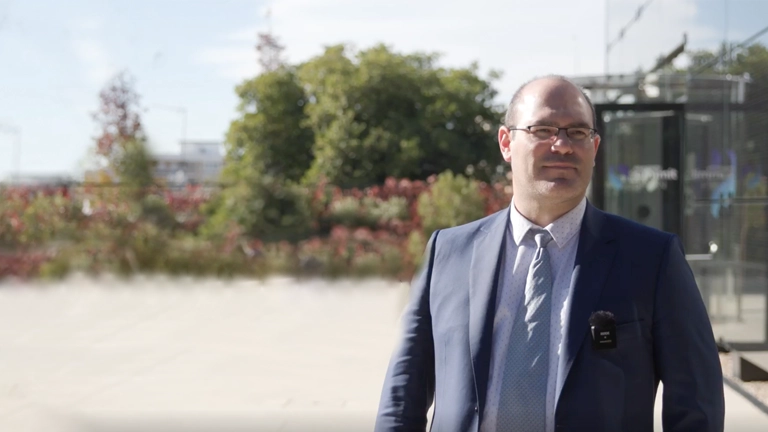

Santiago Cartamil: “My vision is a future without screens”
We meet Santiago, an engineer, entrepreneur, and Executive MBA student at Esade. Drawing on graphene-based technology, he aims to redefine the future of image and sound to make digital communication a more human act.

Santiago Cartamil has always avoided fixed paths. From the choices he made in his studies to his current entrepreneurial venture, the common thread has been a need for change as a personal driving force. “My intuition has always told me to leave doors open,” he explains. “Don’t focus too much on a single thing, because you may end up trapped there.”
Today, he is trying to take the next leap in his career by advancing a vision of a future in which we gradually free ourselves from the screens that so often trap us. He plans to do so through a patented graphene-based technology, a versatile material that makes it possible to move beyond the subpixel technology that has dominated the world of imaging for recent decades.
We speak with Santiago, a student in Esade’s Executive MBA class of 2025–2026, to learn more.
Understanding the world; solving problems
Santiago’s path begins with a youngster eager to understand how the world works. “First nature, then engineering, then society, companies…” He chose to study physics at the University of Granada, seeking a discipline capable of encompassing that ungraspable “everything.” It proved to be the right choice, but he soon missed a more practical orientation, which led him to pivot towards electronic engineering. “Beyond understanding the why, I liked asking myself: when I have a problem, how do I solve it?”
Driven by that mindset, he pursued a master's degree in Materials Science and Nanotechnology at the Autonomous University of Barcelona. It is a hybrid field where disciplines such as physics, chemistry, biology, and electronics converge. “It opens up a space where anything goes. Everything blends together and reappears in a different light,” he explains. And there, in the universe of the infinitesimal, he encountered a material that captivated him: graphene.
Graphene as a reflection of a personality
Graphene is one of the most novel materials available to humankind. It was first isolated in 2004, earning its discoverers a Nobel Prize. It is 200 times stronger than steel, five times lighter than aluminum, and has exceptional conductivity, in addition to being flexible, transparent, and impermeable.
Its enormous potential sparked expectations that were difficult to meet: it was introduced as a super material that promised to change everything. After the initial enthusiasm subsided, it has gradually found technological applications that, discreetly but profoundly, are driving far-reaching changes across many industries. Among other uses, it is employed in electronic sensors, electric batteries, and composite materials used in advanced aeronautics.
Graphene is a simple but extraordinarily powerful material
Graphene occupies a just one atom thick surface, made up of a two-dimensional network of hexagons (similar to a honeycomb pattern). This natural design makes it possible to stack layers of graphene on top of one another. The “magic” lies in the fact that, depending on the angle at which they are placed, the original hexagonal structure changes, endowing the material with new and unexpected properties. “It is a simple material and, at the same time, extraordinarily powerful. It lets you do almost anything, limited only by your creativity and the laws of physics,” Cartamil summarizes.
During his PhD at Delft University of Technology (Netherlands), he used graphene membranes to measure gases. There he experienced one of those moments of serendipity that delights any scientist: while comparing different magnified images—graphene is so thin that it is imperceptible to the human eye—he noticed that one of the membranes had changed color in certain areas. Changes in pressure turned the graphene into something akin to mechanical pixels, capable of modulating light to generate colors. And from colors, images could be built.
That eureka moment soon collided with a familiar reality in science. Ten years earlier, the multinational Qualcomm had acquired a very similar silicon-based invention, used to manufacture a smartwatch that ultimately failed commercially. Initial disappointment was followed by a spark of optimism: this time, the material was different and far more versatile. “Graphene is a platform in itself. I rediscovered a phenomenon that had been unsuccessfully commercialized, but changing the material meant a drastic change,” Cartamil notes.
Improving what exists, for now
What uses could he give to that discovery? “I have to admit that at first the only thing that occurred to me was to use it on screens. That was what the market was demanding,” he recalls. This is how GMOD® (Graphene Modulator) technology was born: a membrane for creating reflective-type displays—similar to the e-ink screens used in e-readers—but much more powerful and faster. The first of eight patents' dates back to 2019 and covers multiple applications, such as optical components for telescopes and satellite laser communications.
“Reflective displays—which reflect external light, like those in e-readers—consume very little energy and are better for the eyes, but they are quite slow. Transmissive displays—which emit their own light, like those in smartphones—allow you to watch full-color video, but they consume too much power and damage eyesight. With GMOD®, we take the best of both worlds,” Cartamil explains.
Applications range from displays to virtual and augmented reality glasses, as well as holograms in smartwatches and vehicles
The initial idea evolved, propelled by the endless possibilities offered by graphene. The same surface that modulates light, as a membrane, is also capable of vibrating and emitting sound. This is how, after several iterations, LATIDO® was born: a technology that integrates images and sound into a single piece of hardware, without relying on separate components.
“Its design is intended to be highly scalable, both in manufacturing volumes and in device size. For example, today we can go to Apple and say: with your augmented reality glasses, you are integrators, but you have one supplier for the projection component and another for the speakers. We offer you both at once,” he explains.
The applications are wide-ranging: from traditional displays to virtual and augmented reality glasses, as well as holograms in smartwatches or vehicles. He is also exploring telecommunications opportunities for industries such as aeronautics and space exploration. For now, the business is divided between the R&D company, SCALE Nanotech, and the commercial arm, Dragon Elements.
A world without screens?
Beyond focusing on immediate market demands, Cartamil has his own long-term vision for changing the way we communicate. “I have children, and I am very sensitive to how they consume technology. Screens may have been necessary, but the addiction they generate is horrific and harmful, especially for children.” His ambition, therefore, is for this technology not merely to make incremental improvements to what already exists, but to replace it with something exponentially better.
“My vision is to make 100% human communication a ubiquitous possibility. Right now, we depend on our phones for everything; we feel naked without them. With LATIDO®, we can turn any flat surface into an audiovisual portal with holographic capability. It would be as simple as approaching any wall to check the news or make a call. By placing these human portals, you enable warmer communication and break the addiction created by going through the phone, which also contains video games, social media, and so on.”
My vision is to make 100% human communication a ubiquitous possibility
Added to this is the possibility of replacing current devices with a more sustainable alternative. “Graphene is a very abundant material. It is made from methane, it is non-toxic, and even biocompatible. It is designed from the outset not to pollute and to be easily recyclable. In fact, its design avoids rare earths, which in turn reduces exposure to geopolitical tensions in the supply chain. These audiovisual portals can be placed on surfaces like a poster, so we would not need heavy devices with multiple components,” he adds.
Cartamil acknowledges that it may sound like a “futuristic” proposal, but in any case, it is not an engineering problem: the capabilities already exist, and it is simply a matter of finding partners who share his vision and are willing to commit to it. The spirit of the times—especially with the disruption brought about by generative AI—also suggests that this is a good moment for bold initiatives. OpenAI offers one such example, having recently recruited the renowned iPhone designer Jony Ive to try to create a product that could bring an end to the smartphone’s long-standing dominance.
A network for the common good
During his transition from the laboratory to the business world, Santiago reached a point where he felt stuck. “As an entrepreneur, I have touched every area that needs to be addressed—finance, accounting, legal, marketing, management—but always through trial and error. I didn’t have a process, a method. And when everything is experience and intuition, doing business becomes impractical,” he admits.
That same intuition led him to pursue an Executive MBA. “Esade, in particular, appealed to me. I sensed something that I now know what it is. It’s what the Jesuits call cura personalis, which involves not only business development, but your own intrinsic development. I needed that,” he explains. “Moreover, I don’t think I would have found Esade’s values at any other business school in the world. And above all, I would not have found a network that shares those values for the common good. For me, that is very powerful.”
Santiago closes the interview with a very practical piece of advice for other scientists or engineers who, like him, want to step into the business world. “I would tell them to pay special attention to operations. The European mindset has a bias when it comes to business: we have a tradition of finance and marketing. But operations never take the lead. Without them, you may be able to compete in the short term, but in the long term it is unsustainable,” he recommends. “And also, be personal and make it personal. If you don’t believe in what you are doing, it is destined to fail.”