Reframing ESG in a context of global rupture
In a hostile and turbulent world, a new challenge is emerging: redefining the meaning of ESG beyond regulatory compliance. Universities and companies alike share the responsibility of developing highly skilled talent that is aware of its systemic impact.

In a world shaped by geopolitical fragmentation, rapid technological acceleration, and the erosion of basic shared assumptions, discussing ESG has become particularly challenging. Beyond safeguarding corporate reputation or complying with regulatory frameworks, the issue at hand is how companies can create sustainable value and generate a positive impact on society. This debate unfolds at a global moment in which the law of the strongest appears to be overriding even the most basic principles of solidarity.
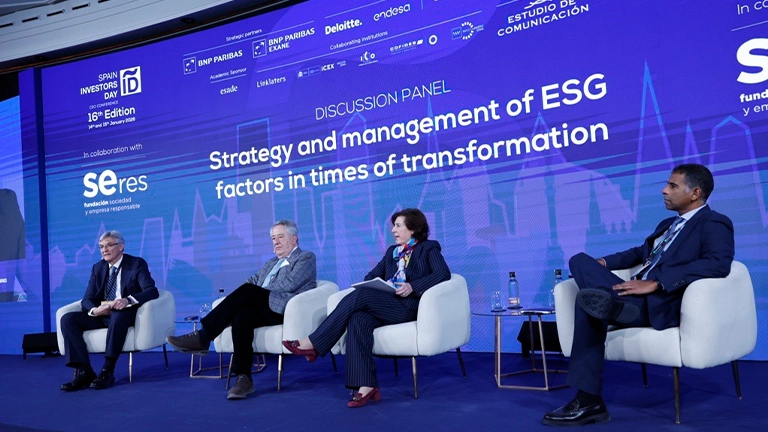
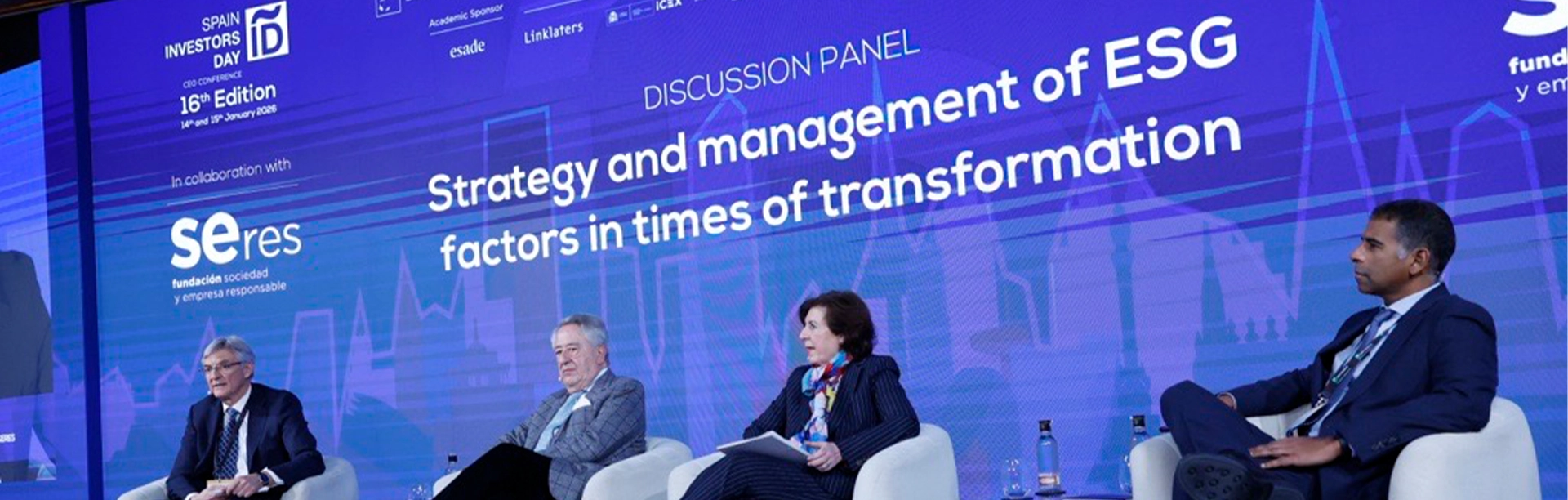
The roundtable Strategy and management of ESG factors in times of transformation, held as part of Spain Investors Day with Esade as an academic partner, addressed this challenge by bringing together perspectives from companies, foundations, and academic institutions. Daniel Traça, director general of Esade, emphasized the central role universities play in educating talent that is conscious of its impact on the world, as well as in acting as hubs capable of convening coalitions of diverse actors to pursue shared solutions.
A more hostile world
The discussion opened with a stark diagnosis from Fernando Ruiz, president of the SERES Foundation, who described the current moment as an exceptional situation marked by volatility and uncertainty, the weakening of global governance, and a shift toward a cruder logic of power. “We are moving from an imperfect system of governance to the law of the strongest,” he noted.
This is compounded by accelerated technological transformation, led by artificial intelligence, and by K-shaped economic growth, in which one segment of society captures the value generated by technology while another is actively impoverished. “All of this represents both a challenge and an opportunity for companies. The ESG approach is what creates long-term value,” he added, advocating for a model in which the pursuit of competitiveness does not come at the expense of the social majority.
Javier Targhetta, president of Atlantic Copper, recalled that major social advances have historically emerged from placing human beings at the center. That focus, he argued, has faded amid current dynamics of domination and repression on the international stage. In response, he underscored the role of civil society and business as spaces to re-center people—not only traditional stakeholders but also forgotten groups. “These efforts ennoble society and represent another step forward in the development of civilization,” he stated.
“We have focused heavily on freedom and much less on harmony, yet society must function as a whole,” reflected Traça. “We need to prepare people who understand that the system depends on what they do. Perhaps this was not essential in a historically stable context, but today it is urgent.”
How do we educate the talent of the future?
The question of talent occupied a central place in the conversation. Traça highlighted Spain’s strong capacity to generate talent, albeit constrained by demographic challenges, while pointing to a clear opportunity if this capacity is linked to the attraction of international students and investment.
He warned, however, that traditional educational models are no longer sufficient. The boundaries between disciplines—technology, the humanities, law, or management—have largely disappeared, and preparing individuals for the age of AI requires cross-disciplinary education, grounded in a deep understanding of how societies function and how individual decisions affect the system as a whole.
As an example, he mentioned the Bachelor in Business and Artificial Intelligence (BBAI), a new undergraduate program that Esade will offer starting next academic year and that integrates the business dimension with applied training. “The goal is for students to be able to understand, design, and lead AI with a technical mindset applied to business impact, from a strategic and ethically responsible perspective,” he explained.
The age of AI requires cross-disciplinary education, grounded in a deep understading of how societies function
“Preparing talent today means educating professionals who understand that competitiveness and social impact are inseparable,” he noted. “A decision that may seem minor can have a brutal impact on the entire system.”
The technological challenge
The impact of technology—and AI in particular—was another key axis of the dialogue. Helena Herrero, president of HP for Southern Europe, stressed that technological disruption is taking place in a context of scarcity—of talent, raw materials, and certainty—that is reshaping alliances and tensions between countries.
“AI will be one of the greatest drivers of productivity and value creation, but the real challenge does not lie in the technology itself. It lies in the ability of people and organizations to adapt, develop critical judgment, and prevent innovation from amplifying existing social gaps,” she explained.
In this regard, Herrero argued for a conception of corporate responsibility that extends beyond the company’s immediate boundaries. Democratizing access to knowledge, investing in continuous learning, and redefining roles so that people can contribute greater added value are, in her view, necessary conditions for technology to act as an ally of human intelligence rather than as a factor of exclusion.
The moment of the new generations
Despite the global backlash, Targhetta suggested that the shift in investor and corporate attitudes toward ESG has been more cyclical than structural. “Even if they do not show it, many of them have not changed internally,” he maintained, expressing confidence that the logic of sharing privilege and returning value to society will ultimately prevail.
Organizations need to willingly integrate technology, talent and purpose to ensure a future of dialogue, cooperation and competitiveness
Herrero echoed this optimism, highlighting that younger generations demonstrate far greater sensitivity to the collective impact of corporate decisions. If properly channeled, this trend could renew the social contract between business and society. “Younger generations think much more collectively than previous ones. That gives hope,” she remarked.
While Traça agreed that this concern exists among young people, he also warned that inaction risks generating deep frustration. “We cannot wait 20 years for that generation to come into power. Our generation must also move closer to them, rather than simply being remembered as the one that destroyed everything. Universities are a particularly interesting space for this intergenerational conversation to take place,” he added.
The roundtable concluded with a call to reframe ESG for the times we face: an environmental “E” grounded in realistic and authentic commitments; a social “S” focused on tangible social impact; and a governance “G” that goes beyond formal compliance. In the speakers’ view, the future of dialogue, cooperation, and sustainable competitiveness will depend on the willingness of individuals and organizations to integrate technology, talent, and purpose into a shared societal project.
Spain Investors Day is a leading economic and financial forum held annually in Spain that brings together senior executives from major Spanish companies with national and international institutional investors. Its objective is to facilitate direct dialogue between companies, investors, and public decision-makers. The participation of academic institutions such as Esade reinforces a long-term perspective and rigorous analysis of the major economic and social challenges.