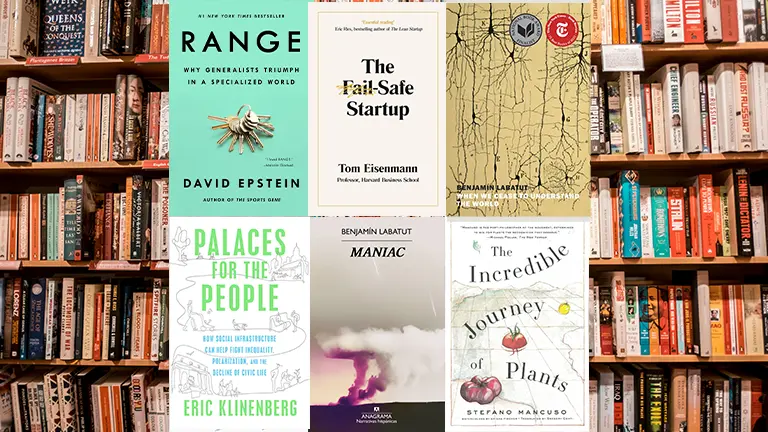

Six books recommended by Esade's faculty
On the International Book Day, we celebrate one more year our particular Sant Jordi. Here is a selection of readings recommended by our professors.

On the International Book Day, Catalonia celebrates the day of Sant Jordi, when it is traditional to give a book and a rose to your loved ones. Therefore, here you have a small collection of readings selected by professors from Esade who collaborate with Do Better. And if you're still hungry for more, at the virtual Sant Jordi stand of the URL libraries you can find many other recommendations from the Universitat Ramón Llull and Esade community.
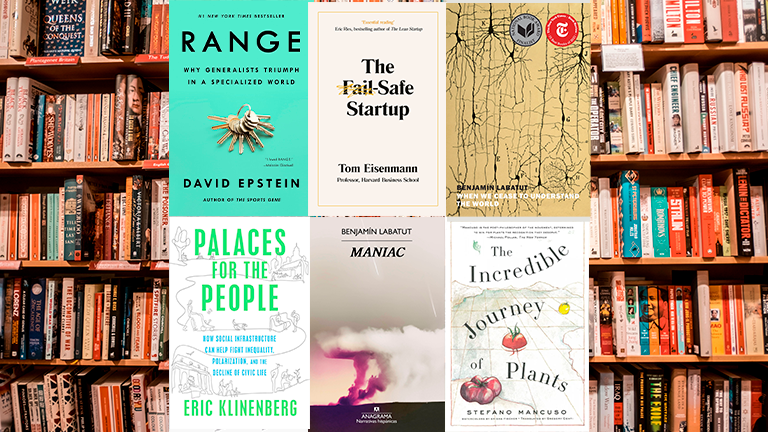
Maniac by Benjamín LabatutBenjamin Labatut's Maniac is an essential reading for any professional interested in understanding how science and technology are transforming our world. Through an exciting and accessible narrative, the book explores two fundamental and contradictory perspectives: on one hand, the ability of science and technology to propel humanity forward with revolutionary innovations; and on the other hand, the author raises important questions about the ethical implications of these advances that warn of a moment of ethical and moral crisis in science. Labatut, through various characters, manages to convey the transformative potential of artificial intelligence and how machines are challenging human capabilities. He illustrates the importance of interdisciplinarity in innovation by showing how ideas from different fields such as physics, mathematics, and computer science have converged to drive revolutionary advances, and underscores how these innovations have impacted cultural and ethical perceptions over time. Likewise, he is able to convey the depth of ideas such as quantum mechanics or game theory in a way that is engaging and understandable to a broad audience, all while posing interesting questions about the ethical implications of our scientific advancements that undoubtedly invite reflection on the social responsibility that universities, companies, and technology sector professionals have in an increasingly interconnected world. This dramatic act reminds us of the personal and collective implications of our technological decisions. David López López. Senior Lecturer, Department of Marketing |
The Incredible Journey of Plants by Stefano MancusoAnxious and exhausted regarding the news you are reading about the impact of climate change and biodiversity crises on the world we are living in? Appreciate the power of storytelling in reading some incredible stories that showcase the resilience of Mother Nature and learn the names of incredible plants that found ways to survive time and places. Because to change the world for good we need new stories that can help us see that ways forward are possible and meaningful. One plant at a time. Valentina De Marchi. Associate Professor, Department of Society, Politics and Sustainability |
Palaces for the People by Eric KlinenbergPalaces for the People is a beautiful sociological exercise that illustrates the need we have today to build and reinforce what Eric Klinenberg calls social infrastructures. With this term, he refers, for example, to clubs and public sports facilities, urban gardens, children's playgrounds, parks, pools, parish and religious centers, neighborhood associations, and also—and wonderfully—to public libraries, precisely called "palaces for the people." Such spaces foster different types of interactions, some recurring and others more informal, but all crucial in counteracting the dynamics of isolation and polarization so prevalent in increasingly segregated and unequal societies like ours. Klinenberg suggests that it is in these palaces for the people where the essential strands of solidarity and fraternity that we need can be created and nurtured. Ignasi Martí. Director of the Esade Institute for Social Innovation |
When We Cease to Understand the World by Benjamin LabatutThere is a perplexing gap between essay and fiction as complex as that which separates science from metaphysics, a space where Benjamin Labatut's masterful work, which garnered worldwide attention in 2020, resides. These are times of scientific uncertainty, of unsettling advances with unforeseeable consequences, even unimaginable ones. Perhaps for this reason, after decades of blind technological trust in technological progress, the characters in When We Cease to Understand the World, their scientific tribulations, and the drift of their ideas, methods, and discoveries allow us to glimpse what is to come at a time when science is once again the primary engine of transformation in our reality and our lives. In the various stories of this book — which are many but also one — quantum mechanics, the theory of relativity, the explanation of black holes, almost-alchemical chemistry, or mathematics share the spotlight with real characters who dedicated their lives and passions to their study and development, with life's cruelty punishing them for a thousand reasons, from madness to trenches, and without being fully aware of their gigantic legacy. Fritz Haber, creator of the Zyklon pesticide, the mathematician Alexander Grothendieck, and the fathers of quantum mechanics Erwin Schrödinger and Werner Heisenberg were some of them, and they never left us. An essential reading to remember the profound flow of science and reality, and the ephemeral nature of the greatest. Juan Moscoso del Prado. Senior Fellow, EsadeGeo |
Range by David EpsteinOur society often celebrates specialization, lauding highly competent scientists, artists, and sports players. Their stories are woven with narratives of sacrifices and relentless dedication. However, we researchers are also well-aware that narrow specialization might come with side-effects: it can lead to tunnel vision, limitation of creativity, and missing out on unexpected connections. In the captivating essay Range, the author challenges the mainstream perception that early specialization is the only way to success, and introduces us to a plethora of counter-examples: athletes or professionals who discover their latent talents later in life, researchers or artists who perform better precisely because they focus on multiple skills, or the woman who, overlooked by expert doctors, meticulously researches and diagnoses her own rare disease. This well-written thought-provoking text inspires us to reflect on the biases inherent in hyper-specialization and embrace diversity, open-mindedness, curiosity and multi-disciplinarity. Jose A. Rodriguez-Serrano. Senior Lecturer, Department of Operations, Innovation and Data Sciences |
The Fail-Safe Startup by Tom EisenmannThe Fail-Safe Startup by Tom Eisenmann, a professor of entrepreneurship at Harvard Business School, is not just another startup guide. It offers a deep dive into why entrepreneurial ventures fail and how to avoid the most common pitfalls. The book merges scholarly research with Eisenmann’s vast practical experience, revealing six patterns of failure and providing actionable remedies to enhance a startup’s chances of survival. It covers various scenarios I have frequently observed in the startup world: poor founder-market fit, insufficient understanding of customer problems, reluctance to pivot, struggles to secure capital, challenges to (rapid) scaling, co-founders turning into opponents, and difficulties in attracting skilled talent, among others. The author provides useful frameworks, for instance, the RAWI (Ready, Able, Willing, and Impelled) model to help founders assess their readiness to scale. He enriches these frameworks with case studies and interviews with entrepreneurs across diverse backgrounds, making intricate concepts accessible and applicable. Ultimately, Eisenmann’s book about failure is a comprehensive roadmap for long-term entrepreneurial success. Whether you are a founder or an innovator within a large corporation, "The Fail-Safe Startup" should be your next great read. Annelore Huyghe. Associate Professor, Department of Strategy and General Management. |