Necessary Conversations: Has solidarity come to an end?
Milagros Pérez Oliva, Hatim Azahri and Jorge Galindo opened the Necessary Conversations series at Esade’s Institute for Social Innovation by asking whether solidarity has broken down — or whether we have simply stopped recognizing it.
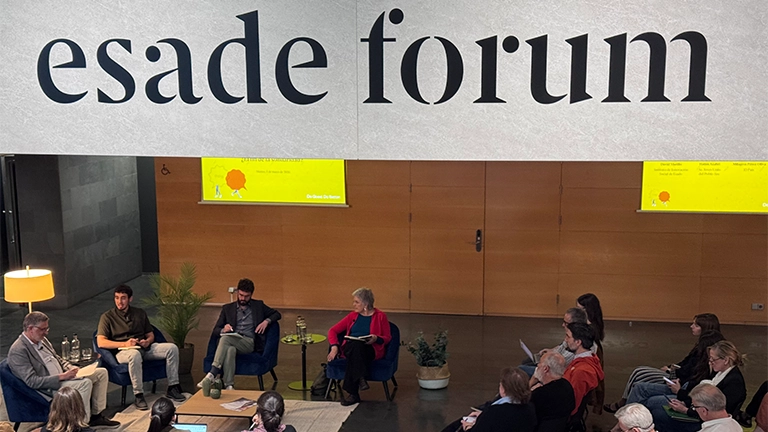
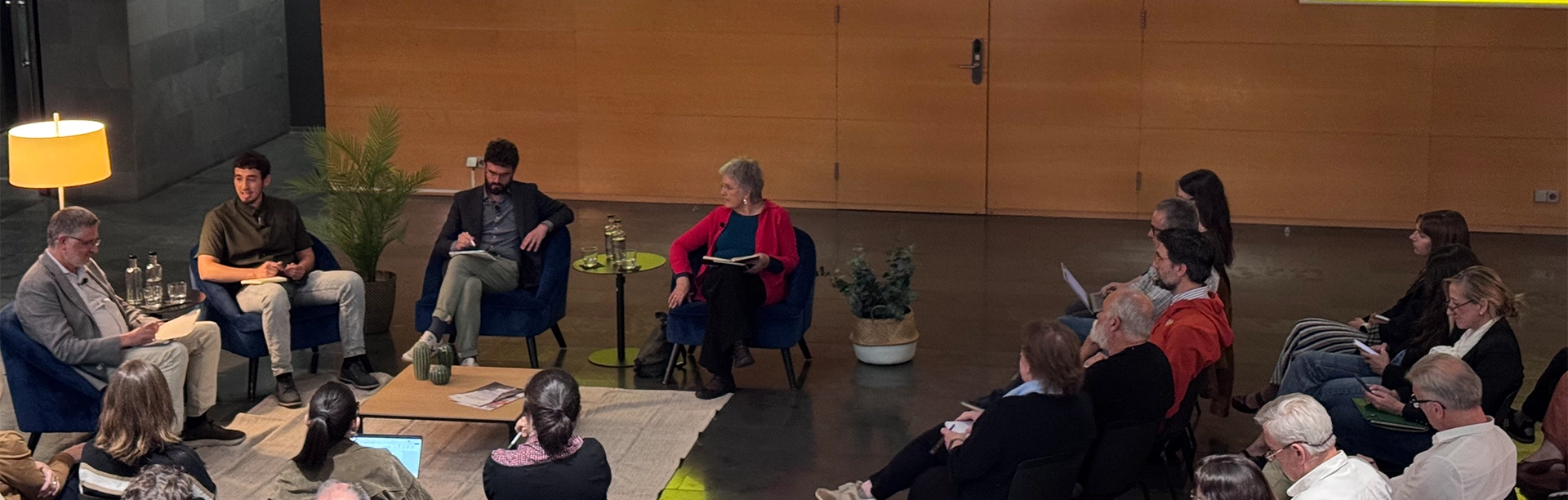
In a warm, living-room-like setting filled with armchairs, coffee tables and soft lighting, David Murillo, Associate Professor of the Department of Society, Politics and Sustainability at Esade and moderator of the session, opened the first edition of Necessary Conversations with a blunt question: Is this the end of solidarity? Even without a dog in the room, the question still had bite.
It was an important question — and a recurring one. Murillo recalled that more than thirty years ago he was already reading Richard Sennett on the corrosion of character and Robert Putnam worrying about half-empty bowling alleys. So part of the debate, he suggested, is an honest one: are we facing something genuinely new, or simply a more acute version of a phenomenon we have been describing for decades?
That was how he introduced the speakers — three perspectives, three generations and three different ways of understanding solidarity.
“We are living through a moment of maximum solidarity”
Hatim Azahri is 28 years old, founder of the Associació de Joves Units del Poble-Sec and recipient of the 2026 Princess of Girona Award. When it was his turn to speak, he immediately rejected the pessimism implied by the title of the event.
“I would dare say we are living through a moment of maximum solidarity, even if the headline says we are in crisis.”
His argument was simple: what has broken down is not solidarity itself, but our definition of it. For too long, he argued, solidarity has been confused with charity — with voluntary gestures activated only in moments of catastrophe. But solidarity, viewed from the neighborhood level, is something else entirely. It is everyday life. Greeting your neighbor. Asking someone’s name. A survival strategy.
“The most effective and intelligent strategy is always cooperation.” He invoked the image of bees and their highly organized hive. Alone, he argued, no one gets very far — even if they seem to move faster.
Azahri also broadened the concept. Today, solidarity crosses generations, species and digital borders. He pointed to international mobilization around Palestine — young people boarding flotillas and physically exposing themselves to danger — as an example of solidarity reaching what he described as “a level of excellence humanity rarely achieves.” If we fail to see it, perhaps it is because we are still measuring it with outdated tools.
“They gave us degrees and kept the housing”
Jorge Galindo, director of EsadeEcPol and trained sociologist, arrived with data — and with a recent title that worked almost as a thesis statement: Neither Merit nor Solidarity: They Gave Us Degrees and Kept the Housing.
His argument centered on a harsh reality: his generation and the one after it were given one tool — higher education — while losing another — access to housing. “And then they are asked to be supportive,” he observed.
“I don’t think the answer to this can simply be intergenerational solidarity. What is breaking down is a cooperative agreement.”
Galindo backed this with numbers. Home ownership among people under 35 has fallen from 67% to 35%. Incomes among those over 65 have grown twice as fast as those aged between 18 and 45. And when wealth — not income — is measured, his generation has lost around 75% relative to equivalent generations two cycles earlier. Almost all of it, he argued, can be explained by one factor: housing ownership.
His conclusion was nuanced: before asking for solidarity, society first needs to rebuild cooperation. Reconstruct a positive-sum agreement between generations. Only then can broader solidarity emerge.
“I don’t think there is a generational conflict. I think there is a gap. We need to close it before it becomes a conflict. Some people are already trying to exploit it.”
“We are witnessing the delayed dismantling of the welfare state”
Milagros Pérez Oliva, journalist at El País since 1982 and coordinator of a recent Barcelona Metrópolis dossier on the topic, brought the longest historical perspective — and perhaps the harshest diagnosis.
Her reading was clear: for decades, solidarity served a strategic purpose for the West. It transferred resources from the Global North to the Global South, filled gaps that geopolitics preferred not to address, and formed part of the broader social narrative. Then came the neoliberal wave of the 1980s, and the underlying mental framework shifted. Education began producing “masters of the universe.” Fraternity — the forgotten third value of the Enlightenment, as philosopher Victoria Camps has argued — disappeared from public discourse.
At the same time, another quieter process unfolded: growing suspicion toward NGOs, obsession with efficiency metrics, and the rise of what she described as the “dark enlightenment” emerging from parts of Silicon Valley — a worldview that explicitly places concepts such as sustainability and solidarity on the list of enemies of progress.
“In the Darwinism that dominates today, it is considered better that those who cannot prosper simply do not prosper. And the world should be governed like a company. They say it openly.”
But her sharpest criticism was directed closer to home. According to Pérez Oliva, the system has found a way to dismantle the welfare state without anyone ever voting against it: doing it gradually. Firing parents and rehiring children at half the salary. Turning employees into false freelancers. All framed within a narrative of generational conflict deliberately cultivated, she argued, since the first demographic studies financed by banks to sell private pension plans.
The tension of the afternoon
There was agreement — but also friction.
Pérez Oliva challenged one of Azahri’s arguments: that institutions should transfer power to younger generations if genuine renewal is to happen.
“Older generations should not have to give young people access to anything. Young people should organize themselves however they want. In fact, you should displace us. You should take the wheel yourselves.”
In her generation, she reminded the audience, even associating collectively was once persecuted. And that repression, paradoxically, generated political consciousness.
Azahri responded quickly. Young people are mobilizing, he argued — society is simply using outdated tools to measure it. The mobilization around Palestine, with international flotillas and young people physically exposing themselves to conflict, represents one of the strongest expressions of solidarity his generation has witnessed.
But he added another important nuance: institutions also bear responsibility. For years, many organizations have expected young people to participate without asking what they are actually being offered when they arrive — symbolic roles, seats without power, listening without decision-making.
“If there is no transfer of power, there is no leadership, and no real agents of social transformation can emerge.”
In his view, conquering space and having space opened are not opposing ideas. They are two halves of the same hive.
What remained on the table
Murillo closed the session with a summary that unintentionally gave shape to the entire afternoon.
Three ideas stood out:
- challenging mental frameworks that oversimplify the debate;
- recovering a sense of agency and possibility for change;
- and recognizing that society is living through a Polanyi-style pendulum moment, where anxiety fuels not only demands for protection, but also demands for saviors.
And one final observation, almost in passing: the most optimistic voice at the table had been the youngest one. The older speakers had been the most critical. That, Murillo suggested, says something too.
There was applause. And afterwards, people remained talking in small groups around the chairs.
If solidarity is something practiced — as Azahri insisted throughout the afternoon — perhaps it begins there.
By not going home just yet.