ROOTS: A student journey into mangrove restoration and transformative learning
In the Gambian village of Sankandi, students and residents join forces to fight water salinization by restoring mangroves. This award-winning project, led by Esade, combines technology and local knowledge to protect the ecosystem.

Waking up under a mosquito net, with a rooster crowing and the fan stopped due to a power cut. We start the day early by heading to the river area to take salinity measurements. The prototype works, even though it needs some recalibration. Later, we return to the Darbo family’s home for a warm meal before delivering a training session to SYDA volunteers. Every moment, from collecting data to sharing food, brings us closer to a vision of restoration, community, and connection.
This is not a travel diary—it’s a snapshot of the deployment phase of the ROOTS Project in The Gambia, a powerful example of what happens when education steps outside the classroom and into the world.
The ROOTS Project was born in September 2024 through Fusion Point's Challenge-Based Innovation (CBI), a partnership between Esade, UPC, and IED in collaboration with IdeaSquare at CERN. Since 2014, business, engineering, and design students have come together to tackle global challenges aligned with the Sustainable Development Goals (SDGs). On this occasion, in collaboration with the SALBIA Project from CSIC-IDAEA, one of the challenges confronted participants with a pressing problem in West Africa: saltwater intrusion into Gambia's main river. As part of the project's implementation in Gambia, carried out in August 2025, ROOTS was awarded 2nd place in the Uniservitate Awards 2026, an international recognition for service-learning projects in higher education. Esade joined the Uniservitate Network this year, coinciding with the first Service-Learning Day held in February at the Fusion Point space.
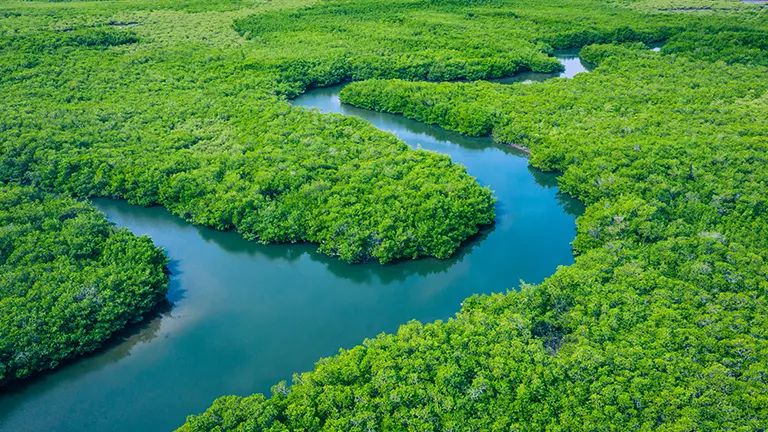
The country, long and narrow, wraps around a river that sustains life. But increasing salinity is damaging rice fields, killing mangroves, and threatening biodiversity and livelihoods. In this context, mangrove forests are not just trees—they are nature’s frontline defense, providing habitat, stabilizing coastlines, and serving as a natural barrier to salt.
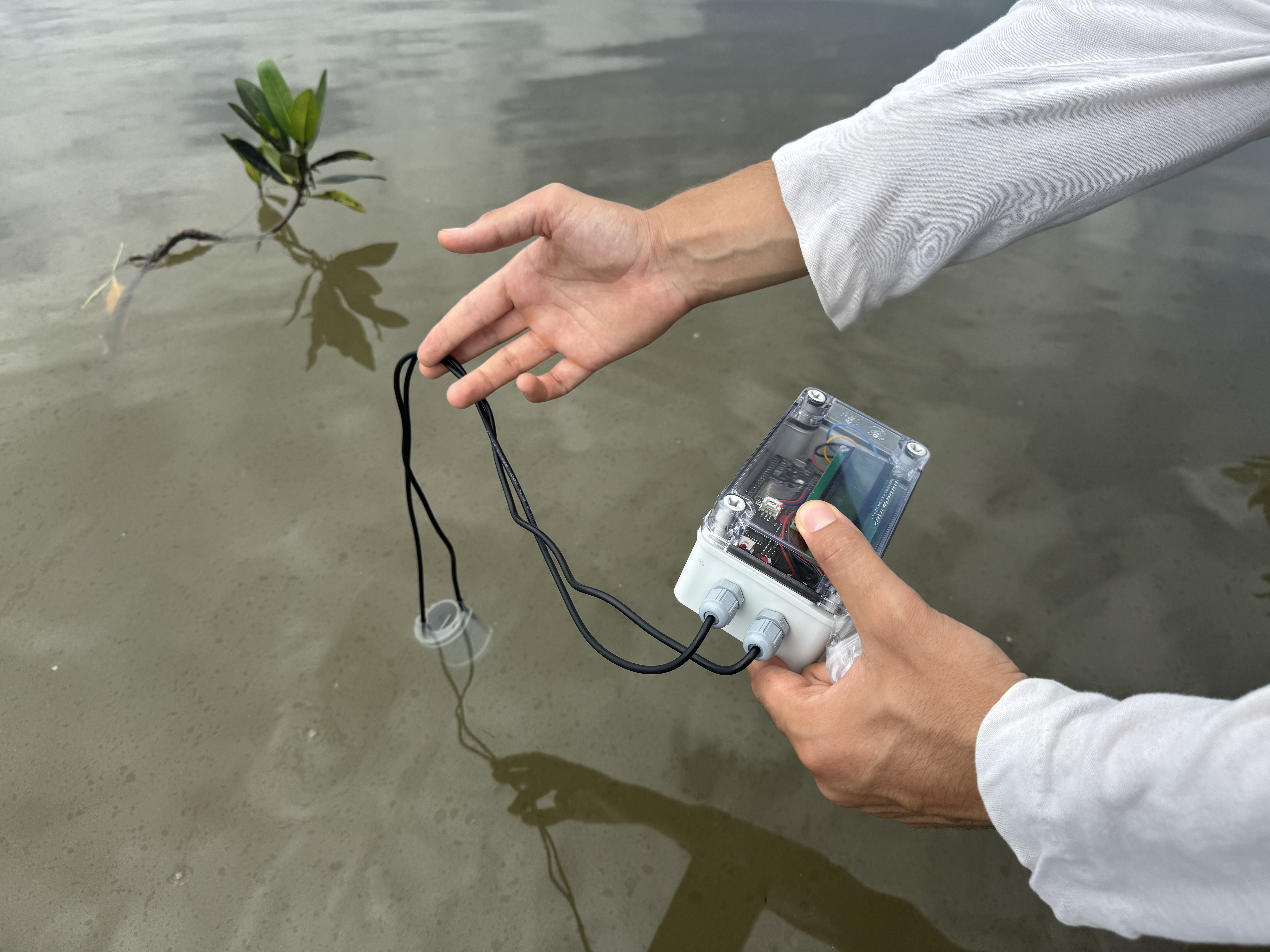
Team Delta, a student group within the CBI 2024 cohort, developed ROOTS: a low-cost, DIY (Do It Yourself) environmental monitoring kit to support community-led mangrove restoration in the village of Sankandi. The device, paired with a simple Android app, measures salinity, records mangrove characteristics and geolocation data, and feeds it to researchers at CSIC-IDAEA to model optimal replanting conditions. The aim? To combine traditional local knowledge with scientific insight and determine which mangrove species thrive best in which areas.
From conception to fieldwork
After presenting their solution online from Barcelona, we were thrilled when CSIC-IDAEA and the Sankandi Youth Development Association (SYDA) expressed a desire to bring it to life. What once felt like an ambitious idea quickly became reality. In July 2025, a team of five students traveled to The Gambia to deploy the project, conduct training, and co-create with the community.
The ROOTS deployment team of Fusion Point students included Adriene Rivera (Esade MBA alumna and project co-creator), Marios Contopoulos (MiBA student), Jon Vadillo (UPC Master in Data Science student), Sebastian Irinciuc (UPC Master in Electronics Engineering student), and Ilias Khayat (UPC Master in Telecommunications Engineering student). As the Academic Coordinator at Fusion Point, I also joined the trip to support the field deployment and facilitate collaboration with local partners. For two weeks, we worked alongside partners from the University of The Gambia, the Department of Water Resources, the GREAT Institute, and WABSA, transferring technical know-how and refining the tools for long-term use.
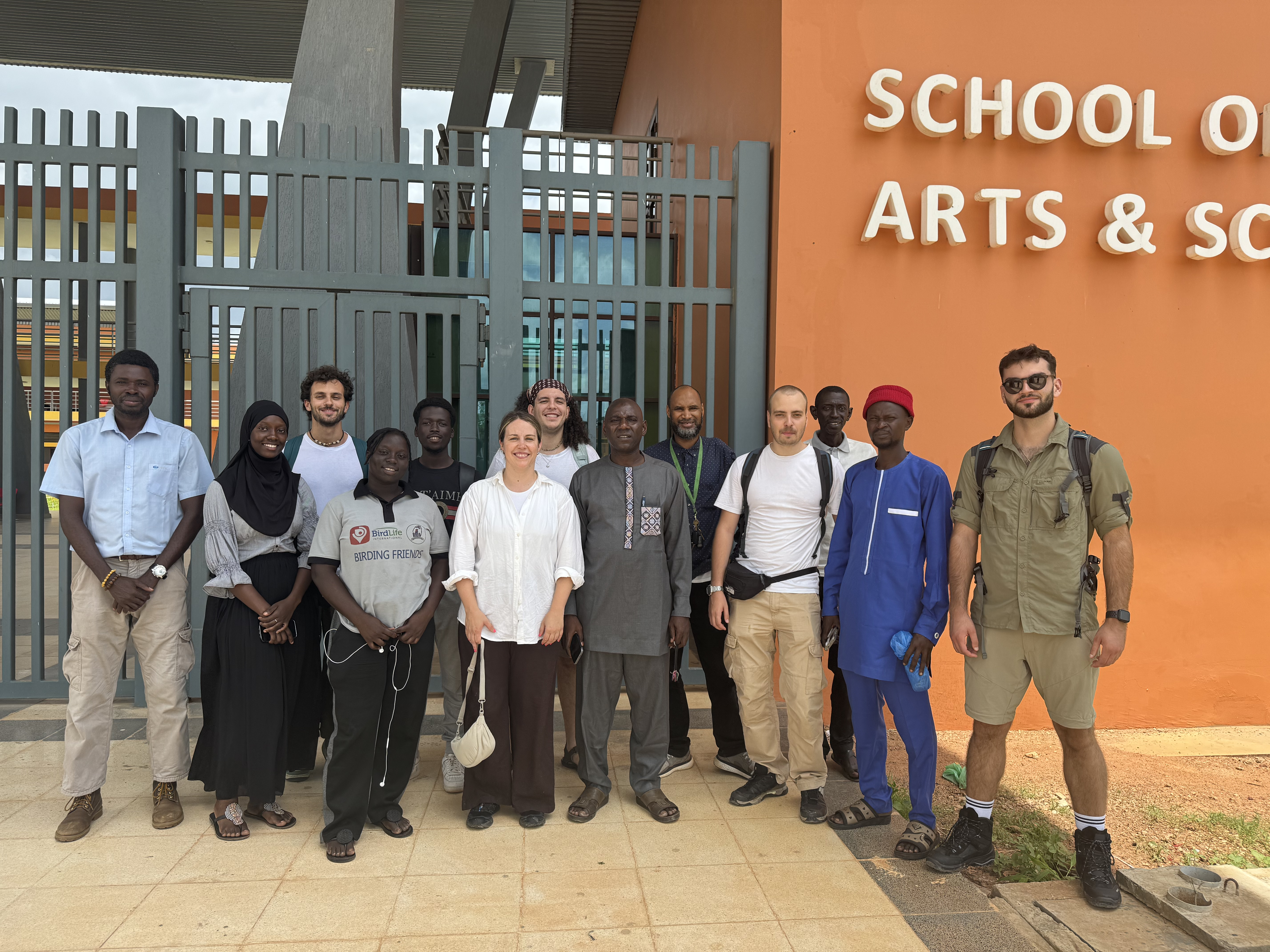
But the real transformation happened in Sankandi. Hosted by the Darbo family—Ansumana Darbo, SYDA’s founder, was our key local partner—we were welcomed into the life of the village and the community. We shared meals, cooked together, played football with the kids, and were formally received by the elders and the alkalo (the village chief). We trained the local environmental committee and the SYDA members on data collection and device use. From youth to elders, men to women, the entire community takes part in reforesting the mangroves—an effort that started years ago, when natural regeneration could no longer keep up with the rate of degradation.
“When we first designed the device, it felt like a concept. But being here, seeing the community’s involvement, it suddenly feels real. We’re not just prototyping a sensor—we’re part of something bigger.”
Adriene Rivera, ROOTS co-creator and MBA alumna.
We were also lucky to count on the support of Jainaba Njie, an Esade MBA alumna from the Class of 2023 and originally from The Gambia whose contribution was invaluable. She welcomed us, shared insights into local culture, helped us navigate customs and logistics, offered key guidance that helped align the project more closely with the community’s priorities and got us to taste her family recipe of jollof rice. Her presence bridged not only continents, but also generations of Esade changemakers.
“It’s the first time I'm involved in a student project that is creating real impact, and I can work in the implementation in the field. It brings so much sense and meaning to everything. Also spending time with the community in Sankandi, learning some Mandinka, playing with the kids... it has been so impactful professionally and personally, an experience that I will never forget.”
Marios Contopoulos, MiBA student.
A hub for mangrove restoration
As a professor and Fusion Point Academic Coordinator, I can say this project was as transformative for me as it was for the students. It broke the traditional barriers between educator and learner. We were all in the field testing the prototype, tweaking code together, creating training materials side-by-side, being overwhelmed by the chaos, confused with the communication barriers, and sorting it out together, with everyone contributing. For a while, I could be a student again, learning from the community, from our partners, and from my own students.
The ultimate dream is to turn Sankandi into a National Hub for Mangrove Restoration. With SYDA’s leadership and the technical support of the University of The Gambia, the ROOTS system can be repaired, replicated, and scaled using local available materials. And the data gathered will contribute to predictive models for more resilient reforestation strategies—not only for Sankandi, but potentially across the region and the continent.
ROOTS embodies the values we uphold at Esade: sustainability, innovation, social impact, and learning by doing. Our students didn’t just work for the community—they worked with it. They practiced systems thinking, inclusive leadership, and deep empathy. They left transformed.
This isn’t just a story about mangroves. It’s about the power of education to connect worlds, and the importance of listening, sharing, and creating together. It’s about shaping future leaders who understand that impact is not about solving problems alone, but about co-building solutions that last.
As we left Sankandi, a few words stayed with us: Abaraka baake—‘Thank you’ in Mandinka, the local language. The gratitude, however, is ours. For in working together, we didn’t just help to restore mangroves—we restored connections and grew roots for a more sustainable future.