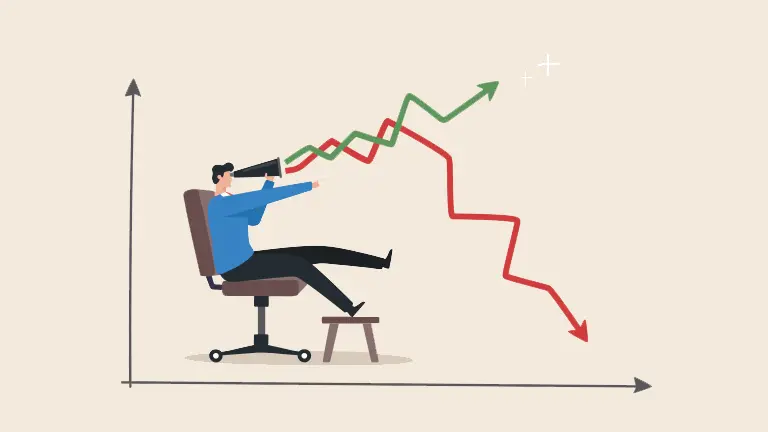

Predicting the future of marketing as we enter the unknown
The success of marketing no longer depends solely on fulfilling consumer needs. Organizations that can predict the global conditions driving demand will be the ones that capture the market.

Whether it’s a low-end essential good or a luxury status item, the traditional marketing function should detect needs and desires to create goods and services that satisfy them.
But as consumption becomes an increasingly dirty word on a planet with finite resources, many purchases will soon be seen as unnecessary, or replaced with products that can be recirculated and re-used. Manufacturers will shift focus from selling as many units as possible, and usufruct will become more important than ownership.
These are the predictions of Esade associate professors of marketing Carles Torrecilla and Gerard Costa, who have explored the future challenges of marketing in Harvard Deusto Business Review. In this article, we offer a brief review of their contributions.
The success of traditional marketing, they suggest, no longer hinges on the ability to analyze consumer needs and create products to fulfill those needs. Instead, organizations that successfully predict the global conditions that will drive demand will be those that capture the market.
Estimating the uncertain
Unlike the functions of the finance team or operations department, which have clear actions and implications, the role of marketing has always been more of a conceptual one. While the accountant works with entries in a ledger, or the operations manager signs off the purchase of a new warehouse, the marketeer predicts what the customer may want and how to engage them.
Traditionally, the starting point has been to assess the expectations of customers and race against competitors to meet those expectations. But in an increasingly globalized world, where mergers and acquisitions mean a competitor one day is a partner the next, brands take on a new level of fluidity. Secrets and confidentiality have given way to knowledge exchange, open innovation and joint R&D.
Within this new landscape, the risk is external to the market: new technology such as AI that renders products or services obsolete; regulations that retrospectively attempt to control innovations that go straight to market without impact assessments; the role of political unrest and climate disaster on the supply chain. In today’s marketing environment, the competition is increasingly part of the same team.
Picking up the slack
Competitors may have to unite against common opponents to ensure the survival of their sector, but the rivalry hasn’t been eliminated. In any commercial operation profitability is key, allowing those with the best financing to buy up the high-performing companies that have less cash in the bank.
Developing algorithms by measuring the actual flow of goods is a more accurate predictor than relying on consumer feedback
Buying up competitors based on past performance alone is a risky business, so prediction is another key element of acquisitions. But forecasting future sales isn’t an exact science, leaving the operations department to do a lot of the heavy lifting.
Developing algorithms by measuring the actual flow of goods is a more accurate predictor of supply and demand than relying on consumer feedback. Opinions are just that — they can’t be used as reliable predictors of an intention to buy.
Dealing with the fall-out
But all the operational algorithms and marketing predictions in the world can’t be relied upon to gauge future trends in today’s climate of uncertainty. The global pandemic, ongoing wars and freak accidents such as the grounding of a barge in the Suez Canal can all trigger the collapse of supply chains that cause chaos with carefully planned prices.
If the fall-out was left to the finance department, inevitably the costs would be passed onto the consumer. But the marketing team knows better than anyone that this tactic can destroy relationships that have taken years to build. Consumers are fickle beings: if their usual supplier is suddenly beyond their budget, they’ll simply switch allegiance to another.
So how does the finance department keep cashflow on an even keel, while the marketing team sustains those longstanding and essential relationships? According to Torrecilla and Costa, the answer lies in financial derivatives.
Hedging the bets
With a close collaboration between finance and marketing, it’s possible to keep customers onside while balancing the books.
To do so, the questions companies should ask themselves include:
- Which customers will accept price increases?
- Which clients will accept a temporary break in the relationship while retaining overall loyalty?
- Who will be happy to delay their purchases until normal services are resumed?
- Which customers would be happy to pay extra to ensure an uninterrupted supply?
- What modifications can be made to the service or product without jeopardizing quality or market position?
The challenge for the marketing team is to ensure that the organization chart, functions and commercialization models of the department can adapt to each of these scenarios. By using their expertise and insight, they can ensure their activities support the use of short-term financial derivatives and retain long-term customer loyalty.
Marketing with a conscience
Environmental, social and corporate governance (ESG) plays an increasing role in the marketing function, and that of the business overall. Financial success is imperative for survival, but it can no longer be pursued at any cost. Financers demand sustainability and environmental measures as conditions of funding, and half-hearted attempts at greenwashing no longer suffice.
AI will continue to play a role, but wise companies will use it to create efficiencies rather than automate the marketing process
The result is purpose-driven strategies that are attractive to financers and stakeholders, ultimately driven by consumer demand. AI will continue to play a role, but wise companies will use it to create efficiencies rather than automate the marketing process.
In the complexities of modern marketing, the skill lies in creating intelligent briefs that acknowledge the many variations in the supply chain, the customer experience and the increasing demand for sustainability. The use of AI can adapt these briefs to create bespoke messaging that supports the goals of financial derivatives, facilitating a frictionless omnichannel that fulfills all needs.
For the marketing manager, the goal remains the same: to generate the ‘wow’ factor. The difference is that the product or service will be an instrument in the experience, rather than at the center of the relationship.