

Tackling the emotional impact of expatriation
As digitalization and globalization continue to transform the world of work, job candidates with a deep understanding of differing social and cultural norms are increasingly valuable to businesses that want to thrive on an international scale.

When a company’s success is measured globally, its identity and policies must reflect global values, and its workforce equipped to build global competencies. To meet this demand, businesses send key workers abroad to transfer the requisite knowledge and skills and develop cross-cultural organizational capabilities.
This strategy comes at a high financial cost to the organization but for the worker there are many emotional costs to bear. As well as the pressure to perform in a new work environment and unfamiliar cultural setting, they may be leaving behind established support networks and dealing with the additional consequences for family and friends.
To better understand the emotional impact of expatriation, Rita Rueff-Lopes, professor in the Esade Master in International Management, and co-authors Romina Leveau (Universitat de Barcelona), Ana Junça-Silva (ISCTE - Instituto Universitário de Lisboa) and Leticia Mosteo (University of Zaragoza) surveyed 99 expatriate workers about their experienced events and felt emotions and trained an artificial neural network to identify patterns between them.
Their research (‘Adapting to a New Country During an Expatriate Mission: The Vital Role of Events and Emotion’, published in Nonlinear Dynamics, Psychology, and Life Sciences) has identified the events that can either promote or hinder emotional well-being during the process of adaptation to the host country.
The findings will help organizations anticipate the issues their workers may face and help them to reduce the negative impact of their expatriate experience.
Evaluating emotions
The participants were asked to provide information about their age, gender, education, marital status, nationality, home country and country of expatriation.
Researchers used the Critical Incident Technique by asking participants to freely describe the most important events (positive and negative) they had experienced during their adaptation to the host country.
A balance between feasible and challenging tasks and having opportunities to learn makes the expat experience more positive
Participants were then asked to identify the emotions that arose from these events using the Scale of Positive and Negative Experience (SPANE), which consists of twelve items: six negative (negative, bad, unpleasant, sad, afraid, angry) and six positive (positive, good, pleasant, happy, joyful, content).
Each item was evaluated on a scale of one to five, one being “rarely or never” and five being “very often”. A total of 221 events were reported – 107 positive and 114 negative. These were analyzed by three judges.
Common themes
The first two judges determined categories based on the similarities present in the reported events. The categories they identified were emotional well-being, social well-being, economic wellbeing, accommodation, culture, the host country’s characteristics, language, regulations of the host country, work, personal development, and physical well-being.
The third judge, who was not told about the purpose of the study, was then asked to attribute each event to one of the categories defined by the first two judges. This allowed the researchers to monitor the level of agreement between the evaluations of the categories, which was confirmed to be statistically significant.
The research team then used IBM’s SPSS statistical software to build an artificial neural network — a machine learning program that mimics the way that the brain processes information — in order to process the relation between events and emotions. The neural network started by grouping the 11 categories of events, or predictors, into three common themes.
These themes, or nodes, were named sources of self-realization and recognition (comprising the events language, work, and opportunities for development), sources of wellbeing (comprising the events social well-being, economic well-being, physical well-being, culture and country characteristics), and needs of security (comprising the events accommodation and country regulations).
The events grouped within each of these nodes were linked to either positive or negative emotions, allowing the researchers to predict the emotional impact of common events.
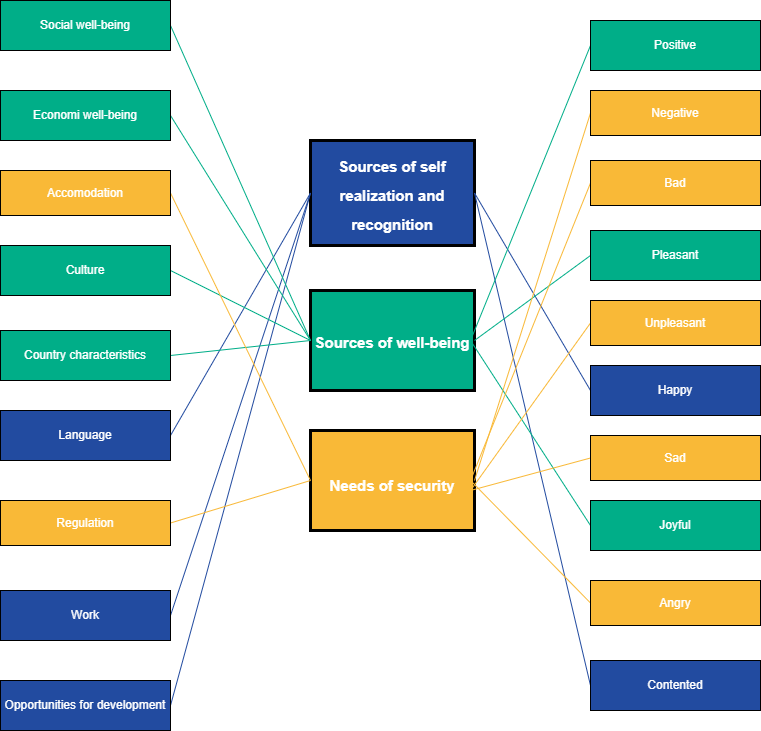
Themes categorized by the neural network.
From there, they were able to develop recommendations for organizations that will help to ensure the smooth and successful integration of expatriate workers:
Sources of self-realization and recognition
When expatriates are satisfied with their work, given a balance between tasks that can be accomplished and those that present challenges, are given opportunities to learn and develop their skills, and can communicate clearly with others, their emotional experience is overwhelmingly positive.
To enable these positive experiences, organizations should focus on providing healthy workplaces, sending expatriates to countries where language is not a barrier, and offering a range of training opportunities.
Sources of wellbeing
Positive ongoing experiences of countries and cultures combined with economic wellbeing, physical wellbeing and social support are all prompts for positive emotions. Social wellbeing was the highest-ranked emotional experience, illustrating the importance of a satisfying social life.
Organizations should provide healthy workplaces, avoid language barriers, and offer training opportunities
While organizations cannot guarantee positive experiences outside of the workplace, they can provide the resources to enable them. Along with the financial remuneration to establish economic wellbeing, healthcare and counseling can promote mental and physical wellbeing, and providing more holidays can help workers to fulfill their need for social interaction.
Organized experiences, activities and team-building exercises can also strengthen social relationships between workers. More generally, specialized coaching programs with a focus on promoting strong social networks can benefit both the organization and the individual.
Needs of security
The categories grouped into this final node (accommodation and country regulations) were exclusively linked to negative emotions. Fear and uncertainty lead to withdrawal, so organizations should provide support with practical relocation issues, proactively work to mitigate negative experiences and remove any barriers that result in the worker feeling unsafe or insecure within their new environment.
The findings, conclude the researchers, illustrate the importance of focusing on the social aspects of expatriation as well as the structure of the role and needs of the business.