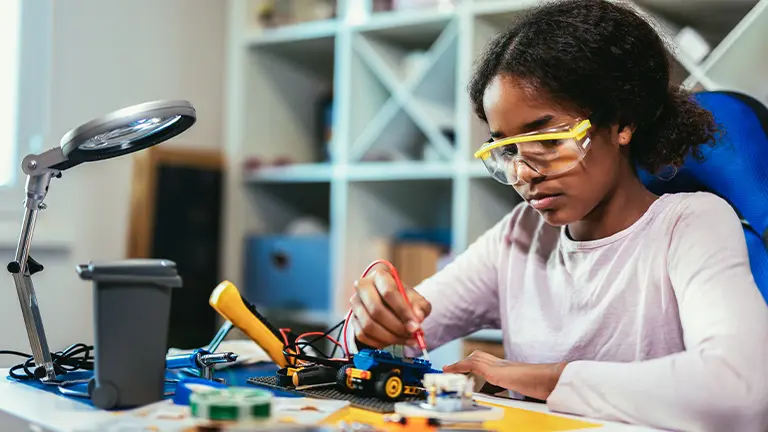

Women, girls, and technology: Close role models versus heroic narratives
The lack of diversity in the tech industry limits its ability to provide effective solutions for everyone. On the International Day of Women and Girls in Science, we propose solutions to bridge the gender gap.

When the first virtual reality headsets became available to the public, a problem quickly emerged that had previously gone unnoticed. Women experienced significantly more dizziness than men when using them due to physiological differences related to balance and ear structure. In a highly male-dominated tech industry, product development overlooked half the population. How could this happen?
The anecdote illustrates how companies risk missing out on business opportunities by failing to consider the diversity of their users. But it also highlights a structural problem in the tech industry: if design and development teams lack diversity, the solutions they create may fail to be inclusive and effective for the entire population.
The presence of women in the tech sector enables technology to address broader societal challenges
For Liliana Arroyo, researcher at the Esade Institute for Social Innovation and former Director General of Digital Society in the Government of Catalonia, the issue of female underrepresentation in the tech sector is critical. On the International Day of Women and Girls in Science, we talked to her about the lack of female representation in the tech sector.
"When we talk about market solutions and research, the topics of interest are closely linked to who is asking the questions, their daily experiences, and the types of challenges they face," Arroyo explains. If workforce representation in an industry is limited, so will be the industry’s ability to detect needs. "Incorporating women allows technology to address much broader challenges," she states. "And in fact, gender is just the gateway to greater diversity."
A gender gap that begins in childhood
The first challenge is obtaining data to measure the extent of the problem. The barometer DonaTIC in Catalonia, presented in 2023, revealed alarming figures regarding female participation in the tech industry. Women made up only 21% of the digital sector’s workforce. If roles related to communication, human resources, or legal affairs are excluded, the percentage drops to just 18%.
Broadening the scope, the data remains discouraging. According to the World Economic Forum, only 3 out of 10 people in STEM professions (science, technology, engineering, and mathematics) are women. Girls Who Code, in a study with Accenture, found that 50% of women leave the tech sector by the age of 35. Meanwhile, the Entelo Women in Tech Report revealed that only 10% of executive roles in the industry are held by women.
There is a problem of self-perception among girls' own abilities that is reflected as early as age 10
As Arroyo points out, the lack of female representation in STEM creates a vicious cycle, as the absence of female role models perpetuates the gender gap. "Women tend to see themselves more as users rather than creators of technology, which limits their access and participation in these fields," she warns.
Based on her experience, public policies have attempted to address the issue through initiatives that promote scientific and technological curiosity among girls. However, these efforts often target girls too late. Programs are usually designed for secondary school students, by which time many have already ruled out the possibility of pursuing these fields. "Research indicates that gender roles become ingrained at age six, and scientific vocations start developing around age eight," she explains.
In this regard, the Women in STEM: From Basic Education to the Professional Career report by EsadeEcPol revealed a significant self-perception issue at a very early age. By the age of 10, girls are 15% less likely than boys to consider math their favorite subject, and 8–9% less likely to believe they are good at it, learn quickly, or enjoy it.
From heroines to local role models
What can be done to close the gap between girls and boys? Arroyo points to two key elements. One is fostering what she calls "zero-kilometer" role models. "In 90% of cases, women who become engineers do so because they have a role model within their family or immediate environment," she explains. Instead of focusing on highly famous figures in the sector, "we need policies that bring role models closer to your neighborhood."
Women should be able to aspire to be 'regular' technologists without having to perform heroic acts
The second element is dismantling prevailing narratives, which are closely tied to self-perception and the impostor syndrome that particularly affects women. "When we talk about female tech role models, we often present them as heroines, making it seem unattainable. Women should be able to aspire to be 'regular' or even 'mediocre' technologists without having to perform heroic acts," Arroyo suggests.
However, the researcher cautions against reducing the importance of role models and self-perception to a personal issue. The gender gap in technology is a structural problem, and solutions must involve everyone—including the other 50% of the population: men.
"When a woman advances in the tech sector, it’s often because another woman has supported her. It’s crucial that female tech, digital, and scientific talent is not valued solely by other women," she explains. "We also need to teach boys to recognize female talent as talent."
Tough times for diversity
In recent months, there has been growing resistance to diversity, equity, and inclusion (DEI) policies in the corporate world, particularly in the tech sector. Companies like Meta and Google have announced that they will stop actively promoting diversity policies. According to Arroyo, this setback is not just symbolic—it will have real effects on labor market structures and society as a whole.
Gender equity in tech requires a collective effort, including public policies and individual initiatives
"The corporate world is a major driver of social change, especially large companies." When the leaders of these corporations fail to appreciate diversity and inclusion, "it’s not just economic opportunities that are lost, but also opportunities for social cohesion and interpersonal trust."
Furthermore, the gender gap in worldviews is widening. "Women are far more aware of diversity and the need to live in inclusive societies and relationships," Arroyo warns. She also highlights the urgent need for positive male role models for young people. "Traditional and regressive masculinities, often linked to far-right values, are gaining influence," she points out.
Despite these challenges, Arroyo delivers a clear message: the fight for gender equity in the tech sector is a collective effort that must include both public policies and individual initiatives. And against the overwhelming presence of male figures in the media, she highlights the role models found in our neighborhoods, cities, and universities. "To the women already working in technology, I say: be ambassadors of your work and your profession."