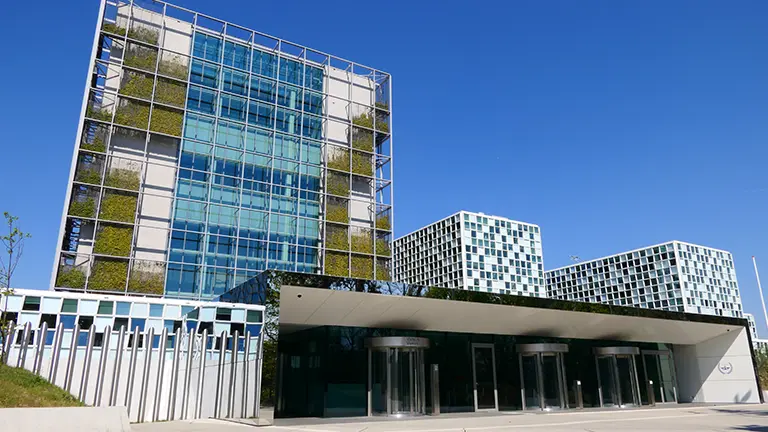
Is the International Criminal Court fit for purpose?
Conceived as a way for the global community to prosecute individuals for grave crimes, the International Criminal Court has always been controversial. But with only 10 successful convictions in a quarter of a century, has it been useful?

Twenty-five years ago, the United Nations General Assembly adopted the founding treaty of the International Criminal Court (ICC). The Rome Statute, thrashed out over a four-week diplomatic conference in the Italian city in 1998, came into force in July 2002.
The Statute established four core international crimes that fall under the jurisdiction of the ICC: genocide, crimes against humanity, war crimes, and the crime of aggression. The court, which is headquartered in The Hague in the Netherlands, can impose sentences of up to 30 years or, in exceptional cases, a full-life term.
Unlike the International Court of Justice, which hears disputes between states, the ICC is the only international court with the power to investigate and prosecute individuals accused of the gravest crimes committed against international communities.
The road to retribution
The idea of an international court to bring individuals to trial was originally proposed after the First World War. Further calls were made both before and after World War Two, and again during the 1950s, prior to the Cold War.
Scholars and politicians continued to push for accountability for international aggressors throughout the 1970s and 1980s. However, it wasn’t until the genocides in the former Yugoslavia in 1993 and Rwanda in 1994 that world leaders began to take significant steps towards establishing a court that could prosecute individuals responsible for international war crimes.
The International Law Commission presented its final proposal for the court in 1994. Following multiple consultations, committees and commissions, the text of the Rome Statute, which gives the ICC its legal standing, was passed by the votes of 120 member states, with seven against and 21 abstentions.
The US vs the world
Today, there are 123 member states within the Rome Statute of the International Criminal Court (officially known as the Assembly of States Parties) — with some notable absences. Forty-one states never signed up to the treaty; China and India were openly critical of it. Others signed the statute but didn’t ratify it into their own legislature, including Russia, Israel and the United States.
The relationship between the US and the ICC has been shaky from the start. The ICC’s jurisdiction includes the prosecution of individuals from non-member states if the alleged crime has been committed on the territory of a member state.
Although US law allows it to impose sanctions on any other country, organization or foreign citizen it considers to pose a threat to its own national security, the prospect of being placed under similar scrutiny by an opposing power has been met with fierce opposition by a succession of governments.
In 2020, Donald Trump’s administration even imposed sanctions against ICC prosecutors, freezing assets and revoking visas.
Cases and controversies
The first individual to be successfully prosecuted by the ICC was Thomas Lubanga Dylio, the former President of the Democratic Republic of Congo. In March 2012, Dylio was found guilty of the war crimes of enlisting and conscripting children under the age of 15 years and using them to participate actively in hostilities.
Since then, the ICC has instigated a further 30 cases, with 10 convictions, four acquittals and 16 suspects remaining at large. With 18 judges selected by the Assembly of States Parties for nine-year, non-renewable terms and an annual budget of around €200 million, many have argued that the ICC is a waste of money and not fit for purpose — allegations the Coalition for the ICC strongly denies.
And, in a statement released to mark the ICC’s 25th anniversary, the President of the Assembly of States Parties H.E. Silvia Fernández de Gurmendi remarked: "Today the world needs more justice than ever. The atrocities of the twentieth century that led to the creation of the Court have not ceased and there is a growing erosion of multilateralism and the rule of law."
ICC prosecutor Karim Khan KC added: “As we mark the 25th anniversary of the Rome Statute, it is a moment to reflect on what has been achieved but, perhaps more importantly, what more we can do together. This milestone should be used to accelerate our action in transforming the long-awaited promise of justice into a reality for those communities we serve. Our willingness to evolve, our focus on improving our work, and our determination to deliver results, will be central to deepening the impact of international criminal justice in the next quarter-century.”
The case against Putin
One area in which action has been accelerated is the investigation of potential war crimes committed by Vladimir Putin. In March 2023, just over a year after Russia invaded Ukraine, the ICC issued an arrest warrant for the Russian president, “for the unlawful deportation and transfer of Ukrainian children from occupied areas of Ukraine to the Russian Federation.”
The same warrant was issued against Maria Alekseyevna Lvova-Belova, Russia’s commissioner for children’s rights. “There are reasonable grounds to believe that Ms Lvova-Belova bears individual criminal responsibility for the aforementioned crimes, for having committed the acts directly, jointly with others and/or through others,” the ICC announced.
The forcible removal of children from their homes is undoubtedly horrific. But with an estimated 24,862 civilian casualties in Ukraine since Russia’s invasion — a figure the Office of the High Commissioner for Human Rights believes is actually much higher — do the warrants go far enough?
“Whilst today is a first, concrete step with respect to the situation in Ukraine, my office continues to develop multiple, interconnected lines of investigation,” says Prosecutor Khan. “As I stated when in Bucha last May, Ukraine is a crime scene that encompasses a complex and broad range of alleged international crimes. We will not hesitate to submit further applications for warrants of arrest when the evidence requires us to do so.”