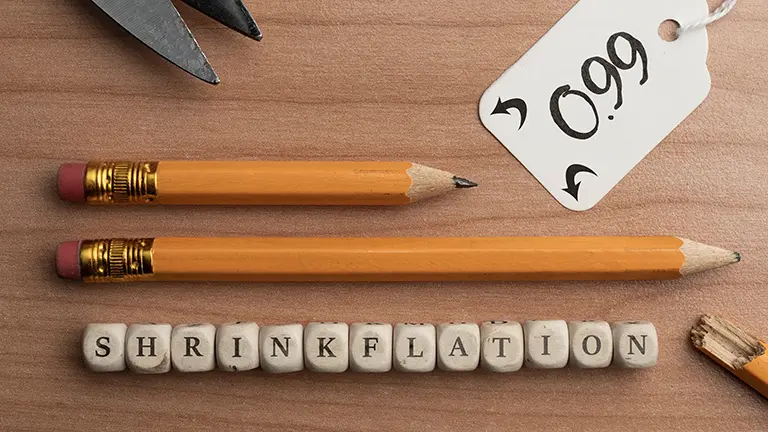

Why customers hate ‘sneaky’ shrinkflation
In the face of rising production costs, one can raise the price of the product or reduce its size. A study reveals why the second option is not a great alternative.

‘Shrinkflation’ — when manufacturers reduce the product size but keep the price the same — is roundly derided as being deceptive and unfair. The topic is so contentious that a Reddit sub-forum dedicated to shrinkflation has over 100,000 members.
However, when Esade’s Ioannis Evangelidis asked participants in his research to judge a firm that downsized its product, the move was much more welcomed when the firm explicitly communicated the change in product size to consumers. The results, published in the journal Marketing Science, show that transparency around pricing is key to customer loyalty.
Honey, I shrunk the products
In July 2023, figures released by Statista revealed that the producer price index in the EU had increased by 33.6 percent when compared with the baseline year of 2015. Many producers have dealt with this increase by directly increasing prices. But, while consumers struggle to keep up with the rising cost of living, other manufacturers have instead decided to reduce the size of the product.
This may initially seem a fair solution that allows households to keep within tight budgets, but there are some obvious flaws in the concept. If, for example, a 400g packet of pasta bought to adequately feed a family of four is suddenly reduced to 300g, the options are to either buy more pasta or eat less food.
Where higher costs in response to rising prices are seen as fair, product downsizing is not
While this may be a viable option for some, exorbitant inflation rates in the US, Europe and much of the world don’t just mean tightening the proverbial belt — many people are at genuine risk of nutritional deficiencies.
So how do businesses balance the steep rise in production and operating costs with the need to retain customers? Gradually downsizing has become increasingly common in recent years, evidenced by the aforementioned popular internet forums and lighthearted newspaper coverage. But does it work?
Raise prices or reduce sizes?
Inspired by the increasing prevalence of shrinkflation, Evangelidis conducted a series of studies to investigate beliefs about the impact of shrinking products on consumers.
The marketing professor recruited over 7000 participants to gather insights into the sizes and prices of a range of products including chocolate, orange juice, potato chips and detergent. Participants were given a varying range of details and information about the products, related to their size, price per unit, and the reasons for the reduction in size or increase in price. They were then asked to answer questions related to whether the decisions made regarding the pricing and sizing of the products were fair or unfair.
In an initial study, when participants were told a chocolate manufacturer was increasing the price due to higher costs, 69.3 percent said this was acceptable. But when told the same chocolate bar would be reduced in size and stay at the same price due to higher costs, only 55.6 percent of participants thought this was fair — despite the unit price being exactly the same in both scenarios.
Full details of the study including materials, pre-registrations, data and analyses code can be found here.
Transparent pricing
Although the study by Evangelidis confirmed that participants believed the practice of shrinkflation to be deceptive, there was one surprising result: participants who were given honest information about why size had decreased were less likely to view the move as more unfair than raising the product’s price.
In a transparency test, participants were informed that the volume of detergent in a bottle had been reduced, and this information was clearly stated on the packaging. When explicitly informed about the change in a transparent manner, 63.1 percent of respondents said it was fair. However, when participants were not told about the change, 69.3 percent thought the change was unfair.
Being honest with customers is always the best policy
Further elements of the research revealed that both price hikes and product downsizes are viewed as unfair when the producer has not experienced surges in production costs.
Honesty is the best policy
The research, says Evangelidis, reveals an important asymmetry in the perceived standards of fairness in pricing: where raising prices in response to rising costs is seen as fair, product downsizing is not.
This aversion, he adds, is driven by a belief that the consumer is being deceived — that the producer is sneakily trying to gain an advantage by reducing size without consumers noticing. But if the producer explicitly states that the product has been reduced in size to combat rising costs, the consumer is more likely to accept the change.
The results have important implications for producers and policymakers alike, Evangelidis says. Producers may find price increases are more positively received than size reductions, while policymakers should closely monitor the practice of downsizing to ensure fairness for consumers.Evangelidis suggests that this could go as far as establishing formal bodies to monitor product sizes as well as price rises. Ultimately, he concludes, being honest with customers is always the best policy.