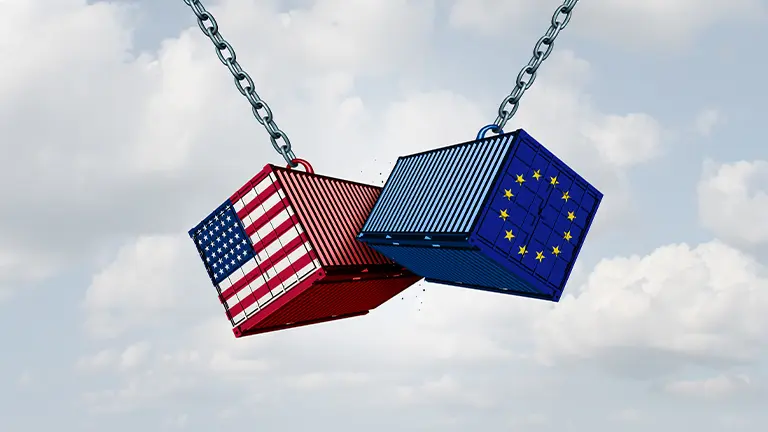

Trump and international trade: A new tariff paradigm
Trade relations between the US and the EU play a crucial role in the global economy. But Trump’s tariff policy marks a turning point, breaking with decades of liberalization and multilateral cooperation.

This article is part of the Newsletter #25 of the Esade Center for Corporate Governance. Subscribe here.
In an increasingly interconnected world, trade relations between the United States and the European Union (EU) play a crucial role in the global economy. Since the establishment of the Bretton Woods System after World War II, these two economic powers have been key pillars in promoting globalization and international trade. Over the decades, trade liberalization and tariff reductions have driven unprecedented economic growth, though not without challenges. In this context, it is essential to understand how trade policies and economic dynamics between the US and the EU have evolved and how they influence today’s economic landscape. This article explores the history, development, and implications of this trade relationship, providing a comprehensive view of its impact and future in an increasingly complex global environment.
Historical context: globalization and international trade in Bretton Woods
After World War II, the Allies (44 countries) gathered in New Hampshire (United States) in 1944 for the “United Nations Monetary and Financial Conference,” which led to the creation of the Bretton Woods System. This new international order aimed to eliminate the prewar trade discrimination and stabilize the international financial system. The gold standard was reestablished, using the US dollar as the reference currency, and multilateral institutions such as the International Monetary Fund, the World Bank, and the GATT (precursor of the current World Trade Organization) were created. Backed by these institutions, the world economy began a rapid globalization process, reflected in the significant growth of GDP and international trade flows.
In 1971, following the Jamaica Accords and the dismantling of the gold standard, which led to floating exchange rates for the dollar and other currencies, a new era began in which both global GDP and international trade grew significantly. Between 1970 and 2020, global GDP rose from approximately $3.4 trillion to over $84 trillion; international trade increased from 27% of global GDP in 1970 to over 60% in 2020; and foreign direct investment (FDI) soared from $13 billion in 1970 to over $1.5 trillion in 2020. These years marked an era of hyperglobalization characterized by deep and accelerated economic integration. This period was marked by the liberalization of trade in goods and services, capital mobility, and the creation of global supply chains.
Trade liberalization and tariffs
During this period, average tariffs on manufactured goods in developed countries dropped from approximately 40% in 1947 to less than 5% in the 1990s, mainly due to the trade liberalization promoted by the GATT during various negotiation rounds. Tariff reductions not only facilitated international trade but also significantly impacted the trade deficits of countries like the United States and the European Union.
In the United States, for instance, before Donald Trump’s return to the White House, Most Favored Nation (MFN) tariffs on manufactured goods were around 2.4%, and about 5% for agricultural products. In the case of the European Union, MFN tariffs were also relatively low—3% for manufactured goods and somewhat higher, 12%, for agricultural goods. In contrast, China’s tariffs were slightly higher: 8% for manufactured goods and 15% for agricultural products (according to WTO data).
According to the OECD, in 2024, the United States recorded a trade deficit of approximately $918.4 billion, representing around 3.3% of its GDP. This deficit was mainly due to high imports of capital goods—such as computers, semiconductors, and industrial machinery—as well as consumer goods, including automobiles and food, mainly from China, Mexico, Canada, Japan, and Germany. Meanwhile, the European Union had a €304.5 billion trade deficit with China, representing approximately 1.7% of its GDP. The EU mainly imported machinery, vehicles, and chemical products from China.
According to Eurostat data, in 2024, trade in goods between the United States and the EU reached €865 billion, with EU exports to the US totaling €531.6 billion (61.46%) and imports from the US totaling €333.4 billion (38.54%). EU exports of services to the US accounted for 42.72% of total trade in services, while imports from the US made up 57.28%. This trade exchange generated a trade surplus for the EU of €48 billion in 2023, representing 2.98% of total trade in goods and services, reflecting the strength and economic interdependence between both sides of the Atlantic.
Trump's new tariff policy
These figures reflect the magnitude of the trade deficits between these economic blocs and highlight the importance of maintaining stable and transparent trade relations in a context of increasing global economic interdependence—something that has unfortunately been undermined by Trump’s change in tariff policy.
Following Trump’s April 2, 2025, announcement of his “Liberation Day,” the principles on which economic globalization and international trade were founded vanished overnight, and countries lost trust in the existing rules of the game. Trump uses tariffs transactionally to serve his own interests. His argument—“any country that maintains a trade surplus with the United States is stealing from us”—was the reason behind implementing a universal minimum tariff of 10%, with additional higher tariffs for countries with larger trade imbalances. These so-called reciprocal tariffs reach 25% for Canada and Mexico and exceed 100% for China. This decision, entirely arbitrary and discriminatory, is a direct attack on the WTO and its principles of transparency and non-discrimination. MFN tariffs disappear from the framework of trade relations, and bilateral negotiations return as the path to reducing these tariff rates.
Final thoughts
Trump’s new (or not-so-new) trade policy, with reciprocal tariffs and a protectionist approach to international trade, has created geopolitical tensions and increased import costs, affecting economies around the world. This shift underscores the need to reassess economic dependencies and seek a new global consensus to foster stability and cooperation. Although in some cases these tariff hikes have been suspended or postponed, it is clear that Trump’s decisions are weakening the multilateral trade framework.
As renowned economist Paul Samuelson once said: “Globalization must bring sustained economic growth. Otherwise, the process loses its economic benefits and political support.” And as Larry Fink, CEO of BlackRock, concluded in 2022, perhaps it is time to rethink our economic dependencies. However, the stability of the regulatory framework for international business and the transparency of tariff measures used to protect markets are fundamental pillars of our market economy.
In a context of growing multipolarity and geopolitical tensions, it is essential for countries to find consensus on key issues that can once again promote international trade, avoid economic fragmentation, and restore a stable and credible international order.