Female leadership and technology for a more human future
The Women Evolution congress brought together leaders from the academic, institutional, and business spheres at Esade to reflect on a purposeful technological transformation focused on innovation and human well-being.

What happens when technological innovation meets female leadership? Esade hosted a new edition of Women Evolution (WE), a congress that promotes the personal and professional growth of women executives, entrepreneurs, and business leaders. With a holistic view of leadership, WE offers experiences that combine knowledge, health, emotional well-being, and technology.
The event gathered representatives from academia, public institutions, and the business world, aiming to strengthen the role of women across all areas of society and to move closer to true gender balance in decision-making spaces. It also highlighted the need to connect artificial intelligence (AI) with an ethical, inclusive, and human-centered perspective—a technology that poses challenges for leadership, organizations, and the way we work and relate to one another.
Technology, equity, and human development
In her institutional welcome, Mar Vila, associate dean of Faculty at Esade, emphasized that AI is no longer a promise for the future but a present-day tool with enormous potential to drive innovation and equity. Integrating it into business is essential for those who wish to remain competitive in a global context. But doing so requires an ethical and humanistic approach: “The challenge is not only to optimize processes, but to put people at the center.”
From the healthcare field, Elvira Bisbe, president of the Barcelona Medical Association, emphasized the importance of linking health and female leadership with technology. AI, she noted, can be a key ally in medical care, as long as it is used responsibly. At the same time, she warned about the risk of saturation and the possibility of creating a bubble around AI, and urged focusing on tools that offer solutions to real needs.
Albert Salarich, councilor at Sant Cugat City Council, stressed that the best innovation is that which improves people’s lives. Meanwhile, Eva Menor, minister for Equality and Feminism at the Government of Catalonia, warned about the risk of digitalization perpetuating gender inequalities. She called for technological transformation to also be a feminist transformation, where women actively participate in creating prosperity and defining new economic models.
New challenges for organizations
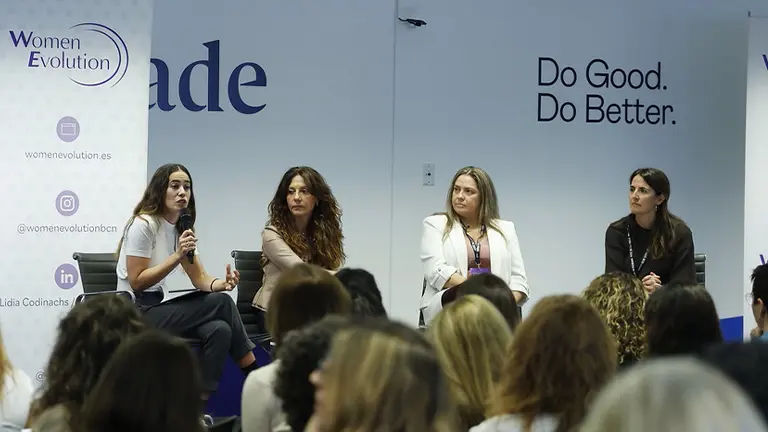
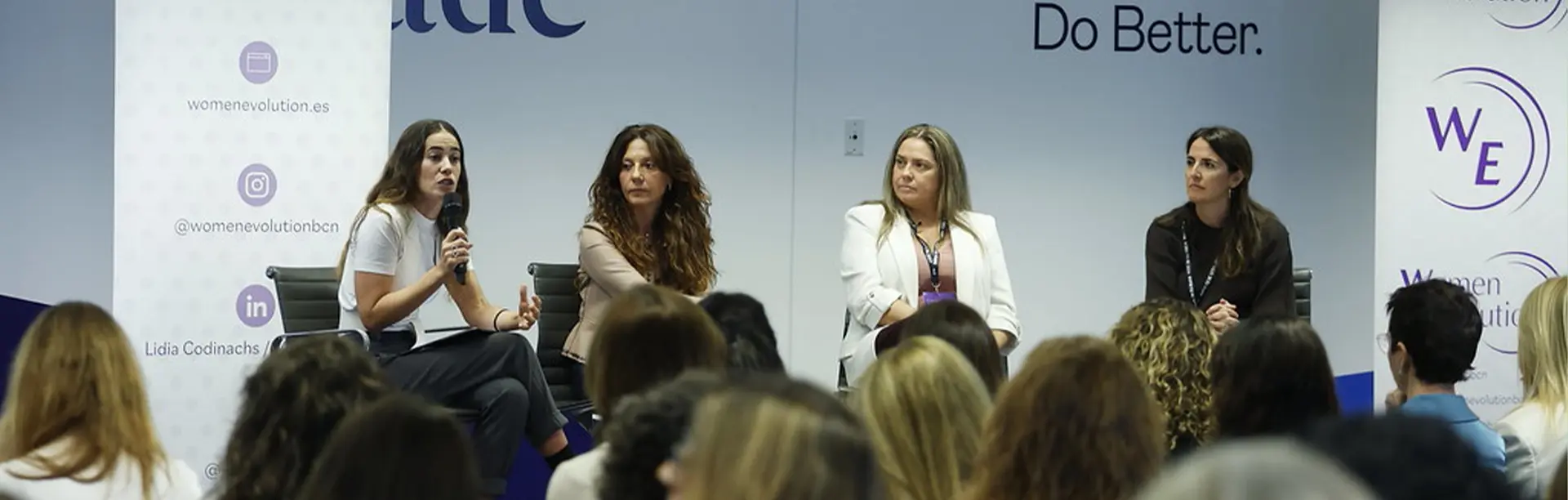
Professor Irene Unceta, academic director of the Bachelor in Business and Artificial Intelligence at Esade, moderated a roundtable on the challenges that AI poses for organizations. “AI makes processes faster and the work experience more accelerated,” she observed. “But even if things are more fleeting, that doesn’t make them less meaningful.” She encouraged organizations to reflect not only on how work is organized, but also on what we value and how we articulate that value in this new technological era.
Elisabet Bergés, head of Vulnerability and Participation Services at Aigües de Barcelona, presented several projects where AI is used for social purposes. Through intelligent data analysis, the company has been able to detect water leaks and cases of energy vulnerability in certain neighborhoods, collaborating with municipal social services to offer concrete solutions. “AI and data management must serve a purpose—and that requires people with social awareness,” she noted.
Lawyer Susana Antequera, recognized among the Top 100 Women Leaders in Spain, spoke about female leadership in the digital era. In her view, the challenge for today’s leaders is to integrate innovation and empathy without losing the human factor that distinguishes people from algorithms. “Algorithms can analyze, but they cannot inspire. Leading in the digital world also means knowing how to connect,” she said.
From a different business perspective, Àngels Miró, general manager of Persona Service Spain, shared her experience in managing uncertainty and change. She explained how honesty, perseverance, and a sense of purpose were key to sustaining her project during the pandemic. In her opinion, female leadership is characterized by long-term vision and the ability to use one’s values as a lever, even in adverse contexts.
AI in business: from efficiency to augmented value
The conference also featured a keynote by Professor Marc Cortés, director of the Executive Master in Digital Business, Innovation & Entrepreneurship at Esade, who addressed the impact of artificial intelligence on the business world. With a provocative reflection—“When the wise person points at the moon, fools look at the finger”—he invited the audience to look beyond technology itself and focus on how it transforms business models and human capabilities.
Cortés explained that AI won’t replace professionals, but those who use it strategically will replace those who don’t. However, outsourcing tasks to AI is useless if one lacks the specialized knowledge to explain and defend the results. For that reason, he advocated for the concept of the “augmented professional,” capable of combining technical knowledge and critical thinking with intelligent use of technology. Companies that adopt this mindset, he added, will become “augmented organizations”—more efficient, more innovative, and more human.
Transformative leadership
Female leadership is not only about occupying spaces but transforming them. To achieve that, AI, digitalization, and innovation can serve as powerful levers for change—provided they are managed with an ethical perspective and a clear sense of purpose. Through this event, Esade reaffirmed its commitment to training leaders capable of integrating technology and humanism to build more sustainable, diverse, and effective organizations.