The Women who carry the company name — and the weight of proving it
Patricia Fisas, Rosa Tous, Carme Hortalà and Vanesa Martínez speak about what doesn’t appear in annual reports: how you lead a company when you are a daughter, a shareholder and a mother at the same time.
Rosa Tous, Corporate VicePresident at TOUS and President of ASCEF, says it with a smile that blends nostalgia and humor: as a child, she and her sisters had earrings for breakfast, rings for lunch and necklaces for dinner. It’s not a metaphor. It was literally like that — always in the workshop, always listening to conversations about the business, always with their hands close to the materials.
That’s what it means to grow up in a family business. There is no separation. Work walks into your home uninvited.
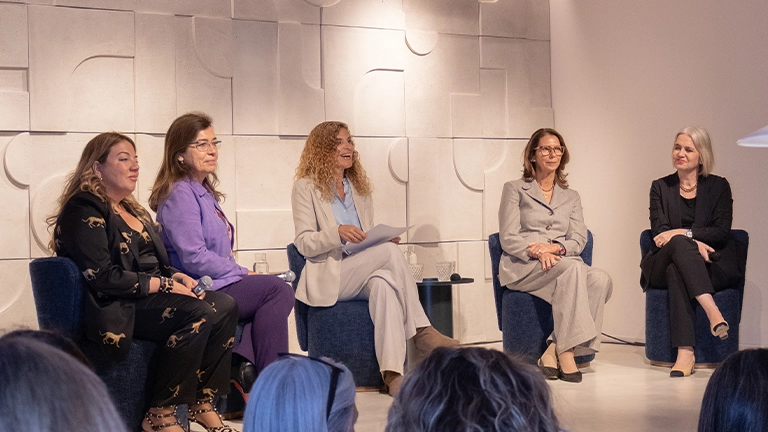
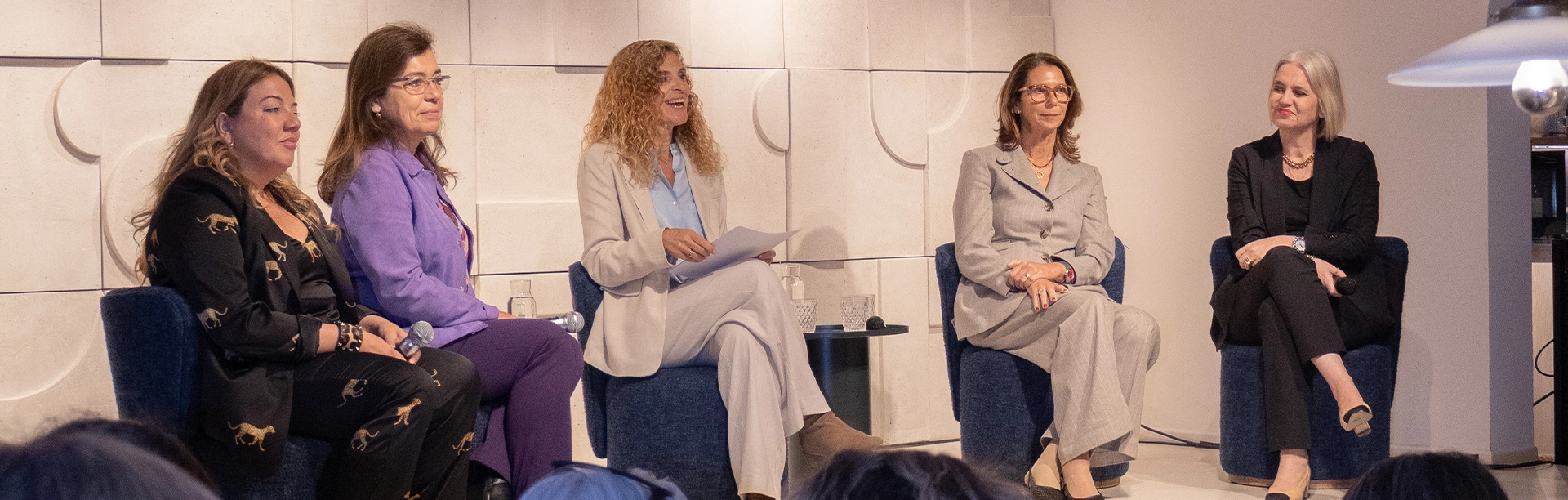
At Juno House — a space in Barcelona’s Eixample designed for women who want to grow professionally — four executives from Spanish family businesses sat in front of a full room to talk about exactly that: legacy, pressure, decision-making, and why, even today, occupying that space requires more explanation than it should.
The event was organized by the Family Business Club of Esade Alumni together with the Women Empowerment Club and Juno House. Eugenia Bieto, director of the Esade Women Initiative and professor of the Department of Strategy and General Management at Esade Business School, opened the session with a figure worth reading twice: women represent 38% of boards of directors in listed Spanish companies. It sounds reasonable. But in executive leadership, that number drops to 24%. And it isn’t rising.
In nearly 20% of listed companies, there are no women in top executive roles.
“When we talk about the role of women, we’re talking about where they should be: in decision-making.” Not a symbolic presence. Real power.
The privilege and pressure of being the daughter
Carme Hortalà now leads the company founded by her mother, Neus Puig — the first female stockbroker in Spain. She started in 1971. In the financial circles of the time, she was treated with a mix of respect and quiet condescension. During her first month, she barely spoke. By the second, she began to move.
Carme never planned to follow her path. She worked in other companies, even in Barcelona’s city council. When she was offered the role in the family firm, she set an unusual condition: that an external CEO should decide whether she was the right person for the job. She didn’t want anyone to think she was there because of her surname.
“When you make a mistake, it hurts me twice as much as when others do — because you matter to me,” her mother would say. In a family business, a mistake is never just operational. It carries a name, a history, a weight.
Rosa Tous confirms this from another angle. She is the eldest of four sisters, yet the company president is the second eldest — her sister. Her sister is her boss. That act of stepping aside — consciously, deliberately — she describes as one of the most important decisions of her professional life.
Vanesa Martínez, CEO of Grupo Carinsa, inherited a company her father built with a deeply international vision. Today, they operate in 58 countries across four continents. She and her sister lead different areas. “Where my sister is, I know the work is well done and done with passion.” That kind of trust cannot be replicated through a hiring process.
Growing without rushing
Patricia Fisas, Senior VP and Chief Research & Innovation Officer at Natura Bissé Group — a cosmetics and wellness company founded in 1979 — recalls that their first attempt to enter the US market failed. There was no interest. They went back, prepared better and tried again, without marketing campaigns — simply letting the product reach the right hands.
“Our success has been quality and effectiveness. But also listening carefully and adapting without losing our identity. Growing without rushing.”
In a business environment driven by short-term results, this almost sounds radical. But it reflects the logic of a well-functioning family business: without external shareholders demanding quarterly returns, there is time to think in generations.
Fisas has even taken this philosophy into neuroscience. The company wanted to measure the real impact of its treatments on emotional wellbeing. They developed studies combining neuroscience and AI, showing up to a 70% increase in overall wellbeing after treatments. Turning perception into measurable evidence.
Rosa Tous, meanwhile, talked about Tous School— a specialized jewelry training program focused on repair and restoration, a family project driven by her mother. With scholarships, partnerships with 13 schools across six countries, and a master jeweler in Manresa mentoring a new generation of artisans, over 400 students have already passed through. A company with more than 600 stores in 40 countries that still finishes every piece by hand. That requires people. Highly skilled people.
Three roles — and the Sunday table
One of the most important themes of the discussion was role separation. How you are a mother at home and an executive at work. How you are a sister at Sunday lunch and a shareholder in the boardroom. How you avoid mixing roles.
“Family, ownership, management — you need to know when to wear each hat,” explained Rosa Tous. The Tous family council operates separately from the board of directors. It’s not bureaucracy — it’s a way to ensure difficult conversations happen in the right place, with the right people.
Patricia Fisas has had a family protocol in place for years — and has updated it several times. Values change. Contexts change. What founders wanted is not always what the next generation wants. Updating the protocol is not a betrayal of the legacy — it is what allows the legacy to survive.
Succession, they all agree, is the hardest conversation. “A taboo conversation,” says Carme Hortalà. No one can force the next generation to take on that role. And yet the question sits at the table every Sunday, unspoken.
The number no one wants to cite
María José Parada, Associate Professor at the Strategy and General Management Department and co-Director of the Esade Global Business Family Initiative, closed the session with a striking statistic. In a 2022 generational study, when asked what role they aspired to, 90% of men said CEO. Only 10% of women did.
Board roles showed similar patterns. But in family councils — the governance body managing relationships within the owning family — women were far more likely to want to lead.
Where women are pushed forward — and where they are held back — were questions left hanging in the room. Along with a more uncomfortable one: how much of this is choice, and how much is shaped by long-standing assumptions?
“Women prepare more for leadership roles — not because they lack capability, but because they feel they will be judged more.”
Parada herself holds two PhDs. And still, her father told her she knew nothing.
Moving forward
At the end of the session, what remained was not a neatly packaged message of empowerment. It was something more tangible: the image of four women carrying the name of their companies — in their roles, in their products, sometimes literally on the façade — and having to build, each in their own way, the authority that in other contexts is simply assumed.
And as Hortalà said before closing:
“Jewelry, cosmetics, perfumes and money. Finance is very feminine!”
Perhaps anyone who thinks otherwise simply hasn’t met these four women.
Or hasn’t had enough earrings for breakfast.