Career lessons for a turbulent world
In a time of deep change, building a career means balancing purpose, adaptability, and resilience. At the Esade Career Fair 2025, students and professionals explored how values and emotional skills shape success beyond technical expertise.

In a world where geopolitical instability, technological disruption, and social transformations redefine the rules of work, building a meaningful career has become as much about adaptability and purpose as it is about skills and knowledge. This was the central message that resonated throughout the Esade Career Fair 2025, a day dedicated to connecting talent and opportunity.
The event gathered more than 2,000 students from 17 programs connected with over 400 professionals representing 90 leading companies and institutions — from Amazon, McKinsey, Inditex, Banco Santander, Novartis, Volkswagen, and Grifols to NATO and Morgan Stanley — in what has become the largest bridge between talent and industry in Esade. Throughout the day, students took part in on-site interviews, one-to-one meetings, alumni roundtables, and themed career activities designed by Esade Careers.
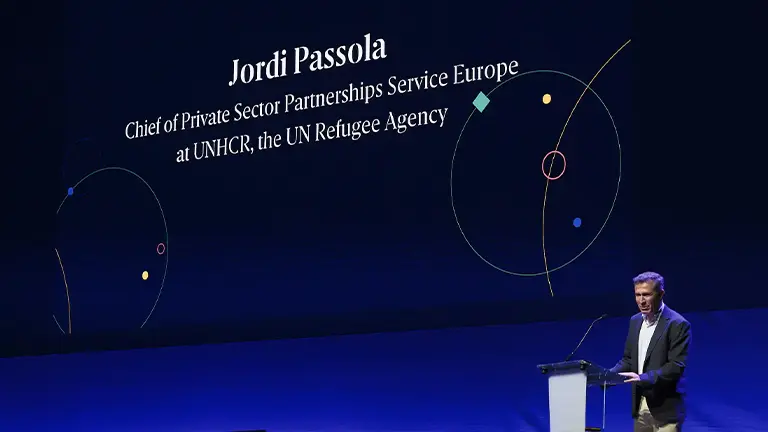
Jordi Passola, Chief of Private Sector Partnerships Service Europe at UNHCR and Esade alumnus, delivered the keynote address, offering insights to help future graduates thrive in their careers during challenging times.
People, not tools, as the enduring differentiator
In his welcome, Esade’s director general Daniel Traça offered a clear message to companies and students alike. For employers, he underlined that “tech and AI very quickly become a commodity.” What endures — and what ultimately differentiates organizations — is the quality of the people who harness those tools with purpose and creativity. He pointed to Esade students’ technical readiness, openness to disruption, entrepreneurial mindset, and ability to build bridges across countries and disciplines. “On top of that,” he emphasized, “values and commitment: not only in how they deliver to companies, but to the world.”
Addressing students, Traça argued that today’s world asks for more than expertise and even more than classic soft skills; it demands emotional skills. He highlighted three anchors for a meaningful career: purpose (knowing what genuinely motivates you), adaptability (finding different paths toward your goals), and resilience (learning from setbacks rather than being defined by them).
Ten lessons for building your professional journey
Jordi Passola’s trajectory — which has taken him from early international experiences in the UK and France, to roles with Médecins Sans Frontières (MSF), and into his current position leading private-sector partnerships for UNHCR in Europe — served as a backdrop of his talk. His message to students was clear: careers rarely unfold as tidy, linear narratives. What matters is how you connect the dots over time, take intelligent risks when opportunities appear, and keep your compass set to purpose.
Passola distilled his experience into practical guidance — not as rules, but as prompts for action:
- Connect the dots early and often. Your professional journey starts sooner than you think; every choice can compound.
- Prefer roadmaps to rigid plans. Have direction, but leave room to jump when consequential opportunities arise.
- Sequence matters. There is a moment in life for everything. Especially in humanitarian work, get field exposure as early as possible.
- Don’t settle if you are not comfortable. If a role doesn’t align with your strengths or values, redesign it or move on.
- Start from purpose. Use frameworks like ikigai to locate the overlap between what you love, what you’re good at, and where you can serve a real need.
- Work hard, play hard — sustainably. Find a balance between life and work and remember that the most important things often happen outside the office.
- Redefine success on your own terms. Let your principles and values weigh more than status and money.
- Lead with kindness. Be compassionate, grateful, and humble; the world has enough arrogance.
- Be authentic in your network. Relationships compound when you are consistent in who you are and in the choices you make.
- Recognize your privilege. Don’t take access or opportunity for granted; use both responsibly.
A tougher world, and why collaboration must scale
Turning to the humanitarian landscape, Passola did not sugarcoat the stakes. He described himself as part of a generation fortunate to enjoy a relatively long period of stability. That era has given way to overlapping crises and a fraying multilateral order. “I believe the UN is still useful,” he said, “but it needs to reform to remain relevant.” The magnitude and complexity of today’s challenges — from displacement and conflict to climate-driven emergencies — exceed the capacity of any government or international body acting alone.
What’s needed, he argued, is a whole-of-society approach that mobilizes the private sector, NGOs, academia, and public institutions together. In a “liquid” world — borrowing Zygmunt Bauman’s metaphor — professionals must learn to manage uncertainty and carve out their space in more competitive, fast-shifting environments. The good news for Esade graduates, he added, is that their training equips them to thrive at precisely these intersections: business and public good, innovation and governance, entrepreneurship and meaningful impact.